
- World
- Feb 03
UN peacekeepers suspend patrols along Lebanon-Israel ‘Blue Line’
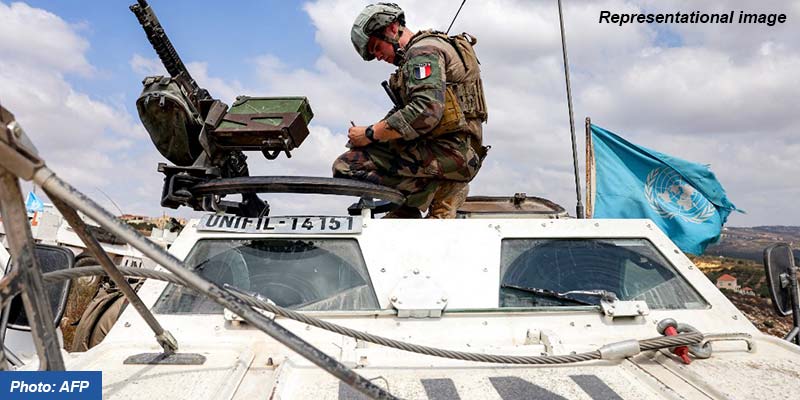
• UN peacekeepers temporarily suspended patrols and other activities along parts of the ‘Blue Line’ in southern Lebanon after the Israeli Defence Forces reportedly dropped a chemical substance near the frontier.
• The incident took place north of the Blue Line on February 1 and led to the suspension of more than a dozen UN peacekeeping activities for over nine hours.
• The UN Interim Force in Lebanon (UNIFIL) said the incident also raised concerns about the potential impact of the unidentified substance on civilians, agricultural land and the longer-term return of residents to their homes and livelihoods near the Blue Line.
• The UN reiterated concerns about flight movements across the Blue Line, saying such activities violate Security Council resolution 1701, which brought an end to the 2006 hostilities between Israel and Hezbollah, and outlines UNIFIL’s mandate.
• The incident comes at a delicate time for UNIFIL, which is set to leave Lebanon at the end of 2026, after nearly half a century of presence along the Blue Line.
What is the history of ‘Blue Line’?
• Following an invasion by Israeli forces into Lebanon, the UN Security Council, in March 1978, established the United Nations Interim Force in Lebanon (UNIFIL) mandating it to confirm the withdrawal of Israeli forces from Lebanon, restore international peace and security, and assist the Lebanese government to restore its effective authority in the area.
• In June 1982, Israel invaded Lebanon for the second time and subsequently established a security zone inside the country, which remained until its withdrawal in 2000.
• In 1985, Israel partially withdrew its forces from Lebanon, but retained control of an area in southern Lebanon controlled by Israel Defence Forces (IDF) and Lebanese De Facto Forces (DFF).
• On April 17, 2000, the government of Israel notified the UN Secretary-General that it would withdraw its forces from Lebanon by July 2000.
• In preparation of the withdrawal of the Israel Defence Forces (IDF) from Lebanon, the UN identified the ‘Line of Withdrawal’, or so-called ‘Blue Line’, largely conforming to the internationally recognised boundaries of Lebanon.
• The United Nations established this Line in June 2000 for the sole purpose of confirming the full withdrawal of the IDF from Lebanese territory.
• The Line is described as the best approximation of the 1923 Boundary Line and the 1949 Armistice Demarcation Line. It does not in any way represent an international border and is without prejudice to any future border arrangements between Lebanon and Israel. The Line is 120 km long.
• Until July 2006, despite numerous violations of the Line of Withdrawal, as well as sea and air violations, and occasional breaches of the ceasefire, the situation in the area remained relatively calm.
• On July 12, 2006, war broke out between Israel and Lebanon after Hezbollah had carried out an attack on an IDF patrol, kidnapping two IDF soldiers and killing three others.
• On August 11, 2006, the Security Council adopted resolution 1701 (2006), which ended the war and in which the Council decided to enlarge UNIFIL (to a maximum of 15,000 troops) and enhance its mandate.
• UNIFIL headquarters is located in Naqoura. The area of operations extends from the Blue Line in the south to the Litani River in the north and is divided into two sectors, East and West.
• The mission has more than 10,000 troops from 50 countries and about 800 civilian staff.
• The mandate for the operation is renewed annually by the 15-member UN Security Council.
• In August 2025, the UNSC extended the UN peacekeeping mission which patrols the so-called Blue Line of separation between Israel and Lebanon “for a final time” till December 31, 2026.