
- World
- Feb 16
39th African Union Summit concludes in Addis Ababa
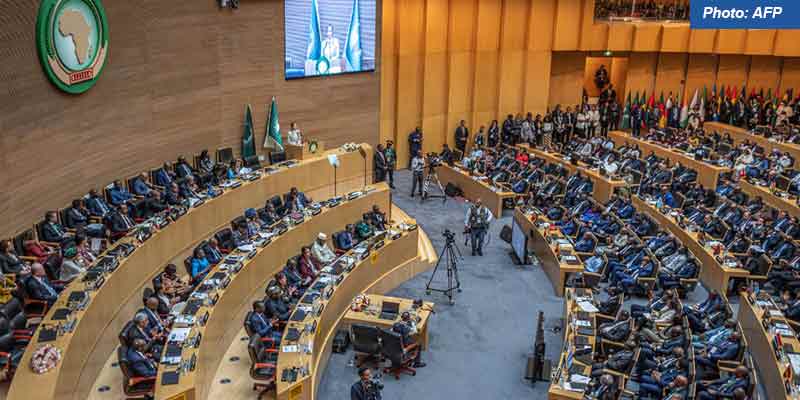
• The 39th Ordinary Session of the Assembly of the African Union (AU) concluded at the AU Headquarters in Addis Ababa, Ethiopia on February 15, following two days of high-level deliberations by African Heads of State and government.
• The Session was held under the outgoing chairmanship of Joao Manuel Goncalves Lourenco, President of the Republic of Angola and chairperson of the African Union for 2025.
• The leaders adopted ‘Assuring Sustainable Water Availability and Safe Sanitation Systems to Achieve the Goals of Agenda 2063’ as theme for the year.
• This theme underscores the critical importance of water and sanitation in driving Africa’s development agenda and addressing the continent’s pressing challenges.
• Calling for sweeping reforms of global institutions, UN Secretary-General Antonio Guterres told African leaders that the absence of permanent African seats on the Security Council is “indefensible”, declaring: “This is 2026 – not 1946”.
African Union
• The African Union is a continental body consisting of 55 member states that make up the countries of the African Continent.
• It was officially launched in 2002 as a successor to the Organisation of African Unity (OAU).
• On May 25, 1963 in Addis Ababa, Ethiopia, the 32 African states that had achieved independence at that time agreed to establish the OAU.
• A further 21 members joined gradually, reaching a total of 53 by the time of the African Union’s launch in 2002. In 2011, South Sudan became the 54th Member State, and in 2017, Morocco became the 55th Member State.
• The OAU was the manifestation of the pan-African vision for an Africa that was united, free and in control of its own destiny and this was solemnised in the OAU Charter.
• Through the 1990s, leaders debated the need to amend the OAU’s structures to reflect the challenges of a changing world.
• In 1999, the OAU heads of State and government issued the Sirte Declaration calling for the establishment of a new African Union.
• The vision for the Union was to build on the OAU’s work by establishing a body that could accelerate the process of integration in Africa, support the empowerment of African states in the global economy and address the multifaceted social, economic and political problems facing the continent. In total, four summits were held in the lead up to the official launching of the African Union.
• The African Union was officially launched in July 2002 during Durban Summit.
• A significant number of OAU structures were carried forward into the African Union. Similarly, many of the OAU’s core commitments, decisions and strategy frameworks continue to frame AU policies.
• The decision to re-launch Africa’s pan-African organisation was the outcome of a consensus by African leaders that in order to realise Africa’s potential, there was a need to refocus attention from the fight for decolonisation and ridding the continent of apartheid, which had been the focus of the OAU, towards increased cooperation and integration of African states to drive Africa’s growth and economic development.
• The African Union’s headquarters is situated in Addis Ababa, Ethiopia.
• In September 2023, the African Union was made a permanent member of the G20.