
- World
- Mar 02
Strategic importance of Strait of Hormuz
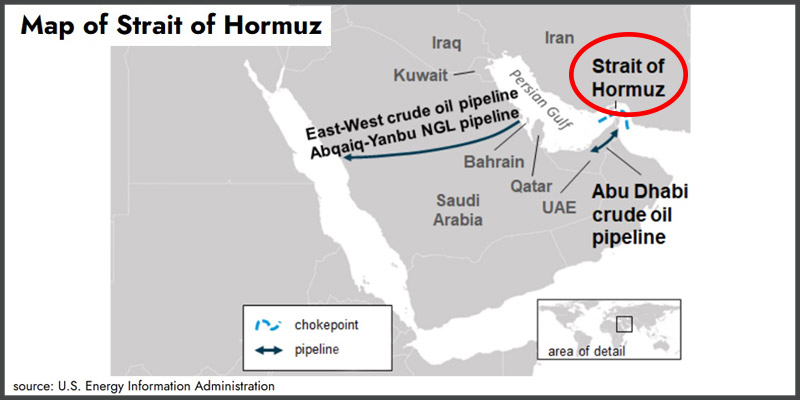
• Oil prices surged after shipping in the crucial Strait of Hormuz was disrupted by retaliatory Iranian attacks following initial bombing by Israel and the United States that killed Iranian Supreme Leader Ali Khamenei.
• Exchange of counterattacks damaged tankers and sharply disrupted shipments in the Strait of Hormuz.
• A longer closure of the Strait would push oil prices higher and cause supply shortages.
Strait of Hormuz
• The Strait of Hormuz, located between Oman and Iran, connects the Persian Gulf with the Gulf of Oman and the Arabian Sea.
• The Strait of Hormuz is the world's most important oil chokepoint because large volumes of oil flow through the strait.
• Chokepoints are narrow channels along widely used global sea routes that are critical to global energy security.
• The narrow channel, approximately 33 kilometres wide at the narrowest point, separates Iran (north) from the Arabian Peninsula (south).
• The inability of oil to transit a major chokepoint, even temporarily, can lead to substantial supply delays and higher shipping costs, resulting in higher world energy prices.
• Although most chokepoints can be circumvented by using other routes that add significantly to transit time, some chokepoints have no practical alternatives.
• Large volumes of oil flow through the Strait of Hormuz, and very few alternative options exist to move oil out of the strait if it is closed.
• In 2024, oil flow through the strait averaged 20 million barrels per day (bpd), or the equivalent of about 20 per cent of global petroleum liquids consumption.
• The bulk of oil exports from regional powerhouses — Saudi Arabia, Iraq, UAE, Qatar, Iran, and Kuwait — must transit this narrow waterway.
How significant is it for India?
• India sources about 40 per cent of its supplies from Middle East nations such as Iraq, Saudi Arabia, the United Arab Emirates, and Kuwait. These countries export crude oil to India through the Strait of Hormuz route.
• For India, the Strait of Hormuz is important as about 2 million barrels per day (bpd) of crude oil out of its total import of 5.5 million bpd transits through the narrow waterway.
• On gas, India’s principal supplier Qatar does not use the Strait of Hormuz for supplies to India.
• India’s other sources of liquefied natural gas (LNG) in Australia, Russia and the US would be untouched by any closure.
• India is 90 per cent dependent on imports to meet its crude oil needs and buys roughly half of its natural gas from overseas.
• While crude oil is turned into fuels like petrol and diesel in refineries, natural gas is used for generating electricity, making fertilisers, and turned into CNG for running automobiles or piped to household kitchens for cooking.