
- World
- Mar 05
International Day for Disarmament and Non-Proliferation Awareness
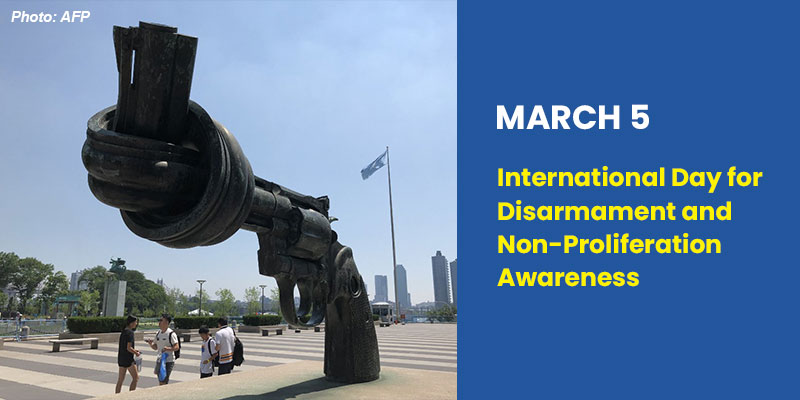
• The United Nations observes the International Day for Disarmament and Non-Proliferation Awareness on March 5.
• It seeks to promote better awareness and understanding of disarmament issues among the public, especially young people.
• Since the founding of the UN, the goals of multilateral disarmament and arms limitation have been central to the organisation’s efforts to maintain international peace and security.
• Weapons of mass destruction, in particular nuclear weapons, continue to be of primary concern, owing to their destructive power and the threat that they pose to humanity.
• The excessive accumulation in conventional weapons and the illicit trade in small arms and light weapons jeopardises international peace and security and sustainable development, while the use of explosive weapons in populated areas is seriously endangering civilians.
• New and emerging weapon technologies, such as autonomous weapons, pose a challenge to global security and have received increased attention from the international community in recent years.
• Global military spending is soaring, fueling a new arms race, and placing immense pressure on national budgets and priorities.
What is the role of UNODA?
• The United Nations Office for Disarmament Affairs (UNODA) was established in January 1998 as the Department for Disarmament Affairs.
• It was originally established in 1982 upon the recommendation of the General Assembly’s second special session on disarmament.
• In 1992, its name was changed to the Centre for Disarmament Affairs, under the Department of Political Affairs.
• At the end of 1997, it was renamed Department for Disarmament Affairs and in 2007, it became the United Nations Office for Disarmament Affairs.
• The Office for Disarmament Affairs supports multilateral efforts aimed at achieving the ultimate goal of general and complete disarmament under strict and effective international control.
• The mandate for the programme is derived from the priorities established in relevant General Assembly resolutions and decisions in the field of disarmament.
• The Office also works to address the humanitarian impact of major conventional weapons and emerging weapon technologies, such as autonomous weapons, as these issues have received increased attention from the international community.
• UNODA provides substantive and organisational support for norm-setting in the area of disarmament through the work of the General Assembly and its First Committee, the Disarmament Commission, the Conference on Disarmament and other bodies.
• It fosters disarmament measures through dialogue, transparency and confidence-building on military matters, and encourages regional disarmament efforts. These include the United Nations Register of Conventional Arms and regional forums.
• It also provides objective, impartial and up-to-date information on multilateral disarmament issues and activities to Member States, States parties to multilateral agreements, intergovernmental organisations and institutions, departments and agencies of the United Nations system, research and educational institutions, civil society, especially non-governmental organisations, the media and the general public.
• UNODA supports the development and implementation of practical disarmament measures after a conflict, such as disarming and demobilising former combatants and helping them to reintegrate in civil society.
Nuclear disarmament and non-proliferation
• Nuclear weapons are the most dangerous weapons on earth. One can destroy a whole city, potentially killing millions, and jeopardising the natural environment and lives of future generations through its long-term catastrophic effects.
• The dangers from such weapons arise from their very existence.
• Although nuclear weapons have only been used twice in warfare, about 12,500 reportedly remain in our world today and there have been over 2,000 nuclear tests conducted to date.
• Disarmament is the best protection against such dangers but achieving this goal has been a tremendously difficult challenge.
• The UN has sought to eliminate such weapons ever since its establishment.
• The first resolution adopted by the UN General Assembly in 1946 established a Commission to deal with problems related to the discovery of atomic energy among others. The Commission was to make proposals for the control of atomic energy to the extent necessary to ensure its use only for peaceful purposes.
• Several multilateral treaties have since been established with the aim of preventing nuclear proliferation and testing, while promoting progress in nuclear disarmament.
• These include the Treaty on the Non-Proliferation of Nuclear Weapons (NPT), the Treaty Banning Nuclear Weapon Tests In The Atmosphere, In Outer Space And Under Water, also known as the Comprehensive Nuclear-Test-Ban Treaty (CTBT), which was signed in 1996 but has yet to enter into force, and the Treaty on the Prohibition of Nuclear Weapons (TPNW).
• More than half of the world’s population still lives in countries that either have such weapons or are members of nuclear alliances.
• While the number of deployed nuclear weapons has appreciably declined since the height of the Cold War, not one nuclear weapon has been physically destroyed pursuant to a treaty.