
- World
- Mar 10
- Sreesha V.M
NATO begins ‘Cold Response’ exercise
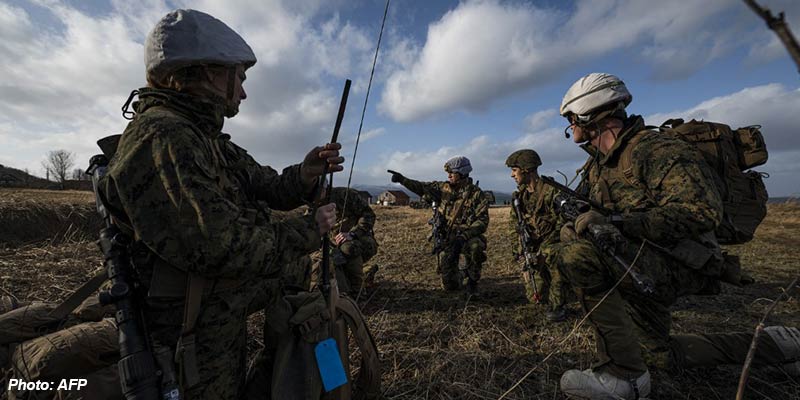
• NATO began its biennial military exercise in the Arctic region on March 9.
• The exercise is called ‘Cold Response’.
What is NATO?
• North Atlantic Treaty Organisation (NATO) was formed in 1949 with the signing of the Washington Treaty.
• NATO is a security alliance of 32 countries from North America and Europe.
• In 1949, there were 12 founding members of the alliance: Belgium, Canada, Denmark, France, Iceland, Italy, Luxembourg, the Netherlands, Norway, Portugal, the United Kingdom and the United States.
• The other member countries are: Greece and Turkey (1952), Germany (1955), Spain (1982), the Czech Republic, Hungary and Poland (1999), Bulgaria, Estonia, Latvia, Lithuania, Romania, Slovakia and Slovenia (2004), Albania and Croatia (2009), Montenegro (2017), North Macedonia (2020), Finland (2023) and Sweden (2024).
• These countries, called NATO Allies, are sovereign states that come together through NATO to discuss political and security issues and make collective decisions by consensus.
• NATO brings together sovereign countries from Europe and North America, consulting and cooperating in the field of security and defence.
• NATO’s fundamental goal is to safeguard the Allies’ freedom and security by political and military means.
• NATO enables members to consult and cooperate on defence and security-related issues to solve problems, build trust and, in the long run, prevent conflict.
• NATO is committed to the peaceful resolution of disputes. If diplomatic efforts fail, it has the military power to undertake crisis-management operations. These are carried out under the collective defence clause of NATO’s founding treaty — Article 5 of the Washington Treaty or under a United Nations mandate, alone or in cooperation with other countries and international organisations.
Highlights of NATO’s military exercise:
• NATO has conducted military exercises across the High North since the early days of the Cold War.
• NATO has been actively increasing its presence by establishing new structures throughout Allied territory in the Arctic and the High North.
• Troops from 14 allied countries will train under harsh, Arctic conditions during the 10-day long exercise.
• Cold Response 2026 is led by a Norwegian-US headquarters established at Reitan, near Bodo.
• Troops from 14 nations are participating, including Norway, the United States, the United Kingdom, Germany, the Netherlands, France, Italy, Canada, Spain, Turkey, Sweden, Finland, Denmark and Belgium.
• The exercise is important for enhancing interoperability among allied forces and for supporting the integration of Finland and Sweden into NATO.
• About 25,000 soldiers will participate in the exercise. Of these, around 11,800 will exercise on Norwegian ground, the rest will be at sea and in the air. In addition to this, several thousand troops are exercising in Finland.
• The overall purpose of the exercise is to contribute to deterrence, strengthen Norwegian and allied defence capabilities, and reassure the population.
• This is achieved by demonstrating Norway’s and NATO’s ability to defend the Alliance’s northern flank.
• Exercises in Norwegian conditions provide allied forces with valuable experience in Arctic environments, which is essential for operational capability in the High North.
• Cold Response is conducted primarily in Nordland, Troms and western Finnmark.
• This constitutes the land component of the exercise, with additional land operations taking place in northern Finland.
• In addition, air operations will be conducted over all the Nordic countries, and maritime operations in the North Atlantic.
• This exercise, along with others like Denmark’s ‘Arctic Endurance’ series of exercises, is included under Arctic Sentry.
What is Arctic Sentry?
• In February 2026, NATO launched Arctic Sentry, a military activity that further strengthens its deterrence and defence across the region.
• With Russia’s increasing military activity and China’s growing interest in the Arctic, Allies have agreed to do more to ensure our collective security in this vital region.
• Arctic Sentry is a multi-domain military activity that is strengthening NATO’s posture in the Arctic and High North.
• This enhanced vigilance activity is providing NATO planners with full visibility of allies’ national activities across the region, allowing NATO to consolidate these actions into one coherent, overarching operational approach.
• Arctic Sentry reflects collective understanding that NATO must do even more as an alliance to ensure security in the Arctic and the High North, and to further strengthen its ability to operate in the region.
• Arctic Sentry is led by Joint Force Command (JFC) Norfolk, with overall strategic direction provided by Allied Command Operations.
• JFC Norfolk will also collaborate with Allied Command Transformation and coordinate activities with the joint US-Canada North American Regional Aerospace Defence Command (NORAD), as well as the US Northern Command and US European Command.
• In 2019, NATO established JFC Norfolk, the Alliance’s operational headquarters in North America (in Norfolk, Virginia, United States).
• One of its main duties is to secure the strategic sea lines of communication across the Atlantic.
(The author is a trainer for Civil Services aspirants.)