
- World
- Mar 18
Astronomers discover a new class of molten planet
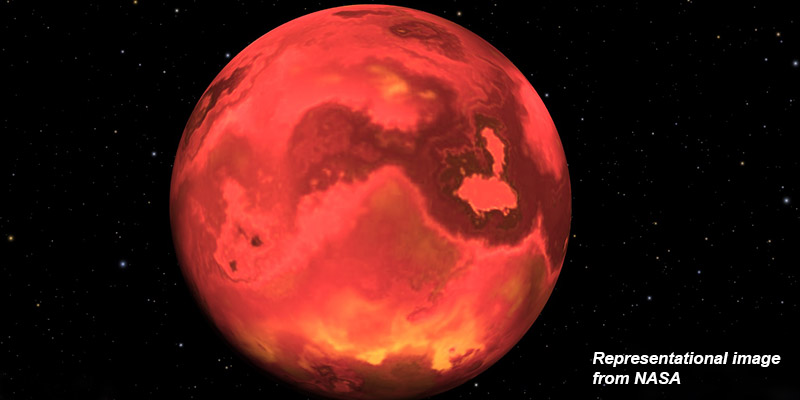
• A study led by the University of Oxford has identified a new type of planet beyond our solar system, one that stores large amounts of sulphur deep within a permanent ocean of magma.
• The exoplanet (a planet that orbits a star outside the solar system), known as L 98-59 d, orbits a small red star about 35 light-years from Earth.
• Light-year is the distance light travels in one year. Light zips through interstellar space at 300,000 kilometers per second and 9.46 trillion kilometers per year.
• The planet has an especially low density.
• Its size is about 1.6 times that of the Earth and contains significant amounts of hydrogen sulfide in its atmosphere.
• Observations from the James Webb Space Telescope (JWST) and ground-based observatories suggested that L 98-59 d appears to belong to an entirely different class of planet containing heavy sulphur molecules.
New category of exoplanets
• Exoplanets with a diameter between 1.5 and 4 times that of Earth have, until now, fallen into roughly two categories.
• They are either rocky planets with a hydrogen-rich atmosphere (‘gas dwarfs’), or they possess a ‘steam atmosphere’ and a large amount of water in their interiors (‘water worlds’).
• Based on the composition and density of its atmosphere, L 98-59 d does not appear to fit into either category.
A planet with an ocean of magma
• Using advanced computer simulations, a team of researchers from the University of Oxford, the University of Groningen, the University of Leeds and ETH Zurich, reconstructed the planet’s history from shortly after its birth to the present day — a span of nearly five billion years.
• By directly linking telescope observations to these detailed physical models of planetary interiors and atmospheres, they were able to determine what must be happening deep inside the planet.
• Their results reveal that the mantle of L 98-59 d is likely molten silicate (similar to lava on Earth), with a global magma ocean extending thousands of kilometres beneath.
• This vast molten reservoir allows the planet to store extremely large amounts of sulphur deep inside its interior, over geologic timescales.
• The magma ocean also helps L 98-59 d to retain a thick hydrogen-rich atmosphere containing sulphur-bearing gases such as hydrogen sulphide (H2S).
• Normally, this would be lost to space over time, due to X-ray radiation produced by the host star.
• Over billions of years, chemical exchanges between its molten interior and atmosphere have shaped what telescopes observe on L 98-59 d today.
• The researchers suggest that L 98-59 d may be the first recognised member of a broader population of gas-rich sulphurous planets sustaining long lived magma oceans.
• More than 6,100 planets beyond our solar system, called exoplanets, have been discovered since the 1990s, though none quite like this one.