
- World
- Mar 27
Balendra Shah sworn in as Nepal’s youngest PM
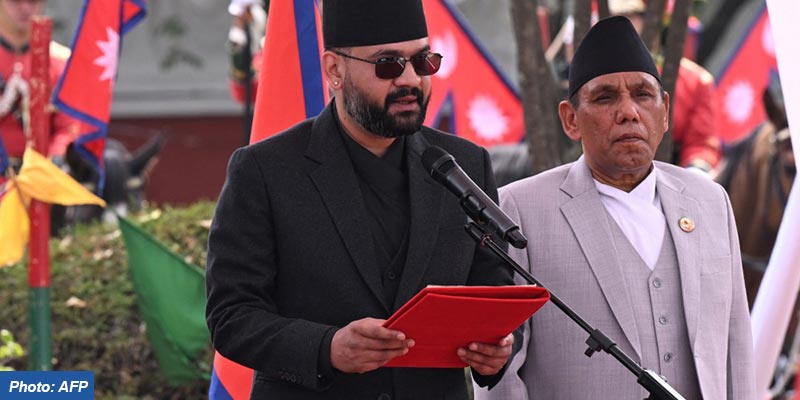
• Balendra Shah, popularly known as Balen, took oath as Nepal’s democratically elected Prime Minister on March 27.
• This comes around six months after the K.P. Sharma Oli-led government was ousted in a Gen-Z protest that shook the nation.
• Following Oli’s ouster, former chief justice Sushila Karki took charge as the interim PM on the recommendation of the Gen Z group.
• In the March 5 general elections, Balen defeated four-time PM Sharma Oli by a huge margin in the Jhapa-5 constituency.
• After three years as the mayor of Kathmandu, Shah teamed up with the Rastriya Swatantra Party (RSP) as its prime ministerial candidate, scoring a victory in the general elections.
• He rose to fame after winning a popular rap battle in Nepal with verses that reflected the frustration of the youth who felt abandoned. He had also criticised corruption and social inequality.
• His songs were also used by the Nepali youth who were part of the mass protest that ousted the previous government.
• The RSP won a landslide victory in the March 5 polls, securing a massive 182 seats out of the total 275 seats in the House of Representatives (HoR), making it eligible to form a majority government.
• Balen was appointed as the 47th Prime Minister by President Ram Chandra Paudel in accordance with Article 76(1) of the Constitution.
• The 35-year-old RSP leader was sworn in by the President at a ceremony at the President’s Office in Sheetal Niwas in Kathmandu.
• Balen is the youngest person to be democratically elected to the office in the Himalayan nation, and also the first person from the Madhes region to hold the top executive post.
• Balen will hold the portfolios of the Defence Ministry and the Industry, Commerce and Supplies Ministry.
India-Nepal Relations
• Prime Minister Narendra Modi greeted Shah on becoming Nepal’s PM.
• PM Modi said he was looking forward to working closely with Shah to take forward India-Nepal ties.
• India remains Nepal’s largest trade and investment partner, accounting for a significant share of its external trade.
• Nepal shares border with five Indian states of Sikkim, West Bengal, Bihar, Uttar Pradesh and Uttarakhand. India-Nepal relations are defined by the deep rooted people to people links, commonality in religion, language and culture of both countries.
• India and Nepal share deep historical, cultural, and religious ties, with Hinduism and Buddhism playing a significant role in their relationship.
• Nepal is home to Lumbini, the birthplace of Lord Buddha, which adds a unique religious connection between the two countries.
• Additionally, the two nations have an open border, allowing for the unrestricted movement of people, fostering close societal ties.
• The familial bonds between India and Nepal are also strong, often referred to as “Roti-Beti ka Rishta” (relationship through food and marriage), which reflects the cross-border marriages and cultural intermingling that bind the two nations together.
• The India-Nepal Treaty of Peace and Friendship of 1950 serves as the cornerstone of this special bilateral relationship, providing for mutual respect, cooperation, and close diplomatic and economic interactions.
• The treaty allows for the unhindered movement of people and goods and forms the legal framework that underpins the deep strategic and cultural relations that the two countries continue to share.