
- World
- Apr 21
Gaza needs $71.4 billion over next decade for recovery, reconstruction
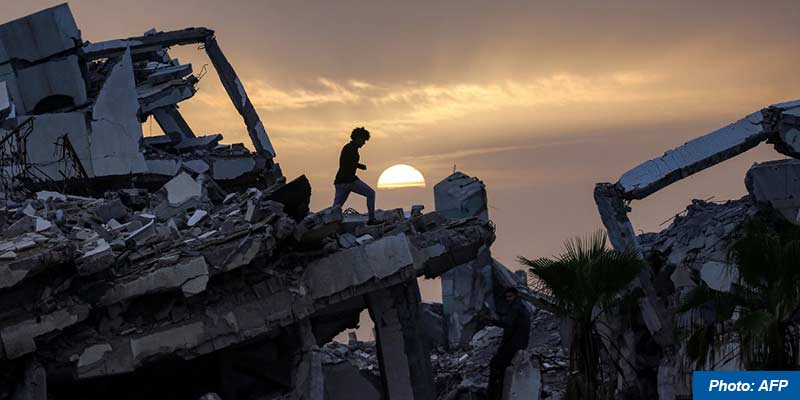
• The European Union and the United Nations released the final Gaza Rapid Damage and Needs Assessment (RDNA), jointly conducted with the World Bank, assessing the damages, economic losses, and recovery and reconstruction needs in Gaza following 24 months of conflict.
• The report warned that human development across Gaza has been set back by 77 years, with $71.4 billion needed over the next decade for recovery and reconstruction.
Current situation in Gaza
• Since the large-scale attack on October 7, 2023, by militant groups from the Gaza Strip into Israel, the escalation of conflict in the Gaza Strip has led to an unprecedented loss of life and a catastrophic humanitarian crisis.
• Over two years of conflict has resulted in more than 71,000 Palestinian fatalities and over 171,000 injured, and many are missing under the rubble.
• The conflict has led to widespread displacement, extensive damage to social, physical, and productive infrastructure, and plunged the strip into a deep humanitarian crisis.
• The conflict has also killed approximately 1,671 Israeli and foreign nationals, the majority in the October 7, 2023, attacks, alongside significant displacement and damage in Israel.
• Over 1.9 million Palestinians in the Gaza Strip have been internally displaced to locations inside of the Gaza Strip.
• Over 1.2 million people — almost 60 per cent of Gaza Strip’s population — have lost their homes.
• Extensive damage to water, sanitation, and waste management infrastructure, a lack of critical resources to operate and maintain the remaining infrastructure, and poor hygiene conditions and food insecurity have left the entire population of the Gaza Strip at risk of disease outbreaks.
• A ceasefire agreement was reached on October 9, 2025.
• The Gaza economy has incurred unprecedented losses as a consequence of the recent conflict.
• Nearly three-quarters of Gaza’s pre-conflict employed population lost their jobs, resulting in an employment-to-population ratio of 9.3 per cent in the Strip.
• The escalation of conflict over the last two years has engendered the collapse of the systems that sustain people’s daily survival and dignity.
• Deprivations in shelter, food security, health, education, and livelihoods occur simultaneously and reinforce one another.
• Multiple sectoral shocks generate a compounding cycle driving hunger, disease, learning loss, loss of income, gender-based violence (GBV), and social fragmentation.
• The scale and extent of deprivation across living conditions, livelihoods/income, food security, gender equality, and social inclusion have pushed back human development in the Gaza Strip by 77 years.
• Over 40 per cent of pregnant and breastfeeding women are severely malnourished, and two-thirds suffer from anaemia.
• The escalation of conflict has resulted in a high number of wounded children with no surviving family.
• The exhaustion of savings and the collapse of informal credit networks have pushed households to sell assets, reduce meals and incur unsustainable levels of debt.
• A UN Security Council Resolution 2803 (2025), adopted on November 17, 2025 endorsed the Comprehensive Plan to End the Gaza Strip Conflict, and welcomed the establishment of a Board of Peace (BoP) as a transitional administration with international legal personality that will set the framework, and coordinate funding for the redevelopment of Gaza pursuant to the Comprehensive Plan, and in a manner consistent with relevant international legal principles, until such time as the Palestinian Authority has satisfactorily completed its reform program, as outlined in various proposals.
Rapid Damage and Needs Assessment (RDNA)
• This Rapid Damage and Needs Assessment (RDNA), conducted jointly by the World Bank, United Nations (UN), and European Union (EU), aims to inform the stakeholders about the physical, social, economic, and
human impacts of the conflict in the Gaza Strip incurred between October 2023 and October 2025.
• The RDNA provides a technical evidence base for recovery and reconstruction planning focused on immediate needs, as well as guide priorities for medium and long term.
• The conflict in the Gaza Strip has inflicted widespread damage across multiple critical sectors, with each sector facing unique challenges and extensive financial needs for recovery.
• The recovery and reconstruction needs across these sectors, estimated at $71.4 billion, highlight the scale and urgency of restoring essential services, economic stability, and social resilience, while undertaking massive reconstruction of damaged infrastructure.
• Physical infrastructure damages are estimated at $35.2 billion, with economic and social losses amounting to $22.7 billion.
• The hardest-hit sectors include housing, health, education, commerce, and agriculture.
• Over 371,888 housing units have been destroyed or damaged, more than 50 per cent of hospitals are non-functional, nearly all schools destroyed or damaged, and the economy has contracted by 84 per cent in Gaza.
• Immediate recovery needs, to be addressed in the first eight months, are estimated to be $10.8 billion while short-term recovery needs with a focus on restoring critical services (18 months) are estimated at $15.5 billion.
• The remaining $45.1 billion is estimated to address the medium to long-term recovery and reconstruction needs.
• The highest recovery and reconstruction needs are in the housing sector ($16.2 billion), followed by agriculture and food system ($10.5 billion), health ($10 billion), and commerce and industry ($9 billion), together accounting for 64 per cent of total reconstruction needs and represent the most urgent priorities.