
- World
- Apr 26
- Sreesha V.M
40th anniversary of Chernobyl nuclear disaster
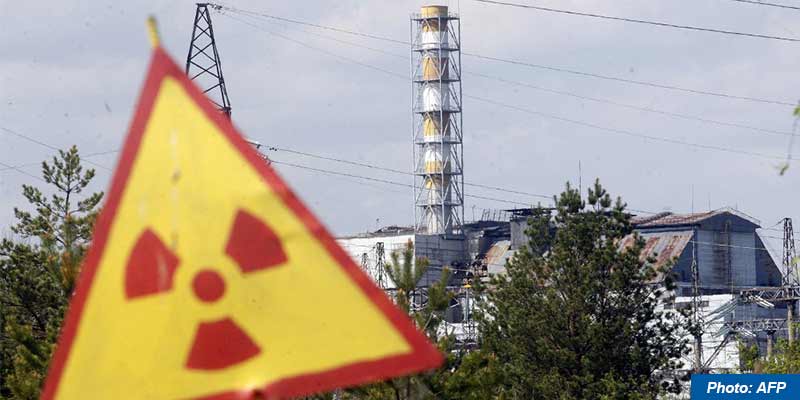
• The United Nations observes International Chernobyl Disaster Remembrance Day on April 26.
• The day serves as an important global acknowledgement of the importance of keeping the Chernobyl incident high on the global agenda, drawing lessons from the emergency and recovery responses, and sharing them globally for the benefit of current and future generations.
• This year marks the 40th anniversary of the Chernobyl (Chornobyl) disaster.
• On April 26, 1986, a sudden surge of power during a reactor systems test destroyed Unit 4 of the nuclear power station at Chernobyl, Ukraine, in the former Soviet Union.
• The accident and the fire that followed released massive amounts of radioactive material over large parts of the Soviet Union, now the territories of Belarus, Ukraine and the Russian Federation.
• The explosion sent five per cent of the radioactive reactor’s core into the atmosphere and upwind into Belarus, Ukraine and parts of Russia — contaminating over 150,000 sq km of the region.
• The radioactive material spread over a 30 km radius from the plant, leading to the creation of an “exclusion zone” on both sides of the Belarus-Ukrainian border — an area of 2,600 square kilometers that is not inhabitable by people to this day.
• Nearly 8.4 million people in the three countries were exposed to the radiation.
• The accident caused serious social and psychological disruption in the lives of those affected and vast economic losses over the entire region.
• Large areas of the three countries were contaminated with radioactive materials.
• The Soviet authorities started the concrete sarcophagus to cover the destroyed Chernobyl reactor in May 1986 and completed the extremely challenging job six months later.
• The Soviet government acknowledged the need for international assistance only in 1990.
• That same year the General Assembly adopted a resolution calling for “international cooperation to address and mitigate the consequences at the Chernobyl nuclear power plant”.
• That was the start of the United Nations’ involvement in the Chernobyl recovery.
• An Inter-Agency Task Force was established to coordinate the Chernobyl co-operation.
• In 1991, the UN created the Chernobyl Trust Fund.
• Since 1986, the UN family of organisations and major NGOs have launched more than 230 different research and assistance projects in the fields of health, nuclear safety, rehabilitation, environment, production of clean foods and information.
• On December 15, 2000, the last reactor in operation at the Chornobyl site was shut down and the phase of decommissioning began. This involves the removal of spent fuel, decontamination and dismantling of structures, systems and components, management of waste and clean-up of associated land.
• In 2002, the United Nations announced a shift in the Chernobyl strategy, with a new focus on a long-term developmental approach.
• UNDP and its regional offices in the three affected countries took the lead in the implementation of the new strategy.
• To provide support to international, national and public programmes targeted at the sustainable development of these territories, in 2009 UN launched the International Chernobyl Research and Information Network (ICRIN).
• The completion of the placement of the new safe confinement over the old shelter was a major milestone achieved in 2019, with €2.2 billion provided by over 45 donor nations through funds managed by the European Bank for Reconstruction and Development (EBRD).
• The new safe confinement was handed over to the government of Ukraine on July 10, 2019.
• The decommissioning of Units 1, 2 and 3 are planned to complete by 2064 and will be conducted under the supervision of the Ukrainian government.
(The author is a trainer for Civil Services aspirants.)