
- World
- May 05
UN concludes cross-border humanitarian operations from Turkey to Syria
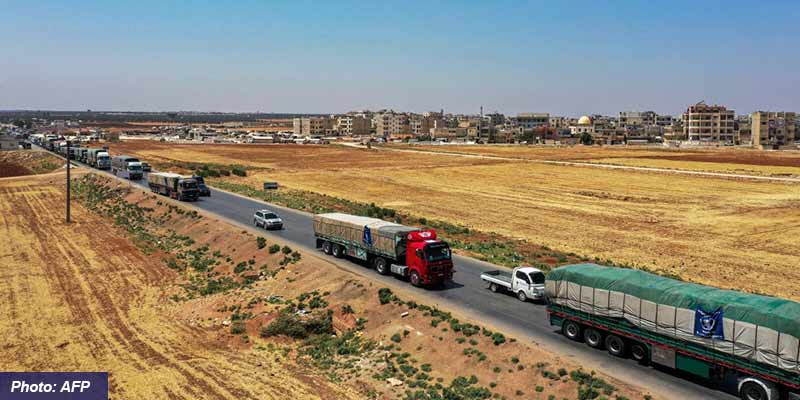
• The United Nations has formally concluded its cross-border humanitarian operations from Turkey into Syria.
• The decision was following the reopening of border crossings to commercial traffic and improved access via regular supply routes.
• The UN aid route was established in July 2014 following the passage of Security Council resolution.
• The mission served as one of the most complex supply chains in the organisation’s history.
• Between August 2014 and the route closure, 58,955 trucks delivered assistance, with an additional 6,124 trucks moving through consent-based agreements with Syrian authorities, bringing the total to more than 65,000 journeys.
• Designed as an emergency measure to bypass shifting security conditions and damaged infrastructure, the operation became a vital lifeline for millions.
• Throughout the operation, UN humanitarian inspection teams provided independent verification to ensure compliance and transparency. According to the UN, the trucks delivered critical aid to support an average of 1.25 million people annually.
Situation in Syria
• The collapse of the Assad-led government on December 8, 2024 brought substantial changes to Syria’s domestic legal framework.
• Its collapse ushered an unprecedented wave of hope and optimism that the sacrifices of the previous 14 years would allow the Syrian people to begin the momentous task of rebuilding and re-unifying their country around a new social contract.
• In the days that followed, the new caretaker government under Ahmed al-Sharaa began consolidating its control, while working to gain international legitimacy and confront challenges facing the country.
• Soon after the fall of Bashar al-Assad, the international community began to ease sanctions against the country, in an attempt to improve the humanitarian situation and revive the battered economy.
• Regional powers including Saudi Arabia, Turkey and Qatar supported renewed engagement, offering to fund public salaries and energy infrastructure, and support Syria’s obligations to international financial institutions.
• On the economic front, the government succeeded in its advocacy for the lifting of crippling sectoral sanctions that had been imposed by the US and others on the former government.
• However, economic conditions remained dire, as inflation, unemployment, and declining purchasing power severely affected people’s daily lives.
• Despite notable progress in restoring order and building new institutions, the transition remains fragile with competing visions for the future trajectory of the country.
• Years of violations and abuses by former government forces and non‑State armed groups have eroded public trust.
• Among the major tasks facing the country is the disarmament, demobilisation and reintegration (DDR) of hundreds of thousands of former government security forces, other non-State armed forces and paramilitary groups; the implementation of holistic transitional
justice processes for crimes committed by these and other forces since 2011; security sector reform (SSR) and institutional reforms, including judicial reform.
• Israel’s military operations in Syria have caused significant civilian harm, mass displacement and widespread destruction. In addition to airstrikes which have killed and injured civilians in violation of international humanitarian law, the Israel Defense Forces repeatedly raided villages, demolished homes and damaged public infrastructure in Quneitra without military necessity and transferred arbitrarily detained Syrian men and boys to Israel.
• Amid these complex security challenges, Da’esh (ISIS) is reportedly increasingly active and dangerous in parts of Syria, posing additional challenges for civilian protection.
• Spasms of violence involving some minority populations have created a series of crises, killing and displacing civilians.
• The World Bank estimates Syria’s needed reconstruction costs at nearly $216 billion.
• As of February 2026, UN agencies reported that 1.4 million Syrian refugees had returned to the country since December 2024, but more than 3.7 million remained in regional countries.
• Additionally, more than 6 million Syrians remained internally displaced as of January 2026.