
- World
- May 07
Number of global migrants rose to 304 million in 2024, says IOM report
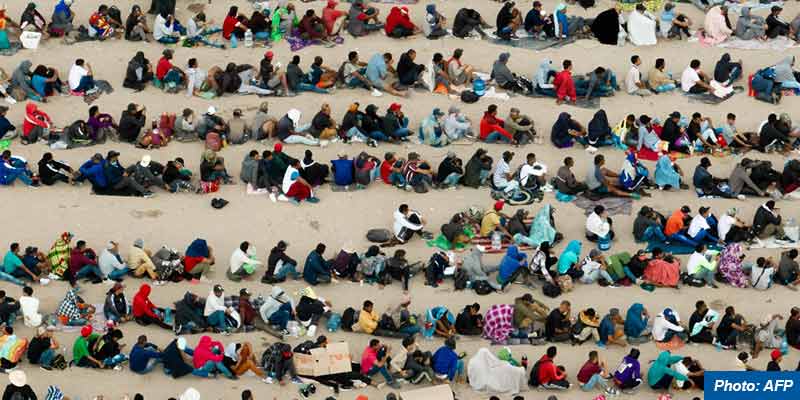
• The International Organisation for Migration (IOM) released the World Migration Report 2026 on May 5.
• There were around 304 million international migrants worldwide by mid-2024, equivalent to 3.7 per cent of the global population, compared with around 275 million (3.5 per cent) in 2020 and a little over 250 million (3.3 per cent) in 2015.
• Despite the increase in absolute numbers, the share of international migrants in the world’s population has risen only incrementally over the past half-century, confirming that most people continue to reside in their country of birth and that internal migration remains far more common than cross-border movement.
• Technological advancements, lower travel costs and digital connectivity have made global mobility more accessible, while economic inequality, demographic trends, conflict and environmental change continue to also shape migration patterns.
• Although most people migrate for employment, family, or education, others are compelled to move due to persecution, violence or disasters.
• While displaced populations such as refugees and internally displaced persons (IDPs) comprise a smaller proportion of total migrants, they often face the greatest vulnerabilities, requiring urgent international attention and protection.
• Since 2000, the International Organisation for Migration (IOM) has been producing world migration reports. The World Migration Report 2026, the thirteenth in the world migration report series, has been produced to contribute to an increased understanding of migration throughout the world.
Defining migration
• Outside of general definitions of migration and migrant, such as those found in dictionaries, there exist various specific definitions of key migration-related terms, including in legal, administrative, research and statistical spheres.
• While there is no universally agreed definition of migration or migrant, several definitions are widely accepted and have been developed in different settings.
• Migration can be defined as the movement of persons away from their place of usual residence, either across an international border or within a country.
• Migrant is an umbrella term, not defined under international law, reflecting the common lay understanding of a person who moves away from his or her place of usual residence, whether within a country or across an international border, temporarily or permanently, and for a variety of reasons.
Migrant workers
• The latest available data show that there were nearly 168 million international migrant workers globally in 2022, accounting for nearly 60 per cent of the then global stock of international migrants.
• The number of international migrant workers has been growing over time, and during the decade from 2013 to 2022 this number increased by more than 30 million.
• Most migrant workers have consistently resided in high income countries. Over 114 million (or 68.4 per cent) lived in high income countries in 2022.
• An additional 29.2 million (17.4 per cent) were living in upper middle-income countries, 18.2 million (10.9 per cent) in lower middle income countries and 5.5 million (3.3 per cent) in low income countries.
• The international migrant worker population remains significantly gendered, with a much larger number of male than female migrant workers worldwide.
• An estimated 102.7 million migrant workers were male (61.3 per cent of the total) and 64.9 million (38.7 per cent) were female.
• In addition to this gender concentration, international migrant workers are also geographically concentrated. Over 70 per cent of female migrant workers resided in high income countries.
• Most male migrant workers (over 67 per cent) were also located in high income countries.
Unsafe migration flows
• The IOM Missing Migrants Project tracks cases where migrants, including refugees and asylum-seekers, die during border crossings or in transit.
• The project was established after the 2013 Lampedusa shipwrecks that claimed at least 368 lives.
• It is the only open-access global database on deaths during migration.
• Since the 2018 edition of the World Migration Report, the series has featured data and analysis from this initiative, highlighting the dangerous consequences of irregular migration routes and the increasing number of displacement events that make mobility ever more perilous.
• In 2024, more than 9,000 migrant deaths were recorded, up from around 8,700 in the previous year, marking the highest annual death toll since data collection began in 2014.
• Crisis-affected countries facing climate disasters and violent unrest accounted for over half of these deaths.
• The increase continues a gradual upward trend since the record low in 2020, when COVID-19 mobility restrictions sharply reduced movement.
• Compared to 2023, recorded deaths increased across all regions, except the Mediterranean (declined from 3,155 to 2,573) and the Americas (declined from 1,413 to 1,272).
International students
• The total number of internationally mobile students tripled between 2002 and 2022. In 2002, the global total was just over 2 million, and by 2022 it reached close to 7 million.
• Between 2020 and 2021, international student flows dipped slightly due to COVID-19 restrictions, but mobility remained resilient and rebounded strongly in 2022, reaching record highs with high demand and reopened borders.
• This steady long-term growth underscores how international student flows have become a primary migration pathway.
• In 2022, there were just over 3.2 million internationally mobile female students (48 per cent), compared to 3.6 million male students (52 per cent).
• Countries in Asia continue to account for the largest share of internationally mobile students.
• In 2022, more than 1 million international students came from China, the single largest origin country worldwide.
• India ranked second, with over 620,000 students abroad.
Refugees and asylum-seekers
• At the end of 2024, there were 36.9 million refugees globally, with 31 million under the UNHCR mandate, and 5.9 million refugees registered by the United Nations Relief and Works Agency for Palestine Refugees (UNRWA).
• A further 5.9 million other people in need of international protection — largely from Venezuela — were reported at the end of 2024.
• The number of refugees under the UNHCR mandate has decreased slightly since 2023, when it stood at 31.6 million.
• There were also approximately 8.4 million people seeking international protection and awaiting determination of their refugee status, referred to as asylum-seekers. This is a 22 per cent increase from the end of 2023.
• Despite partial reporting from the United States (only until mid-2024), the country still had, by far, the largest number of pending asylum claims (3.2 million) by the end of 2024.
• Other countries with large asylum applications included Egypt (631,100), Peru (540,000), Germany (348,900) and Canada (292,100).
• Nationals of Sudan, Venezuela, Syria, Colombia and Afghanistan comprised most new individual asylum applications in 2024.
• At the end of 2024, children (that is, people under 18 years of age) made up around 41 per cent of refugees, people in a refugee-like situation and other people in need of international protection.
• Across multiple countries, relatively new as well as protracted conflicts, in addition to widespread violence, continue to drive large-scale cross-border displacement.
Most refugees by country of origin
• Syria, which for most of the last decade has been the largest country of origin of refugees, saw a decline in these numbers, in part due to returns from Lebanon as well as spontaneous returns at the end of 2024, after the change in government in December of that year.
• Despite the fall in the number of refugees from Syria, however, one in six refugees were Syrian and the country remained the origin country of the largest number of refugees in 2024.
• The conflict in Sudan, which started in April 2023 and continued to escalate through 2024, has resulted in one of the largest displacement crises globally and a dire humanitarian situation.
• The number of Sudanese refugees and asylum-seekers reached 2.8 million in 2024, growing by around one million from the previous year. Most were hosted in neighbouring countries, including Chad (around 1 million), Egypt (over 600,000) and South Sudan (487,700). In 2024, Sudan was the fifth largest refugee origin country, globally.
• While there were fewer refugees from Ukraine in 2024 compared to the two years prior, Ukraine was the third-largest origin country of refugees globally.
Top countries hosting refugees
• Since 2023, Iran has been the host country to the largest number of refugees in the world, overtaking Turkey, which had been the host to the largest number of refugees for 10 consecutive years. Nearly 3.5 million refugees were hosted in Iran in 2024, most of them Afghans.
• With around 2.9 million refugees (largely Syrians), Turkey was the host country to the second largest number of refugees globally, followed by Germany (around 2.7 million).
• In Germany, most refugees originated from Ukraine (1.2 million), Syria (around 725,000) and Afghanistan (nearly 280,000).
• Uganda and Pakistan were the host countries with the fourth and fifth largest number of refugees globally, with nearly 1.8 million and almost 1.6 million refugees, respectively.
• Most refugees in Uganda came from South Sudan (975,000), although the number of refugees from Sudan and Congo increased significantly in 2024.
Internally displaced persons
• Definition: Persons or groups of persons who have been forced or obliged to flee or to leave their homes or places of habitual residence, in particular as a result of or in order to avoid the effects of armed conflict, situations of generalised violence, violations of human rights or natural or human-made disasters, and who have not crossed an internationally recognised State border.
• More than 83 million people were living in internal displacement globally by the end of 2024,40 10 million more than the number of IDPs since the last edition of the World Migration Report (2024).
• This is the highest figure of IDPs ever recorded and more than double the figure recorded in the first global report on internal displacement, over a decade ago.
• Consistent with previous years, the largest number of IDPs were displaced due to conflict and violence (73.5 million), while 9.8 million were displaced as a result of disasters.
• Sudan had the largest number of IDPs in 2024 (a record 11.6 million), driven by a conflict that began in April 2023 and has since intensified.
• It is followed by Syria, where more than 7 million IDPs were recorded.