
- World
- May 11
Why Tenerife island is in news?
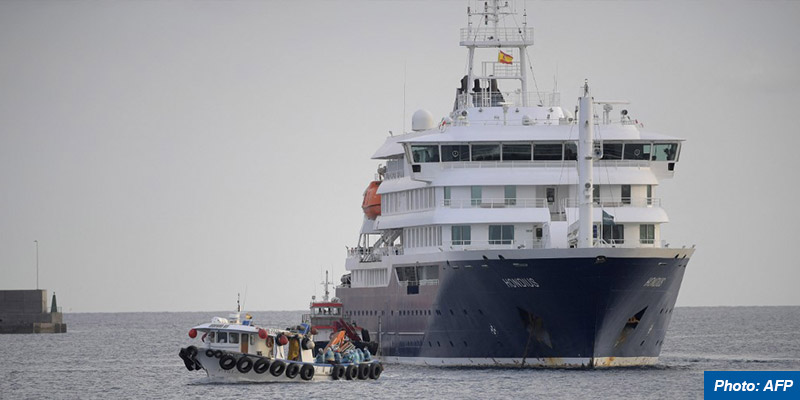
• Passengers and crew from the cruise ship MV Hondius disembarked in Tenerife under a tightly coordinated international health operation led by Spanish authorities and the World Health Organisation (WHO) on May 10.
• The officials sought to reassure the public that the outbreak “is not another COVID”.
• The vessel arrived off the Canary Islands after weeks at sea at the centre of an international public health response triggered by a hantavirus outbreak that has claimed three lives.
• WHO Director-General Tedros Adhanom Ghebreyesus reached Tenerife and stressed that the risk to the wider public remains low.
• There have been eight cases linked to the ship of which six cases have been laboratory-confirmed as hantavirus infections, with all identified as Andes virus (ANDV).
• Hantavirus is a rare disease usually linked to exposure to infected rodents and can cause severe respiratory illness.
• The Andes strain associated with the outbreak is the only known hantavirus strain with documented human-to-human transmission, although WHO has said that transmission risk remains low.
• WHO officials said none of the passengers would travel on commercial flights. Instead, chartered repatriation flights are being coordinated with national authorities under strict health protocols.
Key facts on Tenerife:
• Tenerife is one of the islands belonging to the Canary Islands, and along La Palma, La Gomera and El Hierro, forms the province of Santa Cruz de Tenerife.
• Tenerife is the largest island of the Canary archipelago with an area of 2,034.38 sq km and a population of over nine lakh inhabitants.
• Its economy is based on the tourism sector.
• Located in the Atlantic, some 1,000 km south-west of the Iberian Peninsula and a mere 97 km from the African coast, the seven Canary Islands are a Spanish outermost region of the European Union.
• They are strategically placed between Europe, America and Africa, offering a privileged position for cultural and economic exchange.
• The Canary Islands host world-class research centres and universities, making the region a front runner in fields such as astrophysics, oceanography, renewable energies and biotechnologies.