
- World
- May 13
50 billion tonnes of sand extracted every year, finds UN study
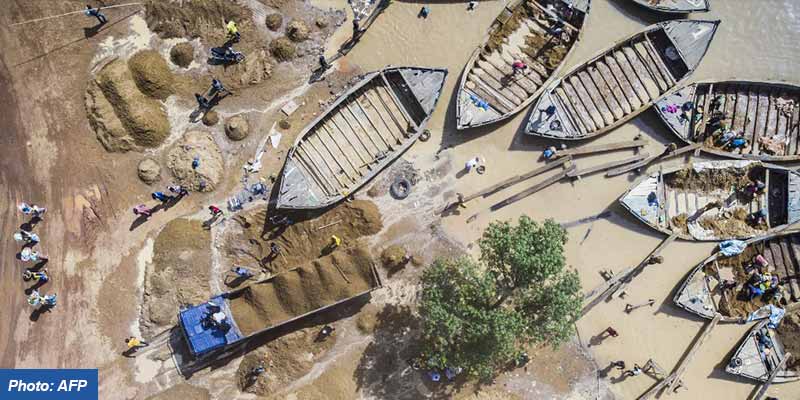
• The world currently uses about 50 billion tonnes of sand every year, while extraction is increasingly taking place in fragile rivers, lakes, coastal zones and protected marine areas.
• Surging global demand for sand, driven by population, economic, urbanisation and infrastructure growth, is outpacing sustainable sand supply, threatening the ecosystems and livelihoods on which we depend, according to a new UN Environment Programme (UNEP) report.
• The report titled ‘Sand and Sustainability: An Essential Resource for Nature and Development’ says that climate change is one of the main drivers of rising demand, as more sand is needed to build infrastructure such as sea walls to protect against rising oceans.
• Population growth and urbanisation are also fuelling demand.
Sand as a foundation of ecosystems
• Sand resources are the most extracted solid material on Earth.
• They are also among the most undervalued despite how essential they are to nature and development.
• Extracted, they are used to build homes, highways, solar panels, sea walls, and for land reclamation in coastal cities.
• Left in place, sand regulates rivers, protects coastal aquifers, filters water, sustains biodiversity, maintains habitats, buffers coastlines against storm surges, and supports fisheries and tourism that billions depend upon.
• In nature, sand plays essential roles, shaping landscapes, riverscapes, and seascapes, and sustaining life. It helps regulate groundwater and river flows, filters water, provides habitats supporting a wide range of species buffers against foods, and contributes to the formation of deltas and beaches.
• By forming beaches and deltas, sand also shields coastlines from erosion, storm surges, and saltwater intrusion into coastal aquifers.
• They provide the literal foundation of modern living and development: shelter, essential services, and the energy transition.
• As part of a dynamic Earth system flow, sand forms landscapes and provides the very morphological stability on which the fundamental functioning of societies and economies rests.
• These values extend to food and water security, climate resilience, disaster risk reduction, and territorial integrity, as sediment dynamics influence river courses, coastlines, and therefore borders and land availability.
• Extraction is increasingly concentrated in ecologically sensitive riverine, coastal, and marine systems.
• Mismanagement can result in cascading consequences: deltas sink, coastlines erode, aquifers become salinised, and habitats fragment.
• These impacts are not confined to the extraction site. Through global trade and infrastructure investment, benefits accrue in growing urban centres while environmental degradation and livelihood losses are displaced onto vulnerable communities elsewhere.
• Critically, while a cubic metre of sand extracted for concrete creates value over an infrastructure’s lifecycle, that same cubic metre left in a river or coastal system can generate benefits over centuries.
• Conversely, well-governed sand systems can support resilient infrastructure, nature-based solutions, economic inclusion, and circular industrial transitions.
• Sand is an integral element of many ecosystems in our mountains, drylands, rivers, coasts, deltas, and lakes, both on land and underwater.
• Where sand flows and accumulates, land is formed and ecosystems are created, biodiversity flourishes, water is purified, and livelihoods are sustained.
• Leaving sand within ecosystems can help achieve the Kunming-Montreal Global Biodiversity Framework goal to conserve and manage 30 per cent of land, waters, and seas (terrestrial, inland water, and coastal and marine areas).
Impact of sand extraction on biodiversity and people
Sand extractions affect biodiversity through multiple pathways that vary by location, extraction method, and scale. Activities range from small-scale artisanal mining to large industrial operations, including open-pit mining, quarrying, and dredging in rivers, coastal zones, and the open sea.
Extraction occurs in almost every country and across a wide range of ecosystems, including drylands, forests, rivers, wetlands, mangroves, beaches, dunes, coral reefs, and intensively managed agricultural and forestry landscapes.
Impacts on freshwater systems
Sand extraction stands out as a major driver of freshwater biodiversity loss. Rivers are frequently targeted because sand is accessible, close to settlements, and commercially valuable. River sand, with its low salt content, is often preferred over coastal sand and usually sells at a higher price. Studies consistently show that sand removal alters riverbeds and sediment composition, changes flow regimes, and can affect groundwater levels, which could lead to land degradation and desertification processes. Besides, sand extraction increases water turbidity, destroys fish spawning grounds, impedes the establishment of aquatic vegetation, and reduces connectivity within river channels and between rivers and riparian habitats.
Impacts on coastal and marine ecosystems
Rising global demand for sand is placing growing pressure on coastal and marine ecosystems. Beach sand is often targeted because it is easy to access and relatively cheap, particularly in rapidly urbanising coastal areas, where it remains a major construction material despite its salt content. Species closely tied to sandy habitats are especially vulnerable. Sea turtles, for example, return to their natal beaches, sometimes decades later, to nest. Mining can reduce nesting success through habitat loss, increase erosion and egg mortality, while changes in sand temperature and composition can skew hatchling sex ratios, with long-term demographic consequences. Poorly managed beach nourishment and sediment relocation can also introduce invasive species or pollutants, including microplastics.
Dredging is a major local stressor that generates impacts through both direct habitat disturbance and altered sediment dynamics, and has the potential to alter coastal morphology, bathymetry and sediment budgets, reshaping ecological processes. Dredging can degrade mangroves, seagrass meadows, coral reefs, and maerl beds, and affects species such as sharks and rays that are already under pressure.
Impacts in terrestrial systems
On land, sand extraction causes major environmental changes throughout the mining life cycle, from exploration and extraction to transport, processing, waste disposal, and closure. These activities reshape landscapes, remove soils and seed banks, clear vegetation, and fragment habitats through roads and infrastructure, altering both abiotic and biotic conditions.
Key Recommendations
The report identifies two fundamental fault lines in global sand governance.
The first is strategic recognition: sand is rarely treated as a national asset for its diverse values, fragmenting responsibility across ministries and jurisdictions without accountability for its long-term stewardship.
The second is biodiversity mainstreaming: ecological thresholds, sediment budgets, and cumulative effects remain absent from most decision-making, leaving extraction to proceed without regard for ecosystem connectivity or long-term resilience.
Closing them requires coordinated action across six fronts.
1) Strategic governance and planning: Governments must recognise sand as a strategic asset and establish national inventories that capture its multiple values. This means establishing an inter-ministerial entity tasked with coordinating policy, developing a national roadmap for sand resources, and balancing competing uses across sectors and jurisdictions.
2) Mainstream biodiversity in sand management and governance: Biodiversity mainstreaming requires better indicators and data, shared tools, and cross-sector collaboration to measure and monitor impacts. Spatial planning must advance through improved data infrastructure on extraction and sensitive areas, and integrated land-sea approaches.
3) Governance across scales: Formalising artisanal mining through cooperative structures, phased and scale-appropriate regulation, and targeted community oversight, while tightening corporate accountability with binding international standards and full transparency of environmental and human rights data.
4) System-level environmental assessment at ecologically meaningful scales: Environmental governance must shift from project-based approvals to system-level assessments that capture cumulative, transboundary, and long-term effects across river basins and coastal zones.
5) Financial system reform: Clear biodiversity and social safeguards need to be embedded in lending and guarantee processes. Public procurement must move beyond lowest-price tendering to require responsible sourcing, mandatory disclosure, and long-term material planning supported by internationally agreed minimum standards for sand extraction as a common benchmark.
6) Data, transparency, accountability & social justice: Greater transparency and community engagement are needed to strengthen sand governance. Standardising disclosure of extraction data, environmental and social assessments, and monitoring results would improve accountability, while reinforcing local stewardship and tenure security can reduce inequities for marginalised communities.
India’s sand mining policy
• India strengthened governance through the updated Sand Mining Policy (2024) and Enforcement and Monitoring Guidelines (2020), by expanding the use of district-level surveys, replenishment studies, and real-time monitoring, while also encouraging the uptake of manufactured sand in public projects.
• The market has also shown increasing adoption of alternatives to naturally occurring sand.
• The government of India has mandated use of manufactured sand in public infrastructure projects.
• Sand is essential for the survival and reproduction of the gharial (Gavialis gangeticus), a critically endangered riverine crocodilian from the Indian Subcontinent. Gharials depend on sandy riverbanks for nesting and on sandbanks for basking and resting, which are vital for thermoregulation and juvenile survival. Riverbed mining, damming, and sediment trapping disrupt sand availability, reducing nesting habitat and undermining reproductive success. Conserving natural sand dynamics in rivers is therefore central to effective gharial conservation.