
- World
- May 16
- Sreesha V.M
NASA’s Psyche spacecraft gets gravity boost from Mars
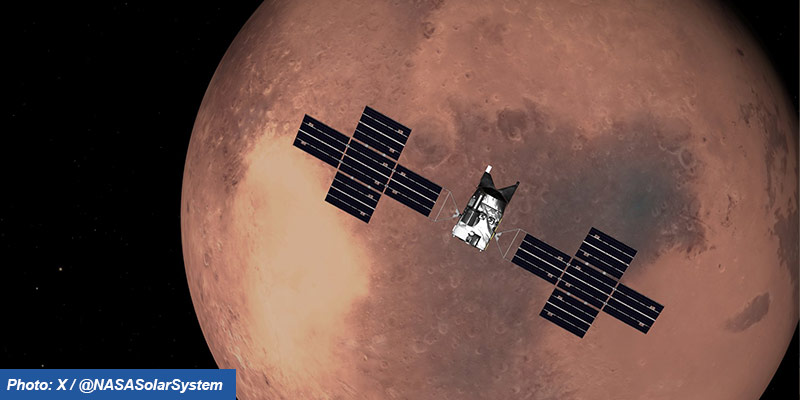
• NASA’s Psyche spacecraft got a boost from Mars on May 15, passing just 2,800 miles (4,500 kilometers) from the planet’s surface at some 12,333 mph (19,794 kph).
• The spacecraft harnessed the planet’s gravitational pull to speed up and adjust its trajectory toward the metal-rich asteroid Psyche.
• Launched on October 13, 2023, the Psyche spacecraft relies on a solar-electric propulsion system and the inert gas xenon for propellant, gradually gaining speed over the course of its long journey.
• Psyche’s mission planners used the Mars flyby to save propellent, letting the planet’s gravity do some of the work instead of the propulsion system alone.
• But gravity assists like these also offer opportunities for missions to practice and to calibrate their science instruments.
• The Psyche mission is a journey to a unique metal-rich asteroid orbiting the Sun between Mars and Jupiter.
• The mission is led by Arizona State University. NASA’s Jet Propulsion Laboratory is responsible for mission management, operations and navigation.
• Psyche spacecraft is scheduled to reach the asteroid in August 2029.
Asteroid Psyche
• Psyche was discovered in 1852 by Italian astronomer Annibale de Gasparis. Because it was the 16th asteroid to be discovered, it is sometimes referred to as 16 Psyche. It’s named for the goddess of the soul in ancient Greek mythology, often depicted as a butterfly-winged female figure.
• Psyche orbits the Sun in the outer part of the main asteroid belt between Mars and Jupiter.
• It is approximately three times farther from the Sun than Earth.
• Scientists think asteroid Psyche could be part or all of the iron-rich core of a planetesimal, a building block of a rocky planet that never formed.
• Because Psyche and Earth orbit at different speeds, the distance from Earth to Psyche varies from less than 186 million miles to more than 372 million miles.
• Psyche is irregular and potato-like. If the asteroid were sliced in half horizontally at the equator it would measure 280 kilometers across at its widest point and 232 kilometers long. Its surface area is 165,800 square kilometers.
• The surface gravity on Psyche is much less than it is on Earth – even less than it is on Earth’s Moon. On Psyche, lifting a car would feel like lifting a large dog.
• The asteroid is most likely a survivor of multiple violent hit-and-run collisions, common when the solar system was forming.
• The asteroid also could also be something else. It could be the leftover piece of a completely different kind of iron-rich body that formed from metal-rich material somewhere in the solar system.
• Psyche may be able to show us how Earth’s core and the cores of the other terrestrial planets came to be.
• While rocks on Mars, Venus, and Earth are flush with iron oxides, Psyche’s surface doesn’t seem to feature much of these chemical compounds. This suggests that Psyche’s history differs from standard stories of planetary formation.
• Because we cannot see or measure Earth’s core directly, Psyche offers a unique window into the violent history of collisions and accretion that created terrestrial planets.
(The author is a trainer for Civil Services aspirants.)