
- World
- May 22
Right to strike protected under key labour treaty, says ICJ
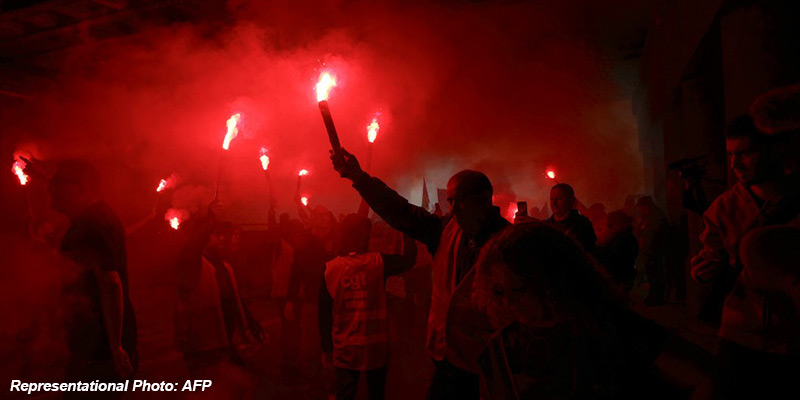
• The UN International Court of Justice (ICJ) issued an advisory opinion that the right to strike is protected under a core International Labour Organisation (ILO) convention.
• By 10 votes to four, the UN World Court ruled “the right to strike of workers and their organizations is protected” under the Freedom of Association and Protection of the Right to Organise Convention, 1948 (No. 87).
• The Court, however, stressed that its opinion did not define the exact scope of the right to strike.
• The case was referred to the Court by the ILO’s Governing Body in November 2023, after years of disagreement among the agency’s core constituents – governments, employers and workers – over whether Convention No. 87 protects the right to strike, even though the treaty does not explicitly mention strikes.
Convention No. 87
• Adopted in the aftermath of World War II, Convention No. 87 is a cornerstone of international labour law, guaranteeing workers and employers the right to form and join organisations of their choosing.
• The convention has been ratified by 158 countries.
• India has not ratified Convention No. 87.
• Convention No. 87 does not explicitly mention strikes, but advocates have long interpreted freedom of association to include that right.
• Everyone has the rights to freedom of peaceful assembly and association, which are essential components of democracy.
• The right of peaceful assembly includes the right to hold meetings, sit-ins, strikes, rallies, events or protests, both offline and online.
• The right to freedom of association involves the right of individuals to interact and organise among themselves to collectively express, promote, pursue and defend common interests. This includes the right to form trade unions.
• Freedom of peaceful assembly and of association serve as a vehicle for the exercise of many other rights guaranteed under international law, including the rights to freedom of expression and to take part in the conduct of public affairs.
• The right to freedom of peaceful assembly and association is protected by Article 20 of the Universal Declaration of Human Rights.
• The interpretation dispute concerns whether the right to strike of workers and their organisations is protected under the Convention No. 87.
• The dispute has persisted for several years.
• Employers’ groups stress that the convention contains no provision whose ordinary meaning implies such a right, and that the treaty’s drafting history showed no intention to include strike action.
• Workers’ representatives, by contrast, argue that the right to strike is inherent in freedom of association and has long been recognized by ILO supervisory bodies.
• The Court acknowledged that Convention No. 87 “does not contain an explicit reference to the right to strike,” but said the absence of such a provision “does not necessarily mean that the issue is excluded” from the treaty.
• The judges found that strike action could fall within the ordinary meaning of workers’ organisations’ “activities” under the Convention, alongside provisions protecting the right of workers and employers to form organizations and defend their interests.
• The ILO Governing Body (the executive body of the organisation) is expected to consider the matter at its 358th session in November.
• Under the ILO Constitution, the ICJ is the judicial body competent to provide authoritative interpretations of international labour conventions.
• Recourse to the Court for this purpose is exceptionally rare in the history of the organisation.
• This was only the second such referral in the ILO’s history. The first request was made in 1932 to the Permanent Court of International Justice, the predecessor of the ICJ, concerning the interpretation of the Night Work (Women) Convention, 1919.
• ICJ advisory opinions are not binding judgments, but they carry significant legal and political weight, shaping debates and national and international law.
The International Court of Justice
• The International Court of Justice (ICJ) is the principal judicial organ of the United Nations.
• It is informally known as the “World Court”.
• It was established by the United Nations Charter in June 1945.
• The first members of the ICJ were elected on February 6, 1946, at the first session of the UN General Assembly. The Court held its inaugural sitting at the iconic Peace Palace in The Hague, on April 18, 1946.
• The Court is composed of 15 judges elected for a nine-year term by the General Assembly and the Security Council of the United Nations.
• The seat of the Court is at the Peace Palace in The Hague (Netherlands).
• Of the six principal organs of the United Nations, it is the only one not located in New York, USA.
The Court has a twofold role:
1) To settle, in accordance with international law, through judgments which have binding force and are without appeal for the parties concerned, legal disputes submitted to it by States.
2) To give advisory opinions on legal questions referred to it by duly authorised United Nations organs and agencies of the system.
• The jurisdiction of the Court comprises all cases which the parties refer to it and all matters specially provided for in the Charter of the United Nations or in treaties and conventions in force.
• The Court can only hear a dispute when requested to do so by one or more States. It cannot deal with a dispute on its own initiative. Neither is it permitted, under its Statute, to investigate and rule on acts of sovereign States as it chooses.
• States which are not members of the United Nations may become parties to the Statute of the Court on conditions to be determined in each case by the General Assembly upon the recommendation of the Security Council.
Composition of the Court
• The ICJ comprises 15 judges, who are each elected to a nine-year term of office and may be re-elected.
• In order to ensure a measure of continuity in the composition of the Court, one-third of the membership is renewed every three years.
• Judges must be elected from among persons of high moral character, who possess the qualifications required in their respective countries for appointment to the highest judicial offices, or are jurisconsults of recognised competence in international law.
• The Court may not include more than one national of the same State. Moreover, the Court as a whole must represent the main forms of civilisation and the principal legal systems of the world.
• Once elected, a member of the Court is a delegate neither of the government of his own country nor of that of any other State.
• Unlike most other organs of international organisations, the Court is not composed of representatives of governments. Members of the Court are independent judges whose first task, before taking up their duties, is to make a solemn declaration in open court that they will exercise their powers impartially and conscientiously.
• Members of the Court are elected by the General Assembly and by the Security Council through parallel procedures.
• Both organs vote at the same time but independently of one another.
• This system is intended to ensure, as far as possible, that the vote in one organ does not influence the vote in the other.
• In order to be elected, a candidate must obtain an absolute majority of votes both in the General Assembly and in the Security Council.
• Currently, 97 votes out of 193 constitute an absolute majority in the General Assembly.
• In the Security Council, where no right of veto applies for the purpose of the election and no distinction is made between the votes of the permanent and non-permanent members of the Council, eight votes out of 15 constitute an absolute majority.