
- World
- May 29
Wars constitute ‘dangerous erosion’ of world order, warns UN chief
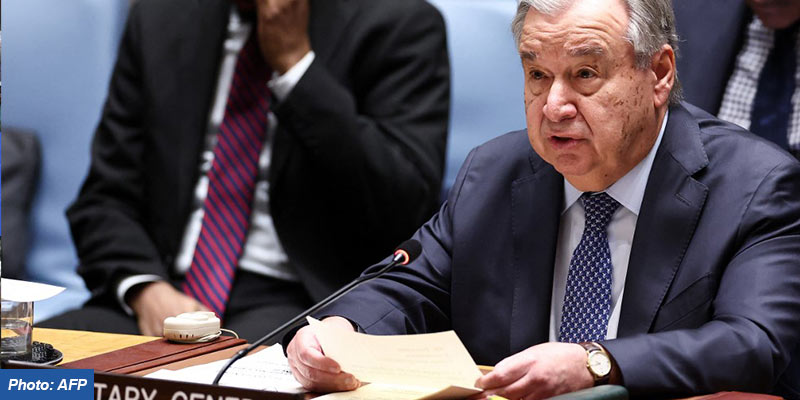
• The UN Charter is facing one of its gravest tests in decades, Secretary-General Antonio Guterres told the Security Council on May 26.
• He warned that wars, arms races, climate shocks and the erosion of international law are placing intense pressure on the multilateral system established to prevent a third world war.
• Guterres described the UN Charter as “a survival guide for humanity”.
• But, its core principles were now under “profound strain” as geopolitical divisions deepen, and conflicts intensify across multiple regions, he added.
• The meeting came amid growing concern over the future of multilateralism and increasing tensions among major powers over the interpretation and application of international law.
• Guterres referenced ongoing wars and rising tensions in Ukraine, the Middle East and Sudan, warning against further escalation.
• The Secretary-General pointed to a series of interconnected global crises that, taken together, were testing the resilience of the international system created in the aftermath of the Second World War.
• Among them, he cited deepening geopolitical mistrust, accelerating military spending, artificial intelligence (AI) and autonomous weapons, attacks on human rights, widening inequality and the worsening climate crisis.
• These seven challenges are interconnected and they are testing the resilience of the Charter itself, he said.
• He also warned that divisions within the Security Council are undermining its ability to respond effectively to global crises.
• Beyond the conflicts, Guterres warned of what he described as a destabilising global arms race unfolding alongside cuts to development and humanitarian aid.
What is the UN Charter?
• The UN Charter is the founding document of the United Nations and the legal basis for the postwar international system.
• Signed in San Francisco in June 1945 after the Second World War, the Charter entered into force on 24 October that year. It has been amended three times since – in 1963, 1965 and 1973.
• It sets out the core principles governing relations between States, including sovereign equality, the peaceful settlement of disputes and the prohibition on the use of force against another State.
• The Charter also established the United Nations’ six principal organs:
i) General Assembly
ii) Security Council
iii) Economic and Social Council (ECOSOC)
iv) Trusteeship Council
v) International Court of Justice
vi) Secretariat.
• India is one of the 51 original founders of the United Nations.