
- World
- Jun 03
James Webb Space Telescope detects methane on interstellar comet 3I/ATLAS
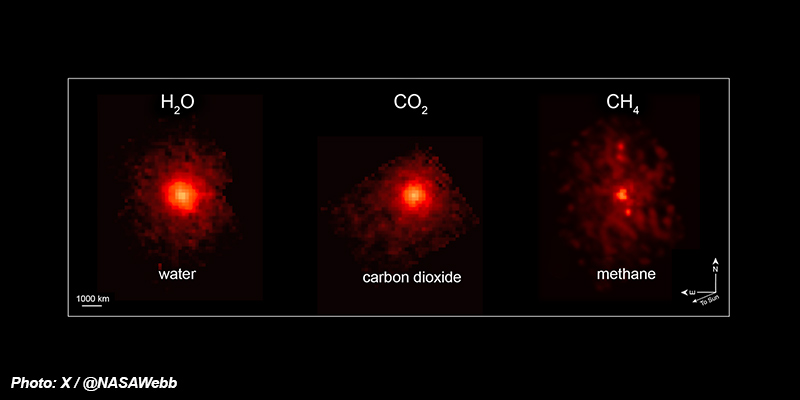
• The James Webb Space Telescope collected its first mid-infrared chemical fingerprint of an interstellar object during a recent revisit to comet 3I/ATLAS.
• For the first time on an interstellar visitor, Webb directly detected methane gas.
• Methane is highly volatile, meaning it sublimates from solid ice into a gas very easily.
• Its delayed appearance in comet 3I/ATLAS suggests it was buried below the comet’s top surface layer and protected from sublimation until heat from the comet’s close pass to the Sun reached deeper parts of the icy sub-surface.
• The amount of methane relative to water found is surprisingly high, with few similar analogs in our own solar system.
• The observations also confirmed that comet 3I/ATLAS remains unusually rich in carbon dioxide, releasing far more carbon dioxide relative to water when compared to typical solar system comets.
• Both these findings point to a very different formation environment and chemistry than the vast majority of comets that formed within our solar system.
• The observations were taken using Webb’s MIRI (Mid-Infrared Instrument) on two separate dates.
• The team’s results were published recently in The Astrophysical Journal Letters.
Comet 3I/ATLAS
• Comet 3I/ATLAS is the third known object from outside our solar system to be discovered passing through our celestial neighbourhood.
• Astronomers have categorised this object as interstellar because of the hyperbolic shape of its orbital path. It does not follow a closed orbital path about the Sun.
• When the orbit of 3I/ATLAS is traced into the past, the comet clearly originates from outside our solar system.
• The NASA-funded ATLAS (Asteroid Terrestrial-impact Last Alert System) survey telescope in Rio Hurtado, Chile, first reported observations to the Minor Planet Center of comet 3I/ATLAS on July 1, 2025.
• Comets are generally named for their discoverer(s). In this case the ATLAS survey team. The letter “I” is for “interstellar,” indicating that this object came from outside our solar system. It’s the third known interstellar object, hence the “3” in the name.
• Comet 3I/ATLAS posed no threat to Earth and remained far away.
• The interstellar comet’s size and physical properties continue to be investigated by astronomers around the world.