
- World
- Jun 26
Twin earthquakes rock Venezuela
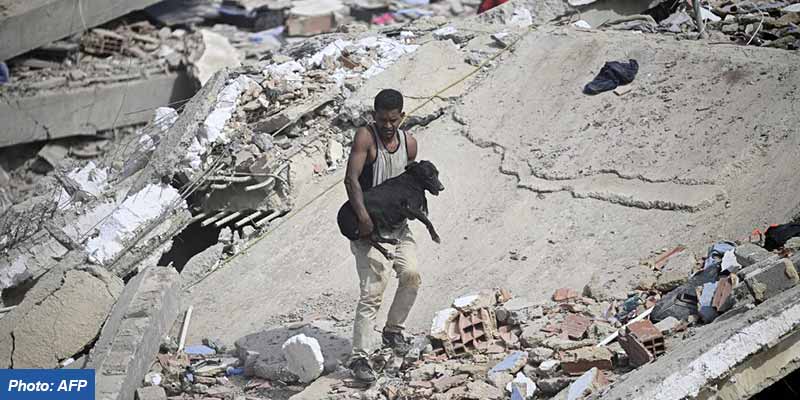
• Two deadly earthquakes struck northern Venezuela less than a minute apart on June 24, causing at least 235 deaths and widespread destruction in and around the capital, Caracas.
• According to the US Geological Survey, the first earthquake measured 7.2 on the Richter Scale. Its epicentre was near the city of San Felipe, home to some 220,000 people.
• The second quake was registered at 7.5 magnitude and was reportedly the strongest tremor to hit the country in more than 125 years.
• Venezuela’s northern coast sits on a boundary between the Caribbean and South American tectonic plates.
• Initial reports indicate significant destruction across several states of Venezuela, with many people reportedly injured while others remain trapped or are still missing.
• In addition, critical infrastructure has been damaged and basic services have been disrupted.
• The coastal region of La Guaira, north of the capital Caracas, suffered some of the heaviest damage and casualties. The country’s main airport is there and was closed due to damage, complicating aid efforts.
• The disaster hit the country already weakened by years of economic turmoil, which left much of its infrastructure fragile.
Some terms related to earthquake
Earthquake: An earthquake is a sudden, rapid shaking of the ground caused by the shifting of rocks deep underneath the Earth’s surface. Earthquakes can cause fires, tsunamis, landslides or avalanches. Earthquakes are classified as, Slight (M<5.0), Moderate (5.0<M<6.9) and Great (M>7.0) depending upon the magnitude on the Richter scale. An earthquake having a magnitude, M<2.0 is termed as a microearthquake.
Seismograph: A seismograph, or seismometer, is an instrument used to detect and record earthquakes. Generally, it consists of a mass attached to a fixed base. During an earthquake, the base moves and the mass does not. The motion of the base with respect to the mass is commonly transformed into an electrical voltage. The electrical voltage is recorded on paper, magnetic tape, or another recording medium. This record is proportional to the motion of the seismometer mass relative to the earth, but it can be mathematically converted to a record of the absolute motion of the ground. Seismograph generally refers to the seismometer and its recording device as a single unit.
Richter scale: The Richter magnitude scale was developed in 1935 by Charles F. Richter of the California Institute of Technology as a mathematical device to compare the size of earthquakes. The magnitude of an earthquake is determined from the logarithm of the amplitude of waves recorded by seismographs. Adjustments are included for the variation in the distance between the various seismographs and the epicenter of the earthquakes. On the Richter Scale, magnitude is expressed in whole numbers and decimal fractions.
Epicenter: It is the point on the surface of the Earth, vertically above the place of origin (hypocenter or focus) of an earthquake.
Aftershock: An earthquake that follows a large magnitude earthquake called, “main shock” and originates in or around the rupture zone of the main shock. Generally, major earthquakes are followed by a number of aftershocks, which show a decreasing trend in magnitude and frequency with time.