
- World
- Jun 27
US hosts Second Pax Silica Summit
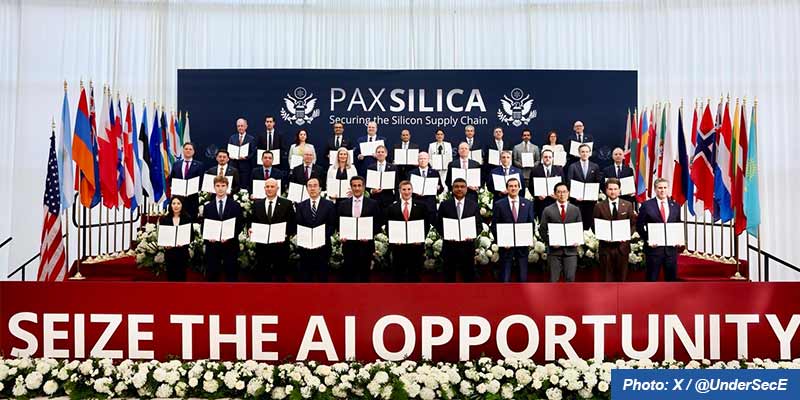
• The United States hosted the second Pax Silica Summit in Washington DC on June 25 and 26.
• The Summit included industry participation, bringing together Pax Silica signatories and private sector representatives to discuss collaboration on securing AI supply chains. Over a dozen affiliate countries participated, further expanding the Pax Silica network of partners.
• As many as 35 countries, including India, signed a joint statement on AI Opportunity, further aligning them on a pro-growth, pro-innovation regulatory approach to AI.
• The joint statement focused on empowering builders, startups, developers, and the private sector while securing global AI supply chains.
• The Indian delegation included S. Krishnan, Secretary, Ministry of Electronics and Information Technology and Nagraj Naidu, Additional Secretary (Americas) in the Ministry of External Affairs.
• The Indian delegation engaged with other governments and industry on advancing collaboration in semiconductors, artificial intelligence, and resilient technology supply chains.
• Ten partners joined as signatories to the Pax Silica Declaration, increasing the total to 24 signatories.
What is Pax Silica?
• Pax Silica is the US Department of State’s flagship effort on AI and supply chain security, advancing new economic security consensus among allies and trusted partners.
• It is a strategic initiative to build a secure, prosperous, and innovation driven silicon supply chain — from critical minerals and energy inputs to advanced manufacturing, semiconductors, AI infrastructure, and logistics.
• “Pax Silica” draws from the Latin ‘pax’ — meaning peace, stability, and long-term prosperity.
• ‘Silica’ refers to the compound that is refined into silicon, one of the chemical elements foundational to the computer chips that enable artificial intelligence.
• Pax Silica seeks to establish a durable economic order that underwrites an AI-driven era of prosperity across partner countries.
• Rooted in deep cooperation with trusted partners, Pax Silica aims to reduce coercive dependencies, protect the materials and capabilities foundational to artificial intelligence, and ensure aligned nations can develop and deploy transformative technologies at scale.
• On December 12, 2025, the US convened the inaugural Pax Silica Summit marking the beginning of a new golden era of cooperation on AI and supply chain security.
Signatories of Pax Silica initiative:
Argentina, Australia, Chile, Costa Rica, El Salvador, European Union, Finland, Germany, Greece, India, Israel, Japan, Kazakhstan, Netherlands, Norway, Panama, Philippines, Qatar, South Korea, Singapore, Sweden, United Arab Emirates, United Kingdom and United States.
• Taiwan is a non-signatory participant in Pax Silica.
How will Pax Silica initiative benefit India?
• Pax Silica seeks to build secure, resilient, and innovation-driven supply chains for technologies foundational to the AI era, particularly silicon and critical minerals that underpin semiconductors, advanced computing, and other high-technology systems.
• Pax Silica partners are building a new architecture that diffuses intelligence, placing the transformative power of AI in people’s hands and unlocking unprecedented possibilities.
• India’s entry into Pax Silica is both strategic and essential. India brings deep engineering and manufacturing capabilities, expanding capacity in critical mineral processing, and a strong trust factor, offering indispensable strengths to the coalition.
• The India-US Pax Silica Declaration is a critical step towards realising the ambitious vision Prime Minister Narendra Modi and President Donald Trump outlined under the Transforming the Relationship Utilizing Strategic Technology (TRUST) initiative.
• The cooperation under Pax Silica would further deepen engagement on critical technologies and supply chain resilience under the India-US Comprehensive Global Strategic Partnership.
• Technology cooperation remains one of the central pillars of the India-US Comprehensive Global Strategic Partnership.
• India’s joining the Pax Silica initiative marks a significant step forward in deepening bilateral collaboration in critical and emerging technologies and reinforces the shared commitment of both countries to resilient, trusted, and future-ready supply chains.