
- World
- Jul 21
Moon Day focuses growing concerns around space debris
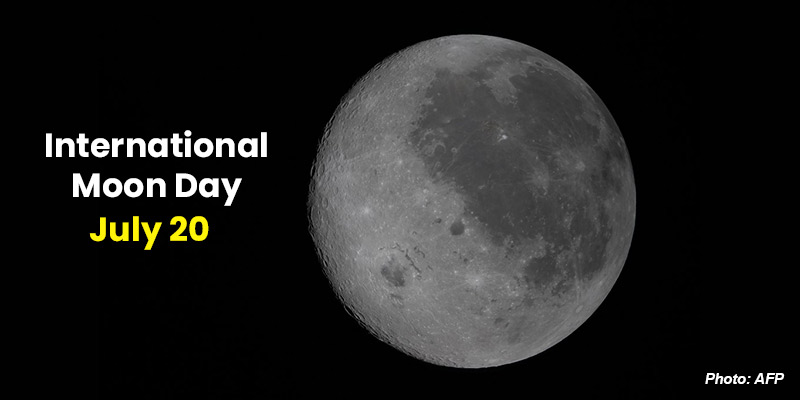
• The United Nations observes International Moon Day on July 20.
• It marks the anniversary of the first landing by humans on the Moon as part of the Apollo 11 lunar mission in 1969.
• From nearly 400,000 kilometers away, the Moon plays a crucial role in supporting life on Earth.
• Its gravitational pull generates tides that oxygenate coastal waters, transport nutrients and sustain some of the planet's most diverse ecosystems, like the Great Barrier Reef.
• With such a significant influence on human life, the Moon has been the subject of scientific study for thousands of years, and understanding it helps provide context for the entire solar system.
• Recently, the world has seen a resurgence in lunar exploration.
• Earlier this year, NASA’s Artemis II mission sent four astronauts on a 10-day journey around the Moon as part of a programme aiming to establish a long-term human presence on its surface by the 2030s.
• China, India, Japan, and several private companies are also pursuing their own lunar mission programmes.
• Amid surging lunar exploration, the UN urged governments to ensure that humanity’s return to the Moon does not come at the expense of planet Earth – or the long-term sustainability of space.
• Space sustainability means that activities in outer space and on the Moon must be carried out in a way that will preserve them for future generations.
• International agreements such as the 1967 Outer Space Treaty established essential principles for the responsible exploration and use of outer space, obliging states to avoid harmful contamination.
• Building on these treaties, UN Member States have adopted guidelines on space debris mitigation and the long-term sustainability, including practical measures like minimising debris, preventing explosions, avoiding intentional destruction of spacecraft, and safely removing defunct satellites and spent rocket stages from orbits.
Why this matters?
• Space debris is rapidly increasing around Earth.
• Satellite pollution may affect the atmosphere and ozone.
• Although international agreements are in place to avoid contaminating outer space, an estimated 140 million pieces of debris larger than one millimetre now orbit Earth.
• Most of these are too small to track but they remain capable of damaging satellites and spacecraft.
Potential impact of space debris
• Defunct satellites eventually re-enter Earth’s atmosphere, where they release metals such as aluminium, lithium and copper. Scientists are studying whether these materials could affect atmospheric chemistry, cloud formation and the ozone layer.
• Detachable rocket sections also contribute to the problem. Some remain in orbit for years before breaking apart or falling back to Earth, while others fragment into thousands of pieces. Hundreds of tonnes of spacecraft and rocket bodies are estimated to re-enter the atmosphere each year, a figure that is expected to increase as satellite constellations grow.
• Smaller mission-related objects — including bolts, lens caps and protective covers — also add to orbital congestion, while repeated collisions and explosions create microscopic particles that scientists believe are already increasing the brightness of the night sky.
• Although most spacecraft burn up during re-entry, larger heat-resistant components can survive the journey, posing risks to people, infrastructure and marine life.