
- World
- Jul 24
ECOSOC elects Algerian diplomat Amar Bendjama as new president
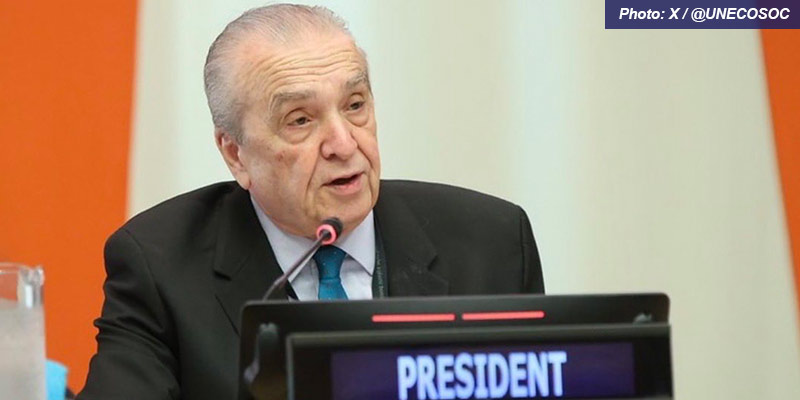
• Algerian diplomat Amar Bendjama was elected 82nd president of the Economic and Social Council (ECOSOC) on July 23.
• He served as vice-president of ECOSOC during the 2026 session.
• Bendjama succeeds Lok Bahadur Thapa, a diplomat from Nepal.
• The presidency changes every year at the ECOSOC’s first organisational session.
• Bendjama is the Permanent Representative of Algeria to the United Nations in New York since April 2023.
• He brings over five decades of successful bilateral and multilateral diplomatic experience, culminating in his stewardship of one of the UN’s principal organs (ECOSOC).

What is ECOSOC?
• The UN Charter established ECOSOC in 1945 as one of the six main organs of the United Nations.
• ECOSOC consists of 54 members, 18 of which are elected each year by the General Assembly for a three-year term.
• The Economic and Social Council (ECOSOC) coordinates the work of UN agencies related to economic, social and environmental development.
• ECOSOC links a diverse family of subsidiary bodies and UN entities dedicated to sustainable development, providing overall guidance and coordination. These include regional economic and social commissions, functional commissions facilitating intergovernmental discussions of major global issues, expert bodies establishing important global normative frameworks, and specialised agencies, programmes and funds at work around the world to translate development commitments into real changes in people’s lives.
• It is the central platform for fostering debate and innovative thinking, forging consensus on ways forward, and coordinating efforts to achieve internationally agreed goals. It is also responsible for the follow-up to major UN conferences and summits.
• Each year, ECOSOC structures its work around an annual theme of global importance to sustainable development. This ensures focused attention, among ECOSOC’s array of partners, and throughout the UN development system.
• By emphasising combined economic, social and environmental concerns, ECOSOC encourages agreement on coherent policies and actions that make fundamental links across all three.
• ECOSOC has the powerful mandate to promote international cooperation on economic, social, cultural, educational, health and related issues.
Specifically, it is tasked with the promotion of:
i) Higher standards of living, full employment, and conditions of economic and social progress and development.
ii) Solutions of international economic, social, health, and related problems, and international cultural and education cooperation.
iii) Universal respect for, and observance of, human rights and fundamental freedoms for all without distinction as to race, sex, language or religion.
• The official languages of ECOSOC are Arabic, Chinese, English, French, Russian and Spanish.