
- World
- Aug 04
Explainer - Why FIFA president Infantino faces backlash?
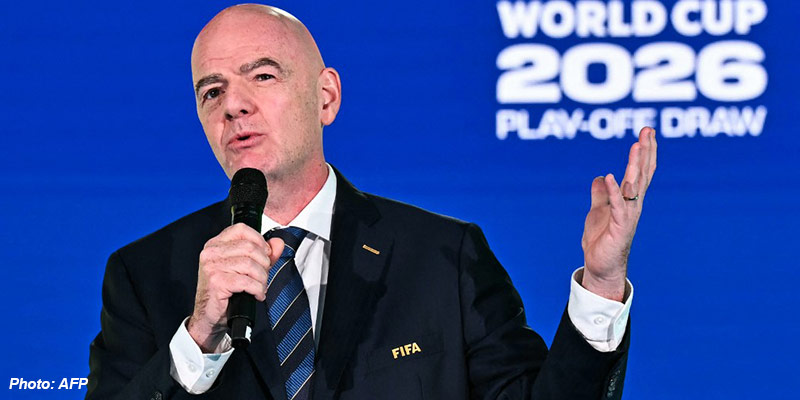
• FIFA President Gianni Infantino is facing criticism after regional confederations UEFA and CONCACAF said they had lost confidence in his leadership.
• The criticism has intensified over Infantino’s failed plan to spin off the world soccer governing body's commercial assets into a new entity backed by private investors.
• FIFA’s plan to unlock up to $4.2 billion from private investors by selling a roughly 20 per cent stake in a new entity overseeing competitions including the World Cup ended in retreat after fierce resistance from stakeholders.
• Attention has now turned to the potential repercussions for Infantino, whose bid for another term as FIFA president from 2027 to 2031 faces increased scrutiny.
What was FIFA’s proposal?
• FIFA, football’s world governing body, announced plans to create a commercial subsidiary to run its biggest events, such as the World Cup and Club World Cup.
• The process follows the conclusion of the FIFA World Cup 2026.
• Almost 16 million fans attended in the stadiums and fan festivals, and billions watched around the world via new channels and innovative forms of content.
• Under the proposal, private investors would be allowed to acquire stakes in the company, but would remain minority shareholders.
• FIFA hopes to raise up to $4.2 billion based on a valuation of $20 billion for the FIFA Forward Enterprise (FFE) initiative.
• Central to this would be a repositioning of FIFA Forward, FIFA’s flagship development programme, which aims to increase funding per FIFA Member Association from $8 million to $20 million for the 2027-30 cycle and grow steadily thereafter cycle-on-cycle.
• This funding would support infrastructure, coaching, national teams, competitions, grassroots football and the women’s game.
UEFA members planned to boycott FIFA competitions
• The Union of European Football Associations (UEFA) and its 55 member associations unequivocally rejected FIFA’s proposal to transfer ownership interests in the World Cup and other FIFA competitions to private investors.
• It said no UEFA national teams will participate in any FIFA competition for so long as these proposals remain alive, unless this proposal has been abandoned in its entirety and binding assurances have been given that FIFA will never again open its governance or competitions to private ownership.
• The European soccer’s governing body said that the World Cup cannot be treated as an investment product.
• The Confederation of North, Central America and Caribbean Association Football (CONCACAF), the 41-member federation for North America, Central America and the Caribbean, rejected the proposal.
• The Asian Football Confederation, which has 47 members, issued a statement saying it stands in solidarity with UEFA and CONCACAF.
• UEFA, CONCACAF and the AFC combined have 143 national associations, well over half of FIFA’s 211 members.
• A majority of the members would have needed to vote in support of the plan for it to proceed.
• FIFA scrapped the proposal after widespread backlash.
What is FIFA?
• Federation Internationale de Football Association (FIFA) exists to govern football and to develop the game around the world.
• FIFA was founded in Paris on May 21, 1904, with a view to organising the world’s most popular sport. The foundation act was signed by representatives from France, Belgium, Denmark, Netherlands, Spain, Sweden and Switzerland.
• The FIFA Member Associations are at the centre of football’s global ecosystem, representing 211 countries and territories across six continents.
• These associations are responsible for the development and governance of football within their territory, including organising competitions, nurturing grassroots programmes, and promoting the sport at all levels.
• FIFA supports them financially and logistically through various programmes. As representatives of FIFA in their countries, they have obligations to respect the statutes, aims and ideals of football's governing body and promote and manage the sport accordingly.
• The FIFA Council is the main decision making body of the organisation in the intervals of FIFA Congress.
• The final composition of the FIFA Council consists of 37 members: one president, elected by the FIFA Congress; eight vice presidents, and 28 other members elected by the member associations – each for a term of four years.
• A minimum of one female representative must be elected per confederation.
• The president and the members of the Council may serve for no more than three terms of office (whether consecutive or not).