
- World
- Aug 06
What is biofouling?
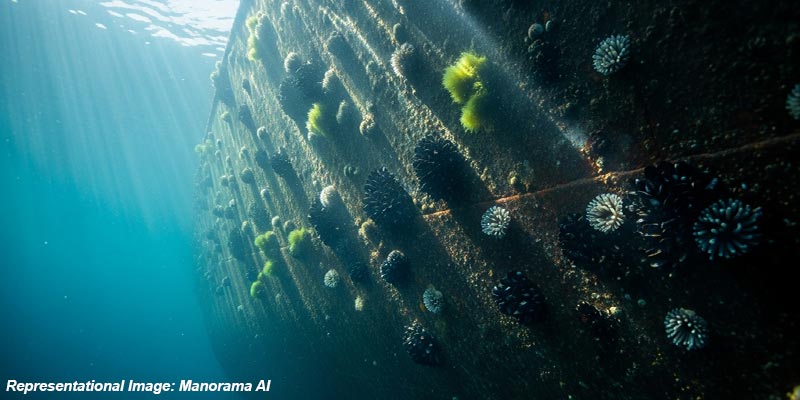
• The ships stranded in the Strait of Hormuz amid the US-Iran war could become an “ecological timebomb”, warned the UN’s International Maritime Organisation (IMO).
• It increases the risk of invasive species spreading to new marine environments once shipping resumes.
• The concern centers on “biofouling” – the buildup of marine organisms such as algae and small animals on ship hulls.
• Vessels that remain stationary for extended periods face an increased risk of biofouling.
• There is a risk of a transfer of species if ships are unable to remove fouling before moving out of an area or after a prolonged period of time in one area.
• The IMO recommends that ship operators follow the IMO biofouling guidelines as far as possible.
• The IMO is developing a legally binding treaty aimed at improving management of ship biofouling and reducing.
Invasive aquatic species
• Invasive aquatic species are introduced to new environments by ships mainly through ballast water or hull fouling.
• While ballast water is essential for safe and efficient modern shipping operations, the multitude of marine species carried in it may pose serious ecological, economic and health problems.
• These include bacteria, microbes, small invertebrates, algae, eggs, cysts and larvae of various species.
• Biofouling is also considered one of the main vectors for bioinvasions and is described as the undesirable accumulation of microorganisms, plants, algae and animals on submerged structures (especially ships’ underwater surfaces).
• Studies have shown that biofouling can be a significant vector for the transfer of invasive aquatic species.
• Biofouling on ships entering the waters may result in the establishment of invasive aquatic species which may pose threats to human, animal and plant life, economic and cultural activities and the aquatic environment.
• A multitude of marine species, carried either in ships’ ballast water or on ships’ hulls, may survive to establish a reproductive population in the host environment, becoming invasive, out-competing native species and multiplying into pest proportions.
• Biofouling has become a growing global problem due to increased shipping and trade, warning that the impacts of invasive aquatic species have been “devastating” in some regions because they are difficult to remove once established.
• Bioinvasions are actually continuing at an alarming rate and there are new areas being invaded all the time.
• The spread of invasive species is recognised as one of the greatest threats to the ecological and the economic well being of the planet, and one of the main drivers of biodiversity loss.
• These species are causing enormous damage to biodiversity and the valuable natural riches of the earth upon which we depend.
• Direct and indirect health effects are becoming increasingly serious and the damage to the environment is often irreversible.
• Moreover, significant economic impact occurs to industries that depend on the coastal and marine environment, such as tourism, aquaculture and fisheries, as well as costly damage to infrastructure.