
- World
- Aug 11
Over 100 people killed after powerful earthquake strikes western Colombia
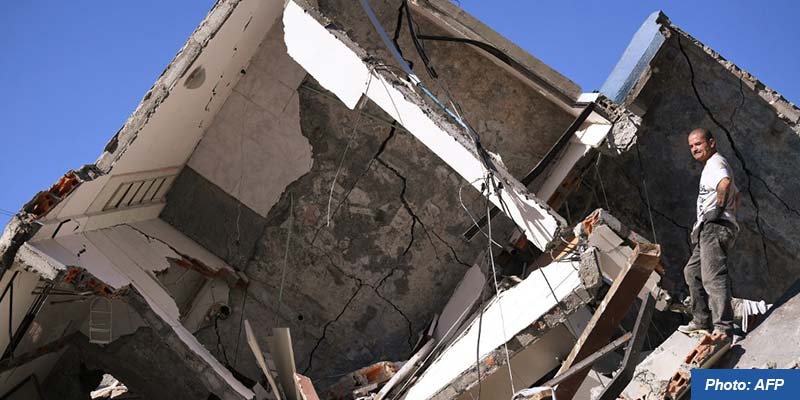
• An earthquake of magnitude 7.4 struck Colombia, killing at least 111 people and injuring at least 87 on August 10.
• The epicenter was San Jose del Palmar in the Choco region, about 400 kilometres west of Colombia’s capital Bogota.
• The tremor was felt across large parts of Colombia and in neighbouring countries, including Panama, Ecuador and Venezuela.
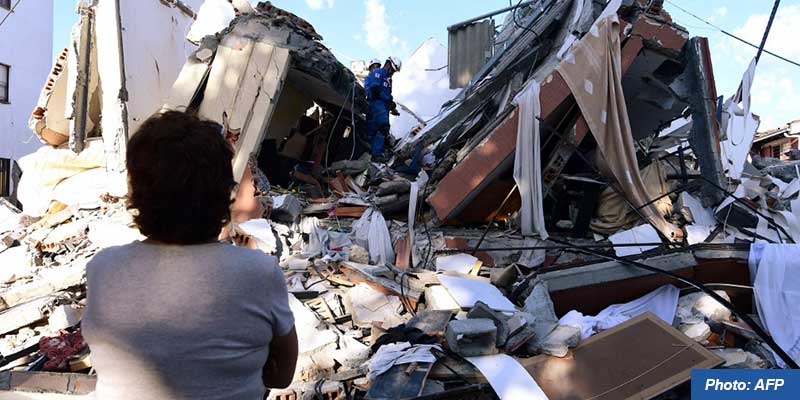
• Authorities are continuing search and rescue operations as the death toll rises.
• Initial reports indicate that homes and other structures have collapsed in several towns, with people still trapped beneath the debris.
• In Cali, the country’s third largest city, authorities have reported multiple landslides with people trapped and have requested reinforcements for rescue operations.
• Damage has also affected transport infrastructure, with several airports in western Colombia suspending operations while facilities are inspected.
• Evacuation orders were issued as far away as the capital, Bogota.
• The government has activated its emergency response mechanisms and continues to assess damage and needs in affected areas.
• The tragedy struck just three days after the inauguration of Colombian President Abelardo de la Espriella.
Some terms related to earthquake
Earthquake: An earthquake is a sudden, rapid shaking of the ground caused by the shifting of rocks deep underneath the Earth’s surface. Earthquakes can cause fires, tsunamis, landslides or avalanches. Earthquakes are classified as, Slight (M<5.0), Moderate (5.0<M<6.9) and Great (M>7.0) depending upon the magnitude on the Richter scale. An earthquake having a magnitude, M<2.0 is termed as a microearthquake.
Seismograph: A seismograph, or seismometer, is an instrument used to detect and record earthquakes. Generally, it consists of a mass attached to a fixed base. During an earthquake, the base moves and the mass does not. The motion of the base with respect to the mass is commonly transformed into an electrical voltage. The electrical voltage is recorded on paper, magnetic tape, or another recording medium. This record is proportional to the motion of the seismometer mass relative to the earth, but it can be mathematically converted to a record of the absolute motion of the ground. Seismograph generally refers to the seismometer and its recording device as a single unit.
Richter scale: The Richter magnitude scale was developed in 1935 by Charles F. Richter of the California Institute of Technology as a mathematical device to compare the size of earthquakes. The magnitude of an earthquake is determined from the logarithm of the amplitude of waves recorded by seismographs. Adjustments are included for the variation in the distance between the various seismographs and the epicenter of the earthquakes. On the Richter Scale, magnitude is expressed in whole numbers and decimal fractions.
Epicenter: It is the point on the surface of the Earth, vertically above the place of origin (hypocenter or focus) of an earthquake.
Aftershock: An earthquake that follows a large magnitude earthquake called, “main shock” and originates in or around the rupture zone of the main shock. Generally, major earthquakes are followed by a number of aftershocks, which show a decreasing trend in magnitude and frequency with time.