
- World
- Aug 29
International Day against Nuclear Tests on August 29
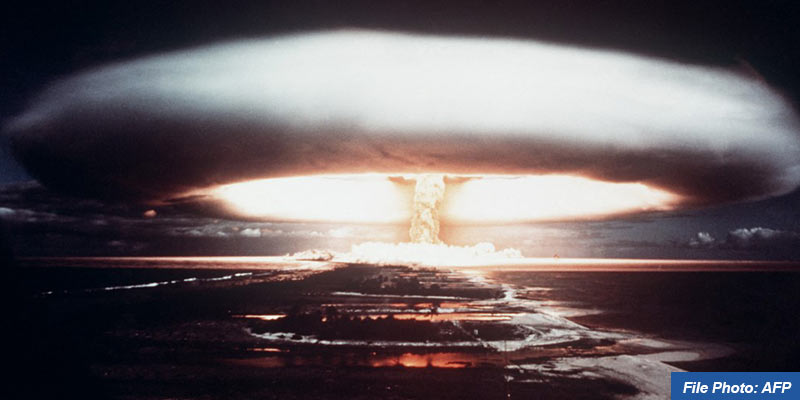
• In 2009, the United Nations General Assembly proclaimed August 29 the International Day Against Nuclear Tests.
• This date recalled the official closing of the Semipalatinsk nuclear weapons testing site in Kazakhstan on August 29, 1991. That site alone has seen 456 nuclear test explosions between 1949 and 1989.
• In the early days of nuclear testing, little consideration was given to its devastating effects on human life, let alone the dangers of nuclear fallout from atmospheric tests.
• Hindsight and history have shown us the terrifying and tragic effects of nuclear weapons testing, especially when controlled conditions go awry, and in light of the far more powerful and destructive nuclear weapons that exist today.
• Nuclear weapons stockpiles have grown exponentially. By the early 1980s there were some 60,000 nuclear weapons, most far more powerful than the bombs used in Hiroshima and Nagasaki.
• Between 1954 and 1984 there was on average at least one nuclear weapons test somewhere in the world every week, most with a blast far exceeding the bombing of Hiroshima.
• Radioactivity from these test explosions spread across the planet deep into the environment.
• The main mechanism for eradicating nuclear weapons testing is the Comprehensive Nuclear-Test-Ban Treaty (CTBT).
What is Comprehensive Nuclear-Test-Ban Treaty (CTBT)?
• The Comprehensive Nuclear-Test-Ban Treaty (CTBT) bans nuclear weapon test explosions by everyone, everywhere: above ground, under water and underground.
• CTBT is an essential component of the international nuclear arms control and disarmament framework.
• It comprises a preamble, 17 articles, two annexes and a Protocol with two annexes.
• By totally banning nuclear testing, the Treaty seeks to constrain the qualitative improvement of nuclear weapons and to end the development of new types of nuclear weapons. It constitutes an effective measure of nuclear disarmament and non-proliferation in all its aspects.
• The Treaty was adopted by the United Nations General Assembly and opened for signature in New York on September 24, 1996. On that day, 71 States signed the Treaty. The first State to ratify the Treaty was Fiji.
• Adherence to the Treaty is nearly universal. To date, 188 countries have signed the treaty and 179 have ratified it.
• However, to enter into force, the Treaty must be ratified by all 44 States listed in its Annex 2, for which nine ratifications are still required.
• North Korea, India, and Pakistan have not signed the CTBT. There are six States that have signed but are yet to ratify the CTBT, which are: China, Egypt, Iran, Israel, and the United States.
• Although the Treaty has not yet entered into force, it has helped to establish a strong global norm against nuclear testing and built confidence that any nuclear test explosion would be reliably detected.
• The Treaty relies on a network of over 300 scientific monitoring facilities around the world that can quickly detect a nuclear test notably smaller than the Hiroshima explosion and pinpoint its location. No state anywhere on Earth can conduct a nuclear weapons test in secret.
Comprehensive Nuclear-Test-Ban Treaty Organisation (CTBTO)
• Known formally as the Preparatory Commission for the Comprehensive Nuclear-Test-Ban Treaty Organisation, the CTBTO exists to prepare for the Treaty’s entry into force.
It has two main tasks:
i) Promoting universal support of the Treaty.
ii) Building up the CTBT verification regime to ensure its operationalisation at entry into force of the Treaty.
• Its headquarters is situated in Vienna, Austria.
Why India has not signed CTBT?
India has claimed that the CTBT is discriminatory because it favours “five nuclear weapon states” — the US, the UK, China, France and Russia — when it comes to fulfilling obligations for eliminating nuclear weapons. Instead, it wanted the CTBT to have a clause on complete nuclear disarmament in a time-bound manner because there are technological differences between the ‘have’ and ‘have not’ countries. India was concerned about the likelihood of those already possessing nuclear weapons upgrading their arsenals through sub-critical and laboratory simulated testing.