
- World
- Sep 14
What is ‘yellow line’ in Gaza?
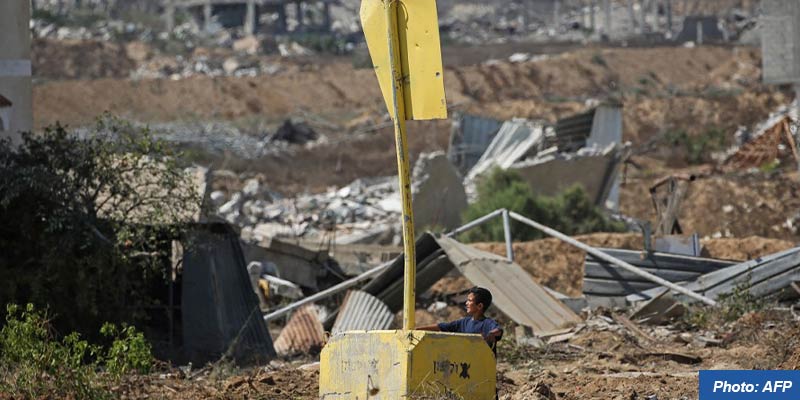
• The Israeli military is quietly building a giant earthen barrier separating the over 50 per cent of the Gaza Strip it controls from the rest of the territory, according to reports.
• The line was envisioned in the US-backed agreement as a temporary division of the territory pending a fuller Israeli withdrawal.
• The “yellow line” splits Gaza into two sections: most of the Palestinian population is confined in the western zone, while the eastern zone is under Israeli military control.
• At first, the “yellow line” left roughly 47 per cent of the Strip for the Palestinian population, but Israeli forces have gradually pushed the line inwards, according to the UN Office for the Coordination of Humanitarian Affairs (OCHA).
• People approaching or crossing it can be at serious risk, because Israeli forces have treated parts of it as a restricted military zone.
• Palestinians currently live in less than 40 per cent of Gaza’s land area.
• This push by Israeli forces has led to the displacement of families living close to the line.
• Some 2.1 million people — almost the entire population of the Strip — are currently displaced and living within the limits of the “yellow line”, according to the UN.
• Many live near the painted yellow blocks, with residents saying they have continued to live in these neighbourhoods — notably Al-Tuffah and Al Zaytoun neighbourhoods in eastern Gaza City — because they have nowhere else to go.
• Families there are constantly on high alert, fearing that they may have to abandon their property and quickly flee if the security situation changes.
• The United Nations said finding safer sites to establish camps for displaced people has become more difficult because much of the suitable land lies within prohibited or restricted areas east, south and north of the “yellow line” and beyond.
• Some 1.98 million people, or 94 per cent of Gaza’s population, need assistance related to shelter and non-food items, according to the latest shelter assessment published by the Office for the Coordination of Humanitarian Affairs.
• Also, 84 per cent of families also live in extremely difficult conditions, including shelters or tents that do not provide adequate protection from the weather.