
- World
- Sep 19
Global gender equality will take 120 years, says WEF
• Nearly every economy tracked since 2006 has advanced gender parity, yet full parity is 120 years away, according to the Global Gender Gap Report 2026 published by the World Economic Forum (WEF).
• Globally, the gender gap now stands at 69.2 per cent closed, where 100 per cent represents full parity, up 0.4 percentage points over the past year.
• While India’s score improved slightly over the last year, its global ranking remained unchanged at 131.
• Chad was the lowest-ranked country in the index, with Iran and Pakistan joining it in the bottom three.
What is Global Gender Gap Index?
For the past two decades, the Global Gender Gap Index has benchmarked progress towards gender parity across four dimensions:
i) Economic Participation and Opportunity.
ii) Educational Attainment.
iii) Health and Survival.
iv) Political Empowerment.
• Marking its 20th edition, the 2026 Global Gender Gap Report covers a cohort of 145 economies and analyses a longitudinal constant sample of 97 economies included in every edition since 2006, providing the longest-running assessment of progress towards gender parity.
• The Global Gender Gap Index measures scores on a 0-1 scale, and scores can be interpreted as the distance covered towards parity (i.e. the percentage of the gender gap that has been closed, numbers rounded).
• Within country comparisons provide a view on areas of strength and weakness within an economy while cross-economy comparisons support the identification of the most effective policies to close gender gaps.
Achievers in reducing gender gap
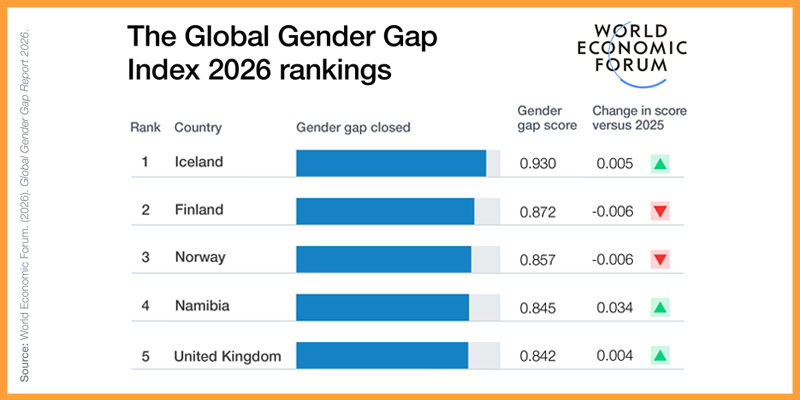
• Iceland leads in the report’s rankings for the 17th consecutive year, with 93 per cent of the gender gap closed, and remains the only country to have closed more than 90 per cent of its gap.
• Finland (87.2 per cent) and Norway (85.7 per cent) hold second and third for the third year running.
• Namibia (84.5 per cent) climbed four places to fourth, the highest-ranked country in Sub-Saharan Africa, followed by the United Kingdom (84.2 per cent), New Zealand (82.8 per cent), Sweden (82.3 per cent), Australia (81.9 per cent), Germany (81.7 per cent) and Ireland (81.4 per cent).
• Australia entered the top 10 for the first time.
• Four economies have appeared in every top 10 since 2006: Iceland, Finland, Norway and Sweden.
• The biggest climbers in this year’s ranking are Kenya (65th, up 33 places), Ghana (56th, up 32), Guatemala (50th, up 31), Angola (87th, up 30) and Czechia (77th, up 25).
Key points of this year’s Index:
• Among the 97 economies tracked since 2006, the gap has closed by 5.2 percentage points to 69.4 per cent, the highest level recorded.
• Improvement peaked before the pandemic, when 76 per cent of tracked economies recorded gains, before widespread setbacks.
• Across the four dimensions of the index, Health and Survival (96.2 per cent) and Educational Attainment (96.9 per cent) are the two dimensions closest to parity, while Economic Participation and Opportunity (61.7 per cent) and Political Empowerment (22.1 per cent) account for the widest gender gaps.
• Political empowerment has gained the most ground in the last 20 years, up 8 percentage points among the economies tracked throughout. In 2006, there was one woman minister for every 8.1 men. Today it is one for every 4.3. In Parliaments, the ratio has moved from one woman for every 5.6 men to one for every three or so.
• Since 2024, women’s share of top-level management has stalled at an average of under 30 per cent across 62 economies.
• Women’s workforce presence has increased from 39.9 per cent in 2015 to 41.8 per cent by June 2026 and grown from 26.7 per cent to 29.6 per cent in senior leadership roles over the same period.
• As seniority increases, women’s representation is reduced. In 2026, women’s representation from entry-level positions to the C-suite (highest-ranking senior executives) drops by half, from 46 per cent to 23 per cent. The “drop to the top” is industry specific, impacting women at
different career stages based on their sector.
• Women hold around two-thirds of chief human resources and chief people officer roles but occupy under one in five chief information and under one in 10 chief technology officer roles.
• Women are less represented in artificial intelligence (AI) firms than in comparable non-AI firms at every level. Within AI occupations, women are concentrated in data annotation roles, which are often lower-paid AI positions.