
- World
- Oct 08
Canadian author Anne Carson wins 2026 Nobel Prize in Literature
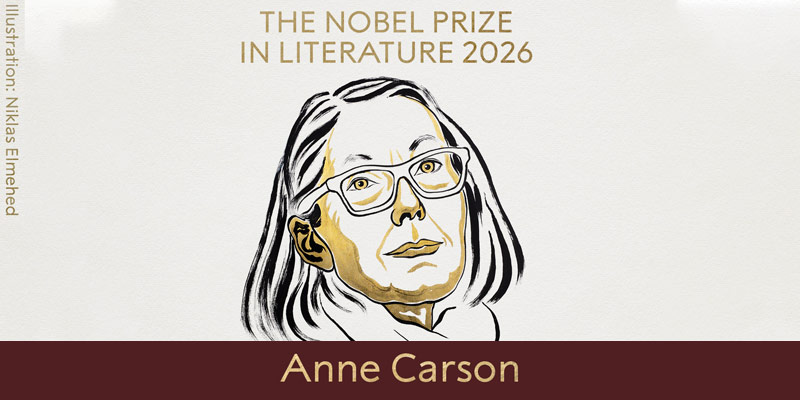
• Canadian poet and essayist Anne Carson won the 2026 Nobel Prize in Literature.
• The prize is awarded by the Swedish Academy and is worth 12 million Swedish kronor.
• Hungarian writer Laszlo Krasznahorkai won the Nobel Prize in Literature in 2025.
Who is Anne Carson?
• Anne Carson was born on June 21, 1950 in Toronto, Canada.
• Almost all her literary production has centred upon the intersection between the philologist’s obsession with words and the poet’s desire for new meaning.
• Her translations from classical Greek may be regarded as independent works in their own right.
• Among these is her interpretation of Sappho’s poem fragments, ‘If Not, Winter’ (2002), along with tragedies such as Sophocles’s ‘Electra’ (2001) and ‘Antigone’ (2015) and Euripides’s ‘Bakkhai’ (2015).
• In her long essay ‘Eros the Bittersweet’ (1986), Carson lays the foundation for her subsequent authorship. With its brilliantly rendered meditation on Eros being the essence and driving force of the poem, the book draws heavily on a compound adjective from Sappho that defines Eros as pain and sweetness combined.
• Carson constantly brings in different voices that play off against each other.
• In ‘Eros the Bittersweet’, she speaks of a “stereoscopic vision that allows her to hold in equipoise two perspectives at once”.
• A case in point is the essay ‘Economy of the Unlost’ (1999), in which Carson sets the sixth century BC Greek poet Simonides of Keos against Paul Celan, and in ‘Men in the Off Hours’ (2000), in which she aligns the historian Thucydides with Virginia Woolf.
• It is through such, often unexpected, literary constellations that Carson has broken away from lyrical poetry bound to the narrative self and inspired new forms of contemporary literature.
• This method of writing leads to playful and ironic works that move not only between classical and modern poetry but also between different genres and artforms.
• In the 1990s, Carson published a series of notable works. Among these is ‘The Glass Essay’ in ‘Glass, Irony, and God’ (1995), which demonstrates the potential of the long poem where genre boundaries are seen to blur.
• The same decade saw the publication of another work, often heralded as Carson’s greatest, titled ‘Autobiography of Red: A Novel in Verse’ (1998).
• ‘The Beauty of the Husband: A Fictional Essay in 29 Tangos’, published in 2001, tells of a cutting and sardonic row with a deceitful husband, its 29 episodes each opening with lines of verse by the romantic poet John Keats.
• An unforgettable work of Carson’s is ‘Nox’ (2010), written in memory of her brother Michael, who was mysteriously absent prior to his death in Denmark in 2000.