
- World
- Oct 09
South African jurist of Indian origin Navanethem Pillay wins Nobel Peace Prize
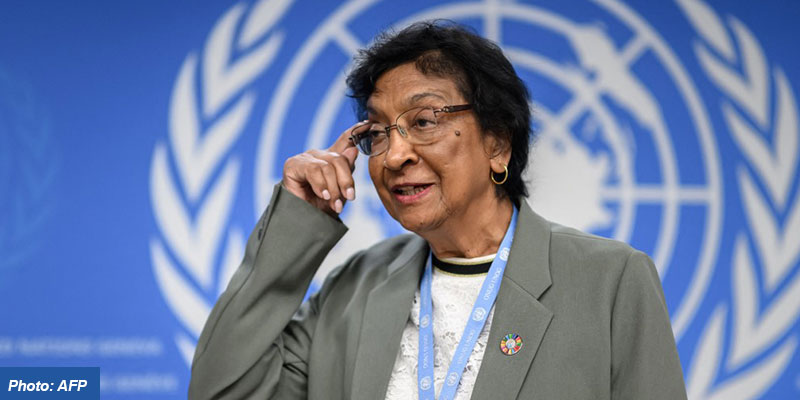
• South African jurist of Indian origin Navanethem “Navi” Pillay won the Nobel Peace Prize for her contributions to promoting peace and international law.
• The Nobel Peace Prize carries a cash award of 12 million Swedish kronor (approximately $1.2 million).
• This year marks 125 years of the Nobel Prizes.
Who is Navi Pillay?
• This year’s laureate has been instrumental in ensuring that war crimes, crimes against humanity and genocide are prosecuted.
• Navi Pillay’s commitment to universal legal principles and her firm moral compass are constants in a long career.
• Born in Durban on September 23, 1941, to Indian parents of Tamil descent, Pillay grew up under apartheid and went on to build a career defending anti-apartheid activists and advancing human rights and equality.
• Pillay became a lawyer and legal pioneer, confronting deep structural discrimination, segregation and exclusion.
• A common thread runs from her early work defending Nelson Mandela and others who stood up against apartheid to her service as a judge in some of the key international court cases of our time.
• Pillay received a BA and a LLB from Natal University South Africa. She also holds a Master of Law and a Doctorate of Juridical Science from Harvard University.
• In 1967, she became the first woman to open a law practice in South Africa’s Natal Province.
• She also worked as a lecturer at the University of KwaZulu-Natal, and later was appointed Vice-President of the Council of the University of Durban Westville.
• In 1995, after the end of apartheid, Pillay was appointed as acting judge on the South African High Court.
• In the same year, she was elected by the UN General Assembly to be a judge on the International Criminal Tribunal for Rwanda, where she served a total of eight years, the last four (1999-2003) as president.
• She played a critical role in the ICTR's groundbreaking jurisprudence on rape as genocide, as well as on issues of freedom of speech and hate propaganda.
• In 2003, she was appointed as a judge on the International Criminal Court in the Hague, where she served on the Appeals Chamber until August 2008.
• She was the United Nations High Commissioner for Human Rights from September 2008 to September 2014.
• Until recently, she chaired the UN Independent International Commission of Inquiry on the Occupied Palestinian Territory.
• At present, Pillay is a judge on the International Court of Justice in the case where Myanmar stands accused of genocide.
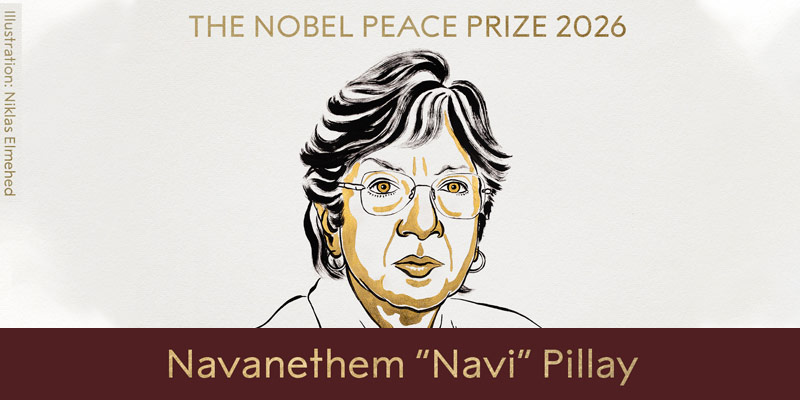
Why the Nobel Committee selected Pillay for the Peace Prize?
• At a time of existential challenges – including more wars and conflicts than the world has seen in a long time – international law is no longer just a supplement to peace and security. It is an absolute necessity.
• Pillay has contributed to strengthen the institutions of international law. Her expertise and steadfastness have made her one of the most respected international jurists of our time.
• Pillay has held states and national leaders accountable and brought hope to victims of violence and conflict.
• In all the positions she has held, she has stressed the responsibility of individuals and states to comply with the rule of law.
• She has also helped define the relevant norms and legal principles. When the International Criminal Tribunal for Rwanda established that rape and sexual violence could constitute a crime against humanity — as well as genocide — her influence was a significant factor.
• In the same case, Pillay was instrumental in a separate legal breakthrough. For the first time, a defendant faced charges of incitement to commit genocide purely on the basis of spreading propaganda.