
- World
- Oct 29
Explainer - US economic embargo against Cuba
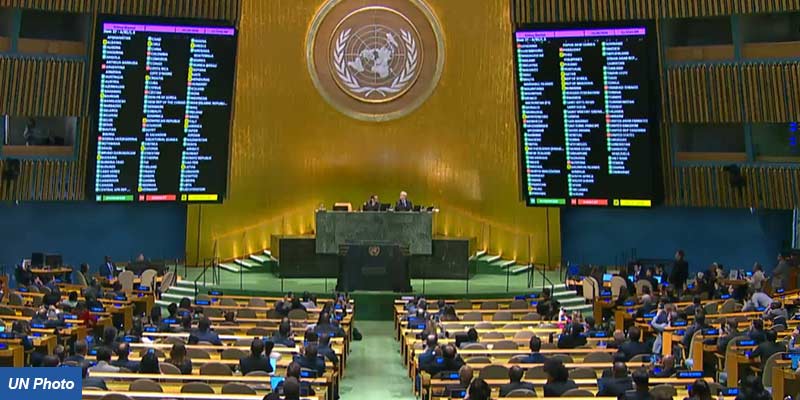
• The UN General Assembly called for the 34th time for an end to the US economic, commercial and financial embargo on Cuba.
• However, it was the weakest backing for the resolution in two decades.
• In 2025, it was adopted by 165 votes to seven, with 12 abstentions.
• The vote came as Cuba struggles with a severe energy crisis exacerbated by a US fuel embargo following the rendition of Venezuela’s President to New York, which has made life harder for people across the island.
Six decades of the embargo
• The United States maintains a comprehensive economic embargo on Cuba.
• The embargo is rooted in the Cold War, when Fidel Castro and his revolutionaries seized power in Cuba in January 1959.
• US President Dwight D. Eisenhower’s State Department imposed the first trade embargo on Cuba in October 1960.
• In February 1962, President John F. Kennedy proclaimed an embargo on trade between the US and Cuba, in response to certain actions taken by the Cuban government, and directed the Departments of Commerce and the Treasury to implement the embargo, which remains in place today.
• The embargo imposed by the US against Cuba is one of the longest in modern history.
• The economic, commercial and financial embargo is defined by a series of US laws that have been enacted over several decades.
• In 1992, the Cuban Democracy Act was adopted, which gave legislative force to all embargo regulations. This Act, also known as the Torricelli Act, prohibits not only US companies, but also their subsidiaries in third countries, from trading with Cuban companies. In addition, it prohibits any merchant ship from entering US territories until six months have elapsed since it last docked in Cuban ports, creating significant difficulties for Cuban maritime trade.
• During the term of office of President Bill Clinton, the Cuban Liberty and Democratic Solidarity (LIBERTAD) Act of 1996, generally known as Helms-Burton Act, was adopted, which established, sanctions for directors of foreign companies that conduct transactions involving US property that was nationalised in Cuba, and contains provisions for the filing of cases in US courts, fostering internal subversion.
• Tensions only eased when the Obama administration established diplomatic relations with Cuba, modifying several aspects of the embargo, such as lifting some travel restrictions. The first steps included the re-opening of embassies and the removal of Cuba from the list of State sponsors of terrorism. Direct mail services between the two countries were restored. Regular direct flights between the two countries were re-established.
• President Obama’s amendments to the regulations on the application of the embargo and his position in favour of eliminating the policy were drastically reversed by the Trump administration.
• The Trump administration has tightened the embargo – a move that has led to an energy crisis and possible humanitarian collapse, according to the UN Resident Coordinator in Cuba.
• The World Health Organisation (WHO) has also warned that energy shortages are taking a toll on health.
• In May, senior UN officials reported that more than 100,000 surgical procedures had been postponed.
• Cuban authorities have repeatedly pointed to further damage to the health system, including delays to vaccination programmes and patients with chronic illnesses unable to get a stable supply of medicines.
• This year, Trump has also raised the possibility of military intervention in Cuba.

34th voting at the UN General Assembly
• Every year at around this time, the assembly – where each of the UN’s 193 Member States has one vote – takes up the “necessity of ending the economic, commercial and financial embargo imposed by the United States of America against Cuba”.
• The Cuban-drafted text reaffirms the sovereign equality of States and the principles of non-intervention and non-interference in their internal affairs, as well as freedom of international trade and navigation – all enshrined in numerous international legal instruments.
• It calls on all States to refrain from adopting such measures and urges those that still apply them to repeal them.
• Every year, whatever the political climate, the issue generates plenty of diplomatic heat. The debate usually spills over two days as countries and regional groups take the floor to explain their positions.
• The UNGA first voted on this in 1992.
• Support has grown markedly since the first vote, when 59 countries backed the resolution, three opposed it, 71 abstained and 46 did not vote.
• It peaked at 191 votes in favour in 2015, 2016 and 2017, during the thaw in relations under US President Barack Obama. The United States and Israel voted against in 2015 and 2017; in 2016, both abstained.
• Some countries have shifted position as governments have changed, but many have held the same line for decades. Canada, China and Russia have long voted in favour, while the United States, backed by Israel, has voted against every year bar one.
What is India’s stand on the issue?
• India voted in favour of the resolution calling for an end to the economic, commercial and financial embargo imposed by the US against Cuba.
• Delivering India's statement, Counsellor at India’s Permanent Mission to the UN Soumya Nair said the General Assembly has repeatedly called for an end to the embargo and rejected laws and regulations with extraterritorial effects that adversely affect the sovereignty of other states and the progress and prosperity of their peoples.
• Citing a report by the UN Secretary-General, India highlighted the impact of the restrictions on Cuba’s economy and essential services.