
- World
- Oct 29
UN World Food Programme gets new chief
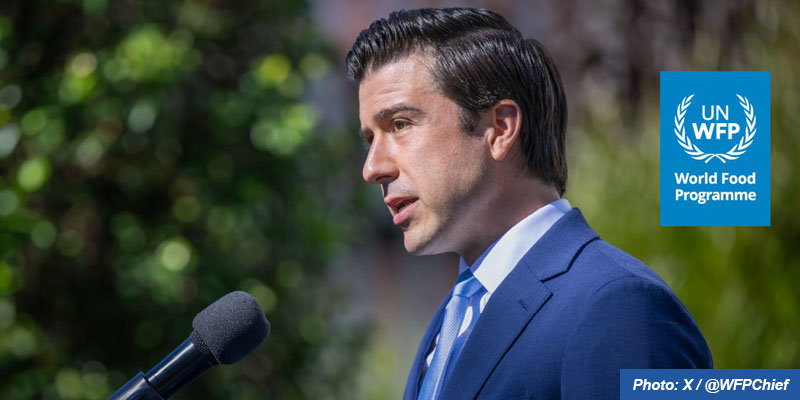
• Luke J. Lindberg assumed office as Executive Director of the United Nations World Food Programme (WFP) on October 26.
• The appointment was made in September by United Nations Secretary-General Antonio Guterres and the Director General of the Food and Agriculture Organisation (FAO), Qu Dongyu, after consultations with the WFP Board at a special session at WFP’s Rome headquarters.
• The Executive Director is appointed for fixed five-year terms and is responsible for the administration of WFP as well as the implementation of its programmes, projects and other activities.
• Lindberg, a US citizen, succeeds former Executive Director Cindy McCain.
• Before joining WFP, Lindberg served as Under Secretary for Trade and Foreign Agricultural Affairs at the United States Department of Agriculture.
• Reducing conflict is the single most effective way to tackle global hunger, Lindberg said, noting that conflict drives two-thirds of the acute food insecurity affecting 266 million people worldwide.
• Lindberg said his first trip as Executive Director would be to Sudan.
• Sudan, South Sudan and Somalia are the three operations where WFP is currently focussing.

What is the role of UN World Food Programme (WFP)?
• The World Food Programme (WFP) is a UN agency saving lives and changing lives, delivering food assistance in emergencies and working with communities to improve nutrition and build resilience.
• The WFP was formally established in 1963 by the FAO and the UN General Assembly on a three-year experimental basis. In 1965, the programme was extended to a continuing basis.
• The headquarters of WFP is situated in Rome.
• The WFP’s efforts focus on emergency assistance, relief and rehabilitation, development aid and special operations. Two-thirds of its work is in conflict-affected countries where people are three times more likely to be undernourished than those living in countries without conflict.
• On any given day, WFP has 4,300 trucks, 135 ships and about 55 aircraft on the move, delivering emergency assistance, relief and rehabilitation, development aid and special operations to people affected by conflict, droughts, floods, earthquakes, hurricanes, crop failures and other disasters. Two-thirds of our work is in conflict-affected countries, where people are three times more likely to be undernourished than those living in countries without conflict.
• The WFP was introduced in 1961 after the 1960 Food and Agriculture Organization (FAO) Conference, when George McGovern, director of the US Food for Peace Programmes, proposed establishing a multilateral food aid programme.
• The Executive Board is WFP’s supreme governing body. It comprises 36 States Members of the UN or Member Nations of the Food and Agriculture Organization of the United Nations (FAO), the Board provides intergovernmental support, policy direction and supervision of the activities of WFP.
• It works closely with its two Rome-based sister organisations, the FAO of the United Nations and the International Fund for Agricultural Development.
• The WFP partners with more than 900 national and international NGOs to provide food assistance and tackle the underlying causes of hunger.
• It is the largest humanitarian organisation implementing school-feeding programmes worldwide and has been doing so for more than 50 years.
• In 2020, the WFP won the Nobel Peace Prize for its efforts to combat hunger, contribution to bettering conditions for peace in conflict-affected areas and acting as a driving force in efforts to prevent the use of hunger as a weapon of war and conflict.
• WFP is headed by an Executive Director
• Powered by dedication and professionalism of 23,000 staff worldwide, the WFP has a presence in over 120 countries and territories.
• The operations are entirely funded through the generous voluntary contributions of donor governments, institutions, corporations and individuals. A total 93.5 per cent of all government contributions go directly to supporting life-saving and life-changing operations.