
- World
- Oct 30
What is Ocean Carbon Intelligence framework?

• The world must strengthen its understanding of the ocean’s carbon system if it is to safeguard one of the planet’s most important climate allies, according to the UN’s 2026 Climate Technology Progress Report released on October 28.
Who released the report?
• It was released by the UNEP Copenhagen Climate Centre in collaboration with the Climate Technology Centre and Network (CTCN) and the UN Framework Convention on Climate Change Technology Executive Committee (TEC).
Significance of the report
• Governments, researchers and investors increasingly look to ocean-based climate solutions to help address climate change.
• The report identifies sustained investment in ocean observation, data infrastructure and modelling as essential for closing critical knowledge gaps, strengthening climate decision-making and supporting the responsible development of ocean-based climate technologies.
• It warns that climate change is already affecting the ocean's ability to absorb and store carbon.
• Growing scientific evidence indicates that warming, acidification, and other pressures are altering the physical, chemical, and biological processes that underpin the ocean’s role as a global carbon sink.
• The report highlights both the opportunities and limitations of ocean-based climate technologies, including blue carbon ecosystem restoration and emerging marine carbon dioxide removal approaches.
• It focuses on the importance of the Ocean Carbon Intelligence framework.
Ocean carbon sink
• The ocean is fundamental to climate stability, livelihoods and sustainable development.
• It currently absorbs approximately 30 per cent of human-induced carbon dioxide emissions and about 90 per cent of the additional heat generated by climate change.
• In doing so, it has substantially moderated the pace and scale of global warming. This climate-regulating function, however, cannot be assumed to continue indefinitely.
• Ocean warming, acidification, deoxygenation, shifting circulation and nutrient patterns, pollution and ecosystem degradation are altering the physical, chemical and biological processes that govern carbon uptake and storage.
• The current rate of uptake is altering ocean chemistry and may reduce the efficiency of future carbon sequestration and long-term storage.
• These changes not only influence the ocean’s role as a carbon sink but also reduce the resilience of marine and coastal systems, placing growing pressure on ecosystems, coastal communities and ocean-dependent livelihoods.
• A weakening sink means that a greater share of anthropogenic CO2 remains in the atmosphere, further constraining the remaining global carbon budget.
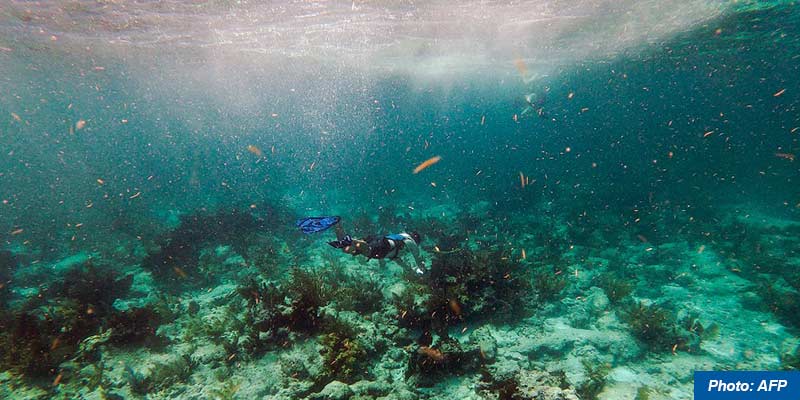
Ocean acidification
• The ocean’s ability to absorb CO2 also depends on alkalinity.
• Alkalinity refers to the ability of seawater to neutralise acid.
• It is mainly controlled by dissolved ions such as bicarbonate and carbonate ions, many of which ultimately come from the slow weathering of rocks on land and are transported to the ocean by rivers.
• The high proportions of bicarbonate and carbonate ions in seawater mean that an addition of acid is quickly neutralised with little change in pH.
• This is the acid-base buffer capacity, and it is responsible for the relatively constant pH of seawater.
• Continued uptake of anthropogenic CO2 is reducing this buffer capacity, causing an increase in ocean acidity and a reduction in the availability of carbonate ions, a process known as ocean acidification.
• As the acidity of the ocean increases, its capacity to absorb CO2 from the atmosphere decreases, impeding the ocean’s role in moderating climate change.
• The reduction in carbonate ions also hinders the production of chalky calcium carbonate shells and skeletons by organisms such as plankton, shellfish and corals.
Ocean Carbon Intelligence
• The 2026 CTPR introduces the concept of Ocean Carbon Intelligence as the foundation for enabling informed climate action and the more effective management of, and reliance on, marine environments for climate change adaptation and mitigation purposes.
• It is a framework that connects ocean science, monitoring technologies, data infrastructure and analytical tools to improve understanding of ocean carbon dynamics and support evidence-based climate action.
• Recognising that the ocean’s role in climate regulation, adaptation and mitigation pathways continues to evolve means there is a growing need to connect ocean observations, data, modelling, scientific knowledge and digital technologies in ways that can facilitate effective decision-making.
• This includes linking open-ocean observations with nearshore monitoring systems and terrestrial river-basin datasets to help address data sparsity in highly dynamic environments, such as upwelling systems and fjords, and to improve the attribution of carbon fluxes and compounding climate risks.
• By bridging the gap between ocean science, climate technologies and real-world implementation, OCI serves as a critical enabler of evidence-based decision-making and the effective design and delivery of ocean-climate solutions.