
- World
- Nov 02
UN’s peacekeeping mission in disputed Western Sahara ends after 35 years
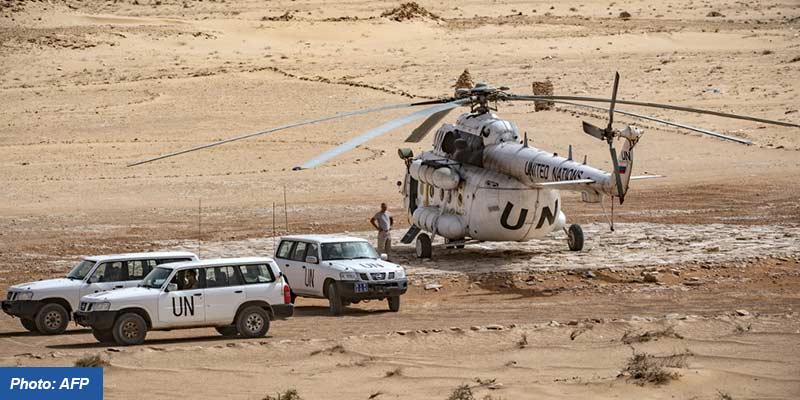
• The UN Mission for the Referendum in Western Sahara (MINURSO) for the disputed Western Sahara ceased its operations on November 1 after 35 years.
• The mission was established to support the settlement proposals and ceasefire reached by Morocco and Frente Polisario.
• The mission’s mandate expired after the Security Council failed to agree on its future.
• Morocco, which claims the Western Sahara as its own, welcomed the decision.
• The Frente Polisario has been seeking an independent state in Western Sahara.
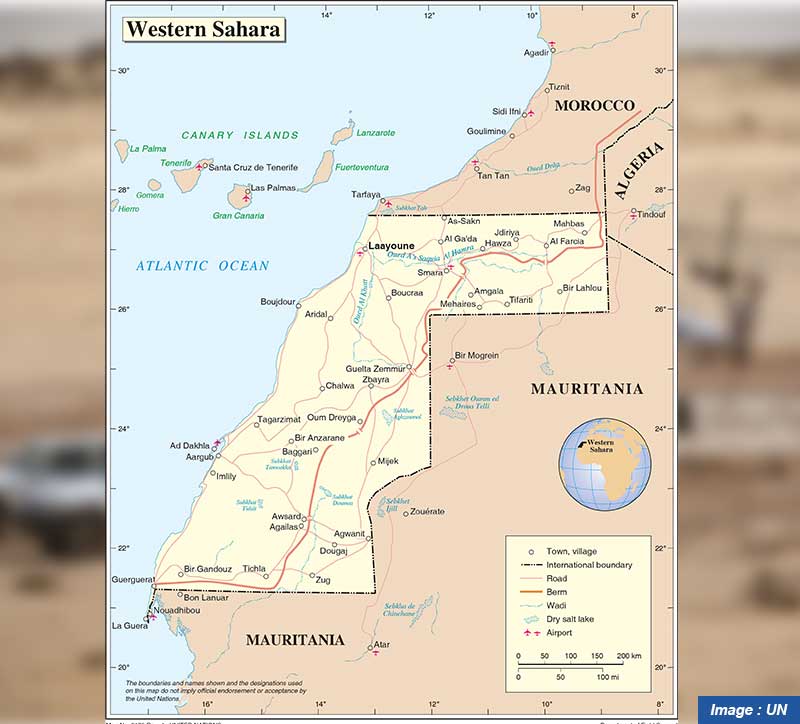
Western Sahara Conflict
• Western Sahara is located on the north-west coast of Africa bordered by Morocco, Mauritania and Algeria.
• Western Sahara has been on the United Nations list of Non-Self-Governing Territories since 1963.
• The colonial administration of Western Sahara by Spain officially ended in 1976.
• In the context of decolonisation, both Morocco and Mauritania laid a claim to the territory, a claim which was opposed by the Frente Popular para la Liberación de Saguia el-Hamra y de Río de Oro (Frente Polisario).
• When the 1975 Madrid Accords partitioned the Territory between Morocco and Mauritania, handing over Spain’s administrative responsibilities to the two countries, an armed conflict broke out between the Frente Polisario on one hand and Morocco and Mauritania on the other.
• Mauritania withdrew its claims on its portion of the territory in 1979, signing an agreement with Frente Polisario.
• Morocco subsequently came to administer the parts of the Territory vacated by Mauritania.
• The dispute escalated into an armed conflict that lasted more than 15 years and claimed more than 16,000 lives on both sides
• A ceasefire was signed in September 1991.
• The UN classifies Western Sahara as a “non-self-governing territory”.
• A revised settlement plan proposed by the United Nations after seven years of diplomatic consultations was rejected by one of the parties in 2004.
• In approving the current phase of direct negotiations in 2007, the UN Security Council called for “a just, lasting and mutually acceptable political settlement which will provide for the self-determination of the people of Western Sahara”.
• Western Sahara is the only remaining non-self-governing territory in Africa listed by the UN.
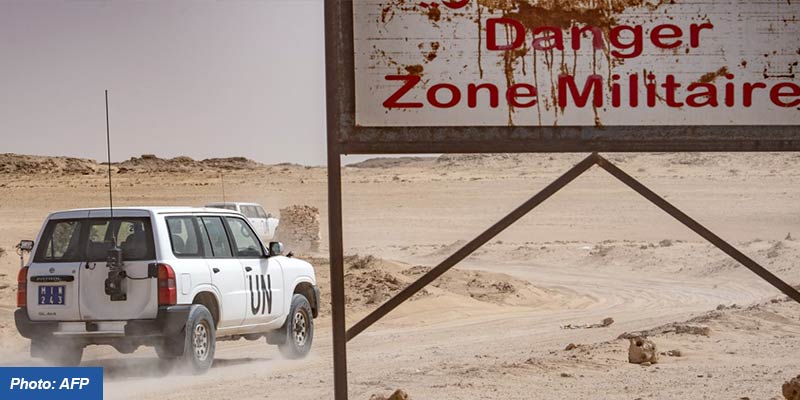
Establishment of MINURSO
• In 1985, the United Nations Secretary-General, in cooperation with the Organisation of African Unity (OAU) initiated a mission of good offices leading to “the settlement proposals”, which were accepted by Morocco and the Frente Polisario in August 1988.
• In 1990, the Security Council approved the Secretary-General’s report containing the full text of the settlement proposals and the outline of the Secretary-General’s Plan for implementing them.
• On April 29, 1991, the Security Council, in its resolution, decided to establish the United Nations Mission for the Referendum in Western Sahara (MINURSO).
In accordance with settlement proposals accepted by Morocco and the Frente Polisario movement, MINURSO was tasked with:
i) The monitoring of the ceasefire.
ii) Overseeing the exchange of prisoners of war.
iii) Repatriation of refugees.
iv) The eventual organisation of a free and fair referendum in which the people of Western Sahara would choose between independence and integration with Morocco.
• While the organisation of the referendum has not been possible to date, other requirements of the mandate have been pursued successfully.
• It contributed to peace and stability in Western Sahara by monitoring, investigating and reporting on the ongoing situation, and working with the parties to reduce tensions as they arise.
• Throughout its existence, MINURSO contributed in a significant way to reducing tensions between the parties and to the de-escalation of conflict activities.
• MINURSO has also been providing assistance to irregular migrants as well as humanitarian assistance in case of natural disasters.
• Since the deployment of MINURSO in September 1991, the ceasefire generally held until November 2020, when Frente Polisario announced its withdrawal from it and declared that it was resuming armed struggle in order to achieve its aims, in addition to pursuing diplomatic and legal advocacy of its cause.
• Twenty MINURSO personnel lost their lives in the mission.
What next for the region?
• Although MINURSO’s operations have now ended, the UN will keep working towards a peaceful resolution through the Secretary-General’s Personal Envoy, Staffan de Mistura.
• UN Secretary-General Antonio Guterres called on all parties “to respect and promote the rights of the people of Western Sahara”.
• When its mandate ended, the mission was headquartered in Laayoune, with nine team sites, four west of the berm and five east of it, and a liaison office in Tindouf.
• It had about 200 civilian staff, military observers and staff officers from over 35 countries, and a dedicated mine action capability.
• The end of the mission raises concerns about stability in the region.
• Rich in minerals and fisheries, Western Sahara is a vast desert territory roughly the size of Colorado along Africa’s northwestern Atlantic coast.
• Bringing Western Sahara under its full sovereignty has been a central objective of Morocco's foreign policy for decades.
• Algeria sees full Moroccan sovereignty over the territory as a major diplomatic defeat.
• The Frente Polisario seeks independence for the territory, which it considers the homeland of the Indigenous Sahrawi people.