
- World
- Nov 04
6.3 billion people now online, yet digital divides persist
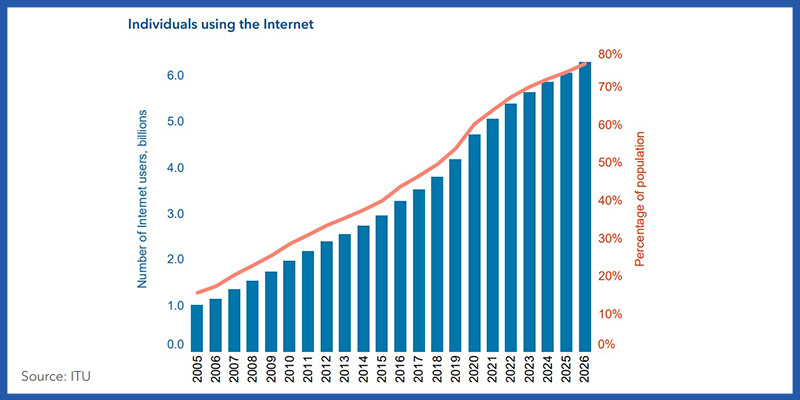
• An estimated 6.3 billion people, or 76 per cent of the world’s population, are using the Internet in 2026, according to Facts and Figures 2026, released by the International Telecommunication Union (ITU).
• The figure is up from a revised estimate of 6.1 billion people, or 74 per cent, in 2025.
• While surpassing three-quarters of the global population represents an important milestone on the way to universal connectivity, two billion people remain offline.
• Being offline means being shut out of countless opportunities, from education to employment.
• Closing gaps in the affordability, availability, quality and use of digital technologies and services is essential to achieving universal and meaningful connectivity, when everyone can use the internet under optimal conditions, at an affordable cost, wherever and whenever they need.
Key findings of the report:
• Gender: Globally, 79 per cent of men and 74 per cent of women use the internet. The ratio of women to men using the internet has increased to 0.94.
• Age: Young people remain more connected than the rest of the population, with 86 per cent of people aged 15 to 24 using the internet globally, compared with 74 per cent of the rest of the population.
• Location: The urban-rural divide has narrowed, although clear disparities persist. Globally, 82 per cent of urban residents have access to the internet, compared with 63 per cent in rural areas.
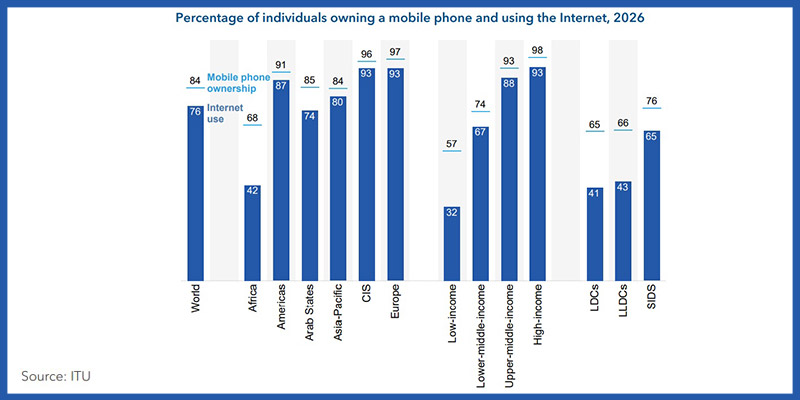
• Mobile phone ownership: Globally, 84 per cent of the population aged 10 and over own a mobile phone. Ownership exceeds 95 per cent in high-income countries, compared with 57 per cent in low-income countries.
• Mobile network coverage: An estimated 97 per cent of the global population lives within reach of at least a 3G network. However, coverage by more advanced technologies remains highly unequal. While 5G reaches 59 per cent of the global population, coverage ranges from 86 per cent in high-income countries to just 4 per cent in low-income countries.
• Monthly mobile use: Average monthly mobile broadband traffic per subscription is 20 GB in high-income countries, roughly six times the 3.4 GB in low-income countries.
• Affordability: The global median price of a data-only mobile broadband basket fell to 1.2 per cent of gross national income (GNI) per capita, while that of a fixed broadband basket declined to 2.3 per cent.

International Telecommunication Union
• The International Telecommunication Union (ITU) is a United Nations specialised agency for information and communication technologies – ICTs.
• ITU was founded in Paris in 1865 as the International Telegraph Union.
• It took its present name in 1932, and in 1947 became a specialised agency of the United Nations.
• ITU is the oldest agency in the UN family, connecting the world since the dawn of telegraph in 1865.
• The headquarters is situated in Geneva, Switzerland.
• ITU is the intergovernmental body responsible for coordinating the shared global use of the radio spectrum, promoting international cooperation in assigning satellite orbits, improving communication infrastructure in the developing world, and establishing the worldwide standards that foster seamless interconnection of a vast range of communications systems.
• From broadband networks to cutting-edge wireless technologies, aeronautical and maritime navigation, radio astronomy, oceanographic and satellite-based earth monitoring as well as converging fixed-mobile phone, Internet and broadcasting technologies, ITU is committed to connecting the world.
• ITU’s global membership includes 194 Member States as well as some 1,000 companies, universities, and international and regional organisations.