
- World
- Nov 06
European orbiter detects hints of volcanic activity on Mars
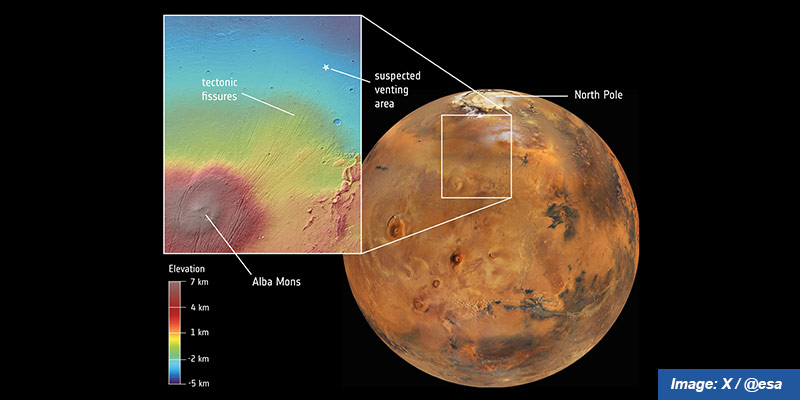
• New evidence from gas seeping above volcanic rifts suggests Mars is not geologically dead deep inside, but merely sleeping.
• Data from the ExoMars Trace Gas Orbiter (TGO) revealed signs of young volcanism on present-day Mars.
• Europe’s long-serving spacecraft detected a steady release of hydrogen chloride in the martian atmosphere.
• Fresh fissures along the Alba Mons region hint at active spots under the surface, where gases from inside the planet may be making their way up to the surface.
• An international research team’s new paper suggests that the release of hydrogen chloride comes from hot magma beneath the surface — a sign of dormant volcanism.
• The ExoMars Trace Gas Orbiter (TGO) first reported hydrogen chloride gas in the martian atmosphere back in 2021.
• This gas is commonly found escaping from magmatic vents on Earth, leading researchers to wonder whether the same was happening on Mars.
• It was early summer in the northern hemisphere of Mars when a team of researchers noticed spikes of hydrogen chloride where it shouldn’t have been, and during an odd season.
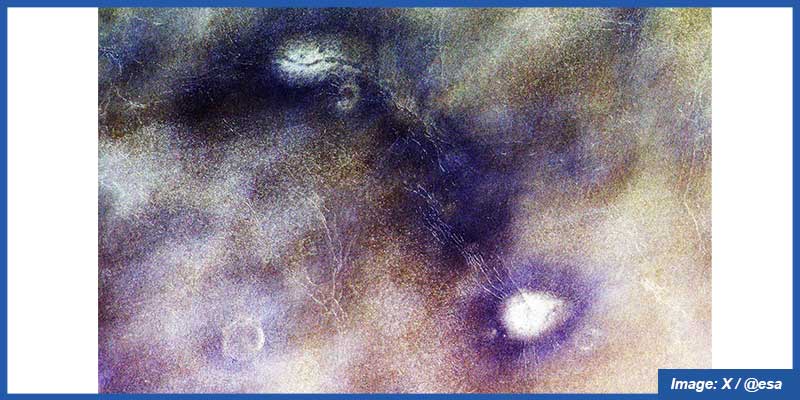
• This gas varies seasonally on Mars, reaching its maximum in the northern hemisphere winter, then mostly disappearing in the summer.
• Most of this variability appears to be linked with Mars’ dust and water cycles. Yet, there was one exception to this pattern, always in the same season and at the same place — above volcanic fissures on the flanks of the Alba Mons volcano, in early summer.
• Mars has the largest volcanoes in the solar system, but it is not known how active they are.
• Orbital imagery shows that some volcanoes appear to have been active within the last few million years, and seismometers have detected marsquakes — the earthquakes of Mars.
• Both facts point to the possibility of Mars being volcanically active.
• However, no new lava flows or eruptions have ever been observed.
ExoMars program
• The European Space Agency’s (ESA) Exobiology on Mars program (ExoMars program) is comprised of two missions:
i) The Trace Gas Orbiter launched in 2016.
ii) Mission carrying the Rosalind Franklin rover is scheduled to launch in 2028.
• Together they will address the question of whether life has ever existed on Mars.
• ExoMars gets its name from the term ‘exobiology’, the study of life beyond Earth.
• The Trace Gas Orbiter (TGO), undertaken in partnership between ESA and Russia's Federal Space Agency, Roscosmos.
• The TGO studies the Martian atmosphere for the presence of methane and other gases that may be present in small concentrations.
• Using the Electra radios, TGO plays an important role today in relaying scientific data from the surface of Mars to Earth on behalf of NASA’s Curiosity and Perseverance rovers.