
- World
- Nov 16
SpaceX pulls off first-ever spaceship catch
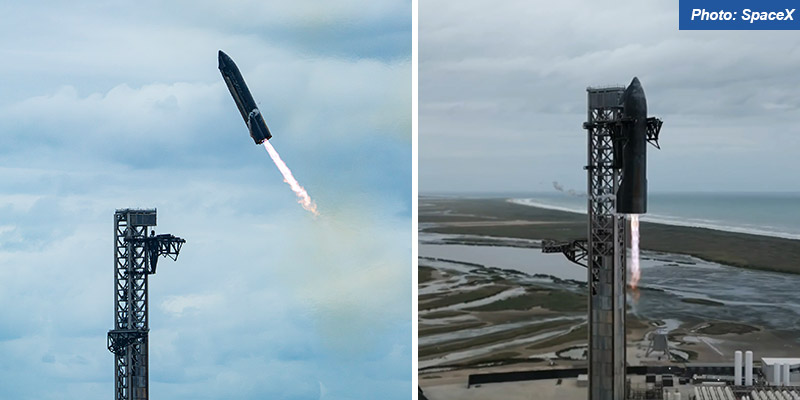
• SpaceX’s Starship 15 spacecraft returned from a 22-hour voyage in orbit and descended for the first time into the grasp of giant mechanical arms at the Texas tower it was launched from a day earlier.
• The 171-foot-tall (52-meter) Starship fell out of thick clouds over SpaceX’s Starbase launch site, reignited engines to flip itself vertical and slowly descended into the tower’s “Mechazilla” arms.
• The towering two-stage rocket’s super heavy booster carried Starship to space on November 13, lifting off from SpaceX’s Starbase, Texas, facilities.
• After making it to orbit, Starship deployed 26 Starlink V3 satellites.
• Starlink is a satellite internet constellation operated by SpaceX.
• Following payload deployment, Starship entered into a long coast phase around Earth.
• After monitoring its systems for more than 20 hours in space, the SpaceX flight control team prepared to return Starship to the launch site.
• Starship successfully relit a single Raptor sea-level engine and performed a deorbit burn, breaking out of orbit and beginning its path through Earth’s atmosphere.
• Starship navigated its way back to the east coast of Texas, flew a final swoosh maneuver out over the Gulf, and approached the same launch site it had just left 22.5 hours prior.
• After breaking through the clouds, three Raptor engines ignited for a landing flip and slow descent into Mechzilla’s waiting arms, which closed to catch Starship for the very first time.
• The success marked a milestone in the space industry’s long pursuit of fully reusable rocket systems.
• Until now, spaceships have been single-use items, discarded or destroyed after missions, making each launch an expensive resource-intensive venture.
• Founded by Elon Musk in 2002, SpaceX is a private American space transportation and services company that designs, manufactures, and launches rockets, spacecraft, and satellites.
• Starship is SpaceX’s next-generation launch vehicle.
• It was built to launch SpaceX’s Starlink satellites more frequently and carry future NASA missions to the Moon.