
- World
- Nov 19
Voyager 1 spacecraft reaches one light-day milestone
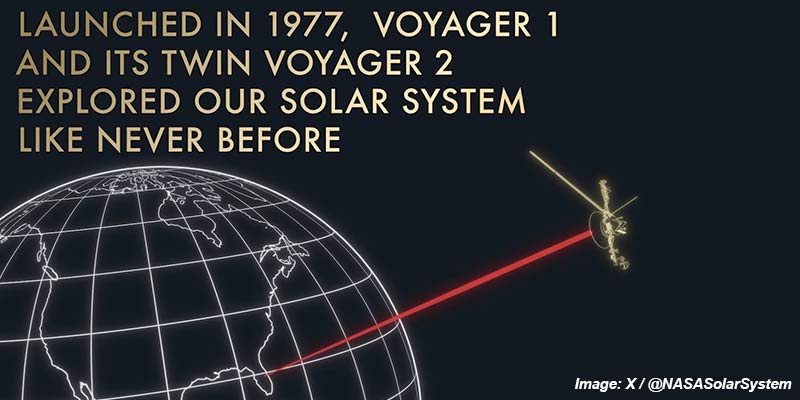
• NASA’s Voyager 1 spacecraft has scripted history by reaching a light-day from Earth on November 18.
• A light-day means the distance that light travels in 24 hours — about 26 billion kms (16 billion miles).
• No other spacecraft from Earth has accomplished this milestone.
When was Voyager 1 launched?
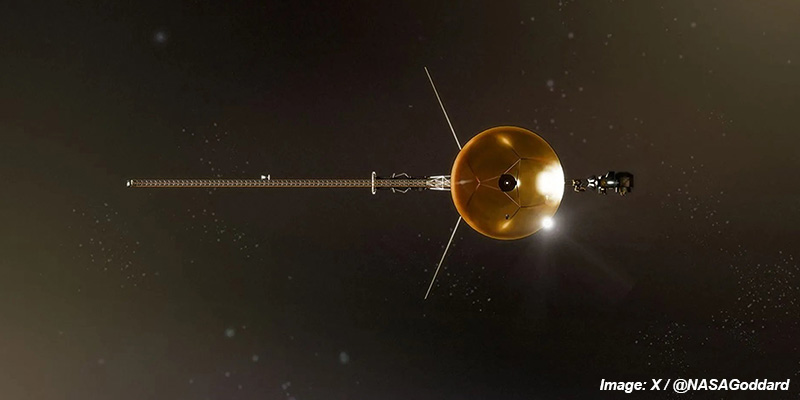
• NASA launched Voyager 1 on September 5, 1977 to fly by Jupiter and Saturn.
• In August 2012, Voyager 1 crossed into interstellar space, the region outside the heliopause, or the bubble of energetic particles and magnetic fields from the Sun.
• Voyager 1 was the first spacecraft to cross the heliosphere, the boundary where the influences from outside our solar system are stronger than those from our Sun.
• Voyager 1 is the first human-made object to venture into interstellar space.
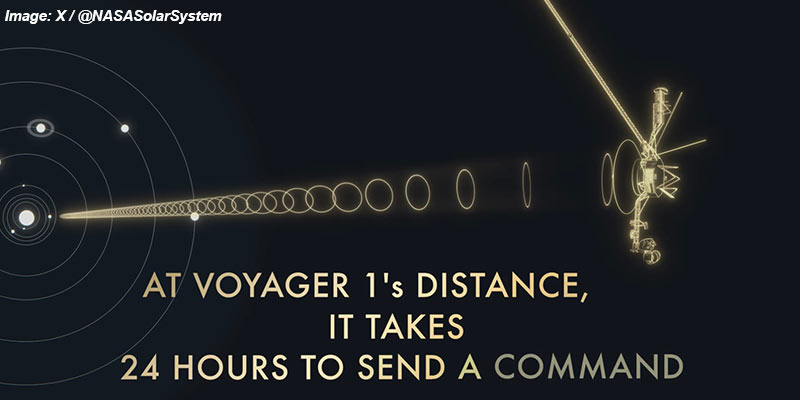
• Radio waves also travel at the speed of light. A message transmitted from Voyager 1 will take an entire day to reach the Earth.
• Voyager 1 is cruising at nearly 61,000 kph (38,000 mph) through the vacuum of space.
• Voyager 1 is headed toward a star more than 17 light-years away from Earth called Gliese 445. It is an obscure star now in the constellation Ursa Minor.
• Voyager 1 and Voyager 2 were designed to explore the outer planets by taking advantage of a planetary alignment that occurs once every 176 years.
• Voyager 1 was launched after Voyager 2 (August 20, 1977). Voyager 2 is the only spacecraft to visit Uranus and Neptune.
• But because of a faster route, Voyager 1 exited the asteroid belt earlier than its twin, and it overtook Voyager 2 on December 15, 1977.
• Voyager 2 is on pace to be one light-day away from Earth in nine more years, in November 2035.
• Both spacecraft continue to provide unique scientific observations of the environment beyond the heliosphere.
• Managed by Caltech in Pasadena, California, NASA JPL built and operates the Voyager spacecraft.
Why measure with light?
• Nothing in the universe travels faster than light.
• Moving through space about 186,000 miles every second, it crosses enormous distances in a given time period, whether it is a second, a day, or a year.
• A light-day is the distance that light will travel in 24 hours, or 25,902,068,356 kms (or 16,094,799,096 miles).
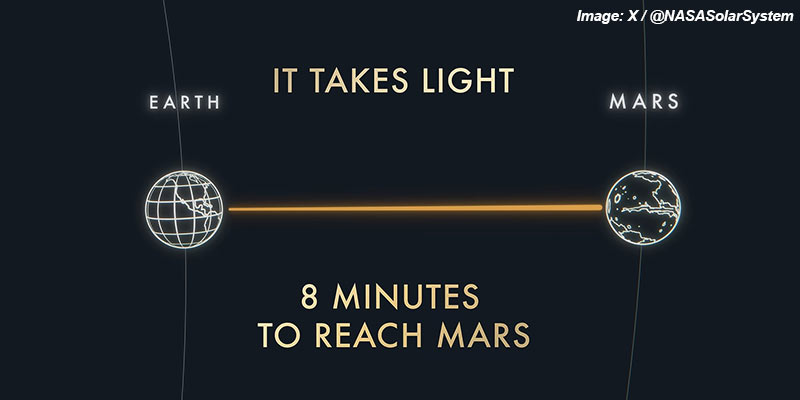
• The Moon is 384,400 kms (238,855 miles) from Earth, on average. The astronauts on the Artemis II mission took about three days to get there, but light can traverse that distance in 1.3 seconds.
• Neptune, the most distant planet in our solar system, with an average distance from Earth of about 4.5 billion kms (2.8 billion miles), is four light-hours and 10 light-minutes away. It took Voyager 2, traveling about 35,000 miles per hour, 12 years to reach Neptune.
• That is why light-year — how far light can travel in a year — is used to measure and convey the vastness of space.
• It is about 9.46 trillion kms (5.88 trillion miles).
• The closest neighbouring solar system to our own, the star Proxima Centauri and its one or more planets, is about 4.24 light-years away (or about 40.15 trillion kms).
• And the next-closest galaxy to our own Milky Way, the Andromeda galaxy, is about 2.5 million light-years away.