
- India
- May 04
- Arpan Tulsyan
Why women remain a political minority
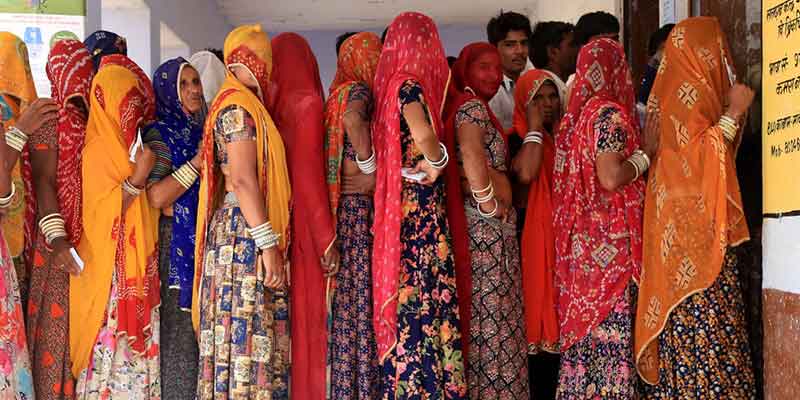
The female voter turnout trend has been steadily increasing since independence. The turnout gender gap, which was at 16.7 per cent in 1962, narrowed down to 1.79 per cent in 2014. This has prompted psephologists Prannoy Roy and Dorab Sopariwala to forecast in their book, The Verdict, that the 2019 election is likely to be dominated by female voters, who will overtake males. It is the result of sustained voter mobilisation campaigns and outreach programmes along with steps such as all-women polling booths.
The introduction of EVMs, which has curbed the practice of booth capturing, also seems to have contributed in encouraging women to come out to vote. In fact, in the 2014 election, female voters surpassed males in eight states and Union territories - Puducherry, Kerala, Tamil Nadu, Goa, Daman & Diu, Lakshadweep, Meghalaya and Manipur.
Despite this, there are only 92.7 eligible female voters for every 100 male voters. Population estimates from Census 2011 show that for every 100 male voters, there should be at least 97.2 female voters. This 4.5 per cent gap translates to 21 million missing female voters in absolute numbers. That means there are 38,000 missing women per constituency.
According to The Verdict, the top three states where women have been disenfranchised due to non-enrolment are Uttar Pradesh, Maharashtra and Rajasthan -contributing 10 out of 21 million missing women. In Uttar Pradesh alone, an average of 85,000 women per constituency will be deprived of their right to vote.
Besides voter participation, another area of concern is the gross under-representation of female candidates and MPs. In April 2014, women - who form 49 per cent of India’s population - constituted only 11.2 per cent of the total 788 MPs, as against a global average of 24.3 per cent. In 1962, only 6 per cent of India’s elected lawmakers were women. Thus in 56 years, the country has not been able to even double its abysmally low percentage. Most of our neighbouring countries exhibit better representation - Nepal (32.7 per cent), Afghanistan (27.3 per cent), Bangladesh (20.6 per cent) and Pakistan (20 per cent).
In the 2014 election, as many as 10 states did not elect any female candidates. However, in the past 10 years (1999 to 2019), the number of women who have contested the general election has increased from 284 to 556. The Women’s Reservation Bill, which proposes 33 per cent reservation for women in the Lok Sabha and state Assemblies, is one of the longest pending legislations in India. Despite being passed by the Rajya Sabha in 2010, it has yet not been tabled in the Lok Sabha.
In this regard, the record of the two biggest political parties have been equally dismal. The BJP’s election manifesto in 2014 had promised the passage of the Women’s Reservation Bill. Not only did the promise remain unfulfilled, of the 434 candidates that the party has fielded in 2019, only 55 are women. Likewise, although the Congress has promised 33 per cent reservation for women in government jobs and Parliament, only 50 of its 424 candidates are women. This amounts to only 12.6 and 11.7 per cent, respectively, and points to their promises being just a gimmick.
However, giving boost to women’s representation are two regional parties - the Biju Janata Dal (BJD) of Odisha and the Trinamool Congress (TMC) of West Bengal. While the BJD has reserved 33 per cent of its seats for female candidates, the TMC went one step further to give 41 per cent of its tickets to women. Besides, an all-women political party - seeking equal representation for women, i.e. 50 per cent in Parliament - is making its debut in this year’s election.
Such under-representation of women is a result of a male-dominated political climate in India, where money and muscle power continue to rule. Then there is a patriarchal mindset that perceives women as incapable of providing effective leadership. A political career requires unpredictable working hours, coupled with scrutiny of personal lives, further discouraging women to participate and address this historical gender imbalance. Hence, women belonging to political dynasties who have the necessary backing tend to succeed better and others are forced to deal with structural barriers and ceilings.
Thus, despite equal citizenship rights, women continue to be a political minority in India. On the one hand, millions of them are missing from the electoral list - a disenfranchisement that is unparalleled in the developed world - and on the other, they don’t enjoy equality of representation and participation in political decision-making when compared to males.
At the grassroots level, 33 per cent of Panchayati Raj seats were reserved for women in 1993. In 2009, 50 per cent reservation was approved by the Union cabinet. As many as 14 states have increased this reservation to more than 50 per cent, with Jharkhand leading the way at 58 per cent. Although this affirmative action has created a space for women in the political arena, a majority of them continue to be proxy candidates for their male family members, who wield de facto power. Effective political participation still eludes women as no sustained effort is being made towards capacity building.
The Panchayati Raj experience shows that it is not only imperative that the representation of women in Assemblies increase, but that this representation is only the first step towards enhancing women’s political participation.
The real challenge of achieving an equal participation in decision-making will go beyond ensuring representation. This under-representation, as a voter or an elected representative, is not just a personal loss for women, but it deprives society as a whole from benefiting from the true potential of decision-making and leadership of half its population.
Arpan Tulsyan is a Senior Research Scholar at the Department of Social Work, Delhi University. The views expressed here are personal.