
- India
- May 23
Modi wave sweeps across geographies
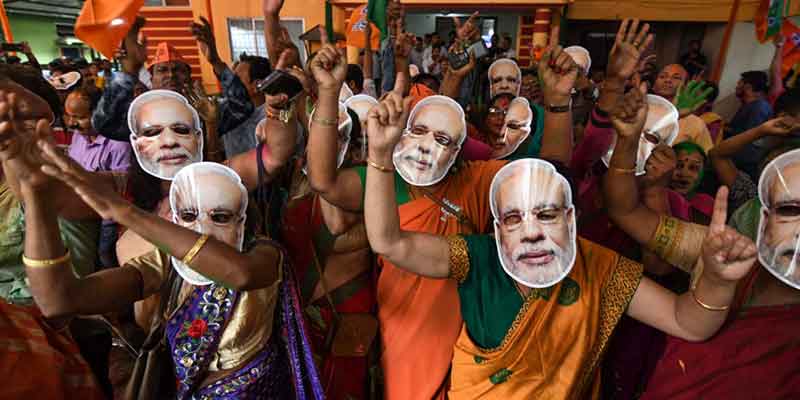
Prime Minister Narendra Modi on May 23 led the BJP to a super-sized victory for a second term in office, as his message of nationalism, security, Hindu pride and a New India was wholeheartedly embraced by voters across large swathes of the country.
The BJP got an absolute majority, bagging 303 seats in the 543-member Lok Sabha, surpassing its 2014 performance when it won 282 seats.
With the election establishing the 68-year-old Modi as the most popular leader in decades, the BJP and its allies in the NDA clinched 350 seats as against their previous 336 seats.
Such was the force of the BJP wave that even Congress president Rahul Gandhi lost in his bastion of Amethi in Uttar Pradesh to Smriti Irani, but in a consolation prize won the Wayanad seat in Kerala. Former prime minister and JD(S) supremo H.D. Deve Gowda also bit the dust when he lost the Tumkur seat in Karnataka, where the BJP bagged 25 of the 28 seats.
After Jawaharlal Nehru and Indira Gandhi, Modi is the third prime minister - and the first non-Congress one - who has been able to retain power for a second term with full majority in the Lok Sabha.
The victory margin left the combined Opposition in the dust, with the Congress topping the group winning 52 seats.
Much like the 16th Lok Sabha in 2014, the lower house of Parliament may be again bereft of the leader of opposition since the Congress fell short of the 54-seat mark needed for the status.
The results are a ringing endorsement of Modi’s popularity, his government’s achievements in the past five years and his campaign, which centred around national security following the Balakot air strikes, nationalism and Hindutva. He also relentlessly attacked the Congress party for what he called its dynastic legacy, and blamed it for the country’s woes, including endemic corruption.
The Opposition had criticised the BJP campaign as divisive and polarising.
Still, the results show that the Modi wave and the party’s brilliant election management swept across geographies, caste lines, age, gender and economic status.
In the politically critical state of Uttar Pradesh, where the SP-BSP combine had posed a stiff challenge, the BJP won 62 of the 80 seats at stake. Although the BJP had won 71 seats in 2014, the performance is far better than the 30-40 seats many exit polls had forecast.
The Modi wave not only swept through the Hindi heartland and Gujarat, as was expected, but also bulldozed through West Bengal, Odisha, Maharashtra and Karnataka. Only Kerala, Tamil Nadu and Andhra Pradesh appeared untouched. Even in Telangana, where it was expected to fare poorly, the BJP won four seats, while the TRS got nine.
The results were staggering for the BJP in the Hindi-speaking states, including those where Congress had won in the recent Assembly elections: it swept all but one of the 29 seats in Madhya Pradesh, 24 out of 25 in Rajasthan and nine out of 11 in Chhattisgarh. Similar was the story in Bihar, Haryana, Himachal Pradesh, Uttarakhand, Maharashtra and Delhi.
The BJP also made huge gains in Odisha, West Bengal and Telangana.
Congress ally DMK won 23 of the 38 seats in Tamil Nadu, while in Kerala, the Congress-led UDF won 19 out of 20 seats.
Final tally
BJP 303
Congress 52
DMK 23
TMC 22
YSRCP 22
Shiv Sena 18
JD(U) 16
BJD 12
BSP 10
TRS 9
LJP 6
SP 5
NCP 5
Independents 4
TDP 3
Indian Union Muslim League 3
CPM 3
JKNC 3
Shiromani Akali Dal 2
AIMIM 2
Apna Dal(S) 2
CPI 2
AAP 1
AJSU Party 1
JMM 1
Kerala Congress (M) 1
Mizo National Front 1
AIADMK 1
AIUDF 1
JD(S) 1
Naga People’s Front 1
National People’s Party 1
NDPP 1
RLP 1
Revolutionary Socialist Party 1
Sikkim Krantikari Morcha 1
Viduthalai Chiruthaigal Katchi 1