
- World
- Nov 30
- Skand Ranjan Tayal
Korean peninsula’s nuclear hangover
The post-World War II ideological struggle between the US and the Soviet Union led to the partition of two nations - Germany in Europe and Korea in Northeast Asia. Both these nations had rather homogeneous societies with one language, one race and one culture and there was no demand of separation from within their citizens. Both these nations suffered as victims of great power rivalry.
The Korean peninsula was united and ruled by the Choson dynasty since the 14th century till 1910 when it became a Japanese colony. After Japan’s defeat, Soviet forces took the surrender of Japanese forces on the Korean peninsula north of the 38th Parallel and US forces took the surrender south of the 38th Parallel. Both the people of Korea and the international community saw this division as a temporary administrative arrangement.
The Korean question was a hot subject of discussion in the newly created United Nations (UN), which resolved to hold elections in the entire Korean peninsula in 1948. By that time the communist administration headed by Kim Il-sung put in place by the USSR in the North and the Syngman Rhee-led administration ordained by the US in the South had become well entrenched.
As free and fair elections are not part of Leftist methodology, North Korea did not agree for elections under UN supervision. Consequently, elections were held in May 1948 in the southern part only and a government led by Syngman Rhee was recognised as the lawful regime of the Republic of Korea (RoK) by the UN in December 1948. In the North, the Democratic People’s Republic of Korea (DPRK) was declared with Kim Il-sung as the prime minister, resulting in both de facto and de jure partition of the country.
From the very beginning, the governments of both Koreas proclaimed their belief in unification and to this day both DPRK and RoK have Ministries for Reunification. Chairman Kim Il-sung attempted unification by force and attacked South Korea in June 1950 with the tacit support of China and the Soviet Union. The North Korean army advanced rapidly and the US intervened under the fig leaf of UN command to rescue the defeated South Korean army. The war eventually came to a standstill in an armistice in July 1953 with the creation of a De-militarised Zone (DMZ) roughly along the 38th Parallel. The situation on the ground is the same till now with heavily armed forces facing each other along the DMZ. South Korean forces are augmented by 28,500 US troops permanently stationed in the country. The only outcome of the tragic war was the death of more than 1.2 million soldiers from the Koreas, the US and China without any significant change in the border between the two warring siblings.
Since the end of the Korean War till the end of the 1960s, the two Koreas engaged in a bitter ideological conflict dotted with clashes at the border, terrorist acts by North Korea and ever-existing threat of war breaking out anytime.
The unexpected visit of US President Richard Nixon to Beijing in 1972 shocked the two Koreas as they had always considered their patrons - the US and China - as implacable ideological foes. That propelled the two Koreas towards unprecedented talks between their own intelligence agencies. The result was the first ever attempt to peacefully manage the relations, and in a joint statement, the Principles for Reunification were agreed.
However, deep ideological differences remained and the next move to narrow down differences was taken only after the collapse of the Soviet Union. This led in 1991 to the Agreement on Reconciliation and Non-aggression as well as a Joint Declaration on the Denuclearisation of the Korean Peninsula. The two Koreas were also admitted to the UN as two sovereign countries. India, as a non-aligned country friendly with both parties, played an important facilitating role in the UN in the admission process.
In the 1990s, North Korea progressed rapidly on the path of developing nuclear weapons, resulting in heightened tension with the US and South Korea. Despite these concerns, liberal South Korean President Kim Dae-jung embarked on a ‘Sunshine Policy’ towards North Korea in 1998. This reconciliatory approach towards the North resulted in the first ever Inter-Korean Summit with the then North Korean supremo Kim Jong-il. The US under President George W Bush, however, did not support the Sunshine Policy and in 2002 branded North Korea as a member of the ‘Axis of Evil’.
In October 2006, North Korea conducted its first nuclear test and it further complicated relations with the South. In spite of strong American reservations, South Korean President Roh Moo-hyun went to Pyongyang in October 2007 and signed a peace declaration with Kim Jong-il.
The liberal Sunshine Policy ended with the return of conservative presidents in South Korea since 2008.
Moon Jae-in - a liberal and human rights advocate - was elected president of South Korea in May 2017 with a promise to return to the Sunshine Policy. He opened back channels with the young North Korean leader Kim Jong-un, who responded favourably.
Events moved rapidly with North Korean participation in the Winter Olympics in South Korea in February 2018. On 27 April, the two Korean leaders met at Panmunjom in the DMZ and issued a historic declaration, laying a roadmap for future détente between the two sides. The two leaders pledged to work towards complete denuclearisation of the Korean peninsula and vowed to soon declare a formal end to the Korean War.
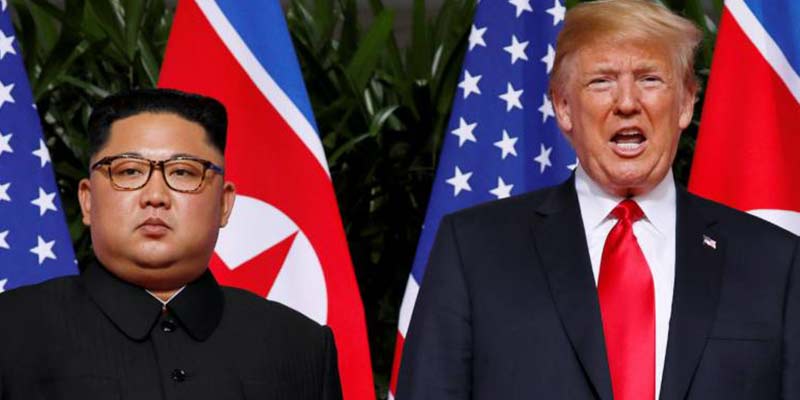
Moon again met Kim on 26 May to iron out differences between the US and North Korea prior to the Trump-Kim Singapore Summit scheduled for 12 June. To sustain the inter-Korean thaw, Moon had his third meeting with Kim in Pyongyang in September and agreed for rapid reduction of forces and equipment from the North-South border. Moon also became the first South Korean leader to address the North Korean people when he exhorted 1.5 lakh spectators at the Arirang festival in Pyongyang to unite as Koreans.
The warming relations between the two Koreas are being watched warily by both the US and China as they have their own vital stakes in the region. But it is clear that the leaderships on both sides of the DMZ have decided to take the future of their countries in their own hands and not to be dictated by external powers.
Moon and Kim have developed a comfortable personal relationship and share a vision of a peaceful and prosperous Korean peninsula. They have kept ideological differences on the back burner and embarked on a course of goodwill and friendship between the leadership as well as people of the two sides.
Moon’s foremost objective is to ensure that there is no war on the Korean peninsula and for that tensions with the North need to be erased. There is no talk of political integration, thus allaying any apprehension on the part of Kim for his regime’s survival. Wisely, the two leaders have identified reunification as a desirable but distant goal; the first steps being towards economic integration.
The Black Swan in this scenario is the fulfilment or otherwise of President Donald Trump’s quest for a denuclearised North Korea. If there is insufficient progress on this issue, Trump’s reaction would be unpredictable and it could draw South Korea in a direct conflict between its ally the US and blood brother North Korea. Whether the ongoing détente between South and North Korea can survive a potential conflict between the US and North Korea on denuclearisation is a question only the future can answer.
Skand Ranjan Tayal was India’s Consul General in Johannesburg, Houston, and ambassador of India to Uzbekistan and the Republic of Korea. The views expressed here are personal.
did you know?According to a 2017 Unification Perception Survey, more than half of South Koreans believe that reunification is necessary
