
- India
- Jan 06
Explainer / Decoding carbon numbers
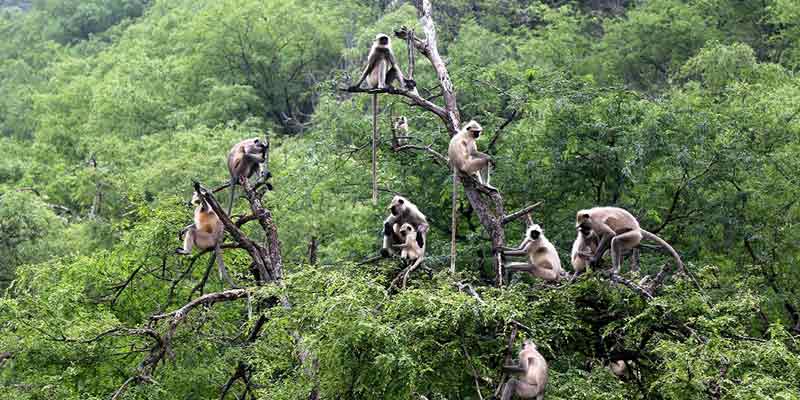
The State of Forest Report (SFR) 2019, which hints at an increase in the carbon stock captured in Indian forests in the past two years, also shows why it is going to be an uphill task for India in meeting one of its international obligations on climate change.
As part of its contribution to the global fight against climate change, India has committed itself to creating an “additional carbon sink of 2.5-3 billion tonnes of carbon dioxide (CO2) equivalent” by 2030.
That is one of the three targets India has set for itself in its climate action plan, called Nationally Determined Contributions (NDCs), which every country has to submit under the 2015 Paris Agreement. The other two relate to an improvement in emissions intensity, and an increase in renewable energy deployment.
India has said it would reduce its emissions intensity (emissions per unit of GDP) by 33-35 per cent by 2030 compared to 2005 levels.
It has also promised to ensure that at least 40 per cent of its cumulative power generation in 2030 would be done via renewable energy.
What is the link between forests and carbon?
* Forests, by absorbing CO2 from the atmosphere for the action of photosynthesis, act as a natural sink of carbon.
* Together with oceans, forests absorb nearly half of the annual global CO2 emissions. In fact, the carbon currently stored in forests surpasses all the carbon emitted in the atmosphere since the start of the industrial age.
* An increase in the forest area is one of the most effective ways of reducing the emissions that acquire in the atmosphere every year.
How do the latest forest data translate into carbon equivalent?
* The latest forest survey shows that the carbon stock in India’s forests (not including tree cover outside of forest areas) have increased from 7.08 billion tonnes in 2017, when the last such exercise had been done, to 7.124 billion tonnes now.
* This translates into 26.14 billion tonnes of CO2 equivalent as of now.
* It is estimated that India’s tree cover outside of forests would contribute another couple of billion of tonnes of CO2 equivalent.
How challenging does this make it for India in meeting its target?
* An estimate by the Forest Survey of India (FSI) last year had projected that, by 2030, the carbon stock in forests as well as tree cover was likely to reach 31.87 billion tonnes of CO2 equivalent in the business-as-usual scenario.
* An additional 2.5-3 billion tonnes of sink, as India has promised to do, would mean taking the size of the sink close to 35 billion tonnes of CO2 equivalent.
* Considering the rate of growth of the carbon sink in the past few years, that is quite a stiff target India has set for itself. In the past two years, the carbon sink has grown by just about 0.6 per cent. Even compared to 2005, the size of carbon sink has increased by barely 7.5 per cent.
* To meet its NDCs target, even with the most optimistic estimates of carbon stock trapped in trees outside of forest areas, the sink has to grow by at least 15-20 per cent over the next decade.
So, what is the way forward?
There are two key decisions to be made in this regard.
1. Selection of the baseline year
* The baseline year can affect the business-as-usual (BAU) projections for 2030. BAU projections are obtained using policies that existed in the baseline year. Now, there has been a far greater effort in recent years to increase the country’s forest cover.
* So, a 2015 baseline would lead to a higher BAU estimate for 2030 compared to a 2005 baseline when less efforts were being made to add or recreate forests.
* The FSI projections made last year used a 2015 baseline. If the 2005 baseline is used, India’s targets can be achieved relatively easily.
* India’s emissions intensity target uses a 2005 baseline, so there is an argument that the forest target should also have the same baseline. But there is a strong demand for a 2015 baseline as well, so that it results in some concrete progress in adding new forest cover.
* When India announced its NDCs in 2015, it did not mention the baseline year. It has to decide on it before it reconfirms its NDC targets ahead of the next climate change meeting in Glasgow towards the end of 2020.
2. Addition of the contribution of the agriculture sector to carbon sink.
At that time, India would also have to define whether it wants to count the carbon sink in the agriculture sector in its target. The NDC specifically mentions that and “additional” 2.5-3 billion tonnes of carbon sink would be created through “additional forest and tree cover by 2030”, but environment ministry officials insist that tree cover outside forest areas must include agriculture as well.
Manorama Yearbook app is now available on Google Play Store and iOS App Store