
- India
- Mar 22
Modi, Morrison hold second India-Australia Virtual Summit
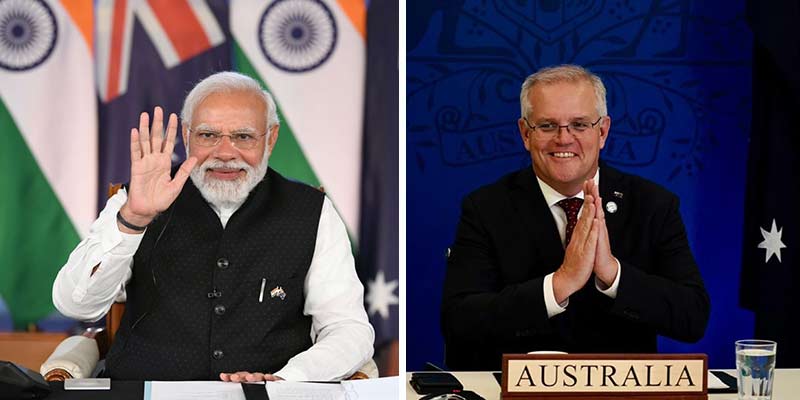
Prime Minister Narendra Modi and his Australian counterpart Scott Morrison held the second India-Australia Virtual Summit on March 21.
They welcomed the considerable progress made in the Comprehensive Economic Cooperation Agreement (CECA) negotiations. India and Australia aim to conclude an interim CECA at the earliest and work towards an ambitious, full CECA by the end of the year to enhance trade and investment ties and deepen the CSP.
Highlights of the summit:
• The leaders welcomed the substantial progress in deepening political, economic, security, cyber, technology and defence cooperation.
• Both sides agreed to establish the General Rawat India-Australia Young Defence Officer Exchange Programme.
• As many as 29 antiquities have been repatriated to India by Australia. These artefacts comprise sculptures, paintings and photographs, across centuries, some dating back to the 9th-10th century, from different parts of India. The artefacts include 12th century Chola bronzes, 11th-12th century Jain sculptures from Rajasthan, 12th-13th century sandstone Goddess Mahisasuramardini from Gujarat, 18th-19th century paintings and early gelatin silver photographs.
• Both countries signed an MoU for joint cooperation on critical minerals projects between Khanij Bidesh India Ltd. (KABIL), India and Critical Minerals Facilitation Office (CMFO), Australia.
• They are looking forward to an early resolution of the issue of taxation of offshore income of Indian firms under the India Australia Double Taxation Avoidance Agreement (DTAA).
• Modi and Morrison underscored their commitment to encouraging nationally appropriate actions to reduce emissions to address climate change, energy security and job creation, and continuing international collaboration, including through the Quad, the G20, the UNFCCC and International Solar Alliance.
• They welcomed the extension of the Australia-India Strategic Research Fund (AISRF) – a pillar of collaboration on science, technology and research – and the commitment to build on the successful 2021 India Australia Circular Economy Hackathon.
• They welcomed the inaugural India-Australia Foreign Ministers’ Cyber Framework Dialogue held between Minister Payne and Minister S. Jaishankar last month.
• Both leaders welcomed the agreement to establish the India-Australia Centre of Excellence for Critical and Emerging Technology Policy in Bengaluru.
• They underscored their commitment to the cooperation between India, Australia, Japan and the United States on advancing the Quad’s positive and ambitious agenda to promote regional stability and prosperity.
India-Australia relations
• The historical ties between India and Australia started immediately following European settlement in Australia from 1788. All trade to and fro from the penal colony of New South Wales was controlled by the British East India Company through Kolkata.
• India and Australia established diplomatic relations in the pre-Independence period, with the establishment of India Trade Office in Sydney in 1941. The end of the Cold War and simultaneously India’s decision to launch major economic reforms in 1991 provided the first positive move towards development of closer ties between the two nations.
• The bilateral relationship has undergone evolution in recent years, developing along a positive track, into a strategic partnership.
• Building on the elevation of relations with Australia from a Strategic Partnership to a Comprehensive Strategic Partnership (CSP) in June 2020, the year 2021-22 saw increasing depth and breadth of engagements in the bilateral, trilateral and plurilateral formats, with progress made on various initiatives agreed under the CSP, including establishment of new mechanisms for cooperation.
• Bilateral mechanisms include high level visits, Annual Meetings of Prime Ministers, Foreign Ministers’ Framework Dialogue, Joint Trade & Commerce Ministerial Commission, India-Australia ‘2+2’ Foreign Secretaries and Defence Secretaries Dialogue, Defence Policy Talks, Australia-India Education Council, Defence Services Staff Talks, Energy Security Dialogue, JWGs on different issues, etc.
• India-Australia Joint Ministerial Commission (JMC) was established in 1989 to enable interaction at a government and business level on a range of trade and investment related issues.
• A Civil Nuclear Cooperation Agreement between the two countries was signed in September 2014. The agreement came into force from November 13, 2015. It ensures that Uranium mining companies in Australia may fulfil contracts to supply Australian uranium to India for civil use with confidence that exports would not be hindered by domestic legal action challenging the consistency of the safeguards applied by the IAEA in India and Australia’s international non-proliferation obligations.
• The fourth edition of bilateral maritime Exercise AUSINDEX between the Indian Navy and the Royal Australian Navy (RAN) was held in September 2021 off Australia’s Northern Territory coast.
• A ‘Joint Guidance for the Australia–India Navy to Navy Relationship’ was signed between the Indian Navy and Royal Australian Navy in August 2021.
• Both sides have formally launched the resumption of negotiations to conclude an India-Australia Comprehensive Economic Cooperation Agreement (CECA).
• At present, the bilateral trade volume is estimated at around $12 billion and it is expected to witness an increase following the signing of the early harvest trade deal on goods and services.
Manorama Yearbook app is now available on Google Play Store and iOS App Store
UPSC - India, Australia relations