
- India
- Apr 03
India, Australia ink Economic Cooperation and Trade Agreement
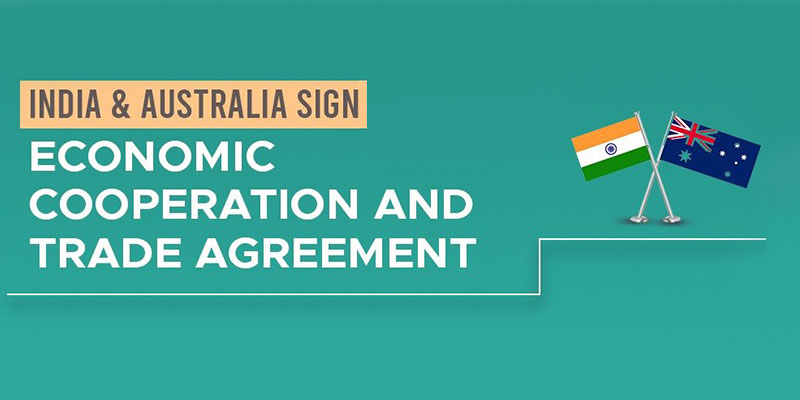
India and Australia signed Economic Cooperation and Trade Agreement under which Canberra would provide duty-free access in its market for over 6,000 broad sectors of India, including textiles, leather, furniture, jewellery and machinery.
The agreement is likely to be implemented in about four months.
The India-Australia Economic Cooperation and Trade Agreement (Ind-Aus ECTA) was inked by Commerce and Industry Minister Piyush Goyal and Australian Minister for Trade, Tourism and Investment Dan Tehan in a virtual ceremony, in the presence of Prime Minister Narendra Modi and his Australian counterpart Scott Morrison.
The agreement would help in taking bilateral trade from $27.5 billion at present to $45-50 billion in the next five years.
The pact will contribute towards large employment generation, which is estimated at around 10 lakh over the next 5-7 years as the labour-intensive sectors are likely to gain the most.
India-Australia trade relations
• India and Australia established diplomatic relations in the pre-Independence period, with the establishment of India Trade Office in Sydney in 1941. The end of the Cold War and simultaneously India’s decision to launch major economic reforms in 1991 provided the first positive move towards development of closer ties between the two nations.
• The bilateral relationship has undergone evolution in recent years, developing along a positive track, into a strategic partnership.
• Building on the elevation of relations with Australia from a Strategic Partnership to a Comprehensive Strategic Partnership (CSP) in June 2020, the year 2021-22 saw increasing depth and breadth of engagements in the bilateral, trilateral and plurilateral formats, with progress made on various initiatives agreed under the CSP, including establishment of new mechanisms for cooperation.
• Australia is the 17th largest trading partner of India, while New Delhi is Canberra’s 9th largest partner. India’s goods exports were worth $6.9 billion and imports aggregated to $15.1 billion in 2021.
• India and Australia are partners in the trilateral Supply Chain Resilience Initiative (SCRI) arrangement along with Japan which seeks to enhance the resilience of supply chains in the Indo-Pacific Region.
• Further, India and Australia are also members of the Quad, also comprising the US, and Japan, to further enhance cooperation and develop partnership across several issues of common concern.
• The India-Australia ECTA will further cement the already deep, close and strategic relations between the two countries and will significantly enhance bilateral trade in goods and services, create new employment opportunities, raise living standards, and improve the general welfare of the peoples of the two countries.
• The interim deal will pave the way for a Comprehensive Economic Cooperation Agreement (CEPA) with Australia. It will be the second such pact after the one with the United Arab Emirates (UAE), which was signed in February.
Highlights of the agreement:
• There will be eight chapters in the agreement — goods, services, rules of origin, sanitary and phytosanitary measures, technical barriers to trade, customs procedure and trade facilitation, legal and institutional issues and movement of natural persons, and trade remedies.
• Both countries will facilitate the recognition of professional qualifications, licensing, and registration procedures between professional services bodies.
• The ECTA provides for an institutional mechanism to encourage and improve trade between the two countries.
• The ECTA covers almost all the tariff lines dealt in by India and Australia respectively.
• Australia trades in about 6,500 tariff lines, while India has over 11,500 tariff lines.
• India will benefit from preferential market access provided by Australia on 100 per cent of its tariff lines. This includes all the labour-intensive sectors of export interest to India such as gems and jewellery, textiles, leather, footwear, furniture, food, and agricultural products, engineering products, medical devices and automobiles.
• On the other hand, India will be offering preferential access to Australia on over 70 per cent of its tariff lines, including lines of export interest to Australia which are primarily raw materials and intermediaries such as coal, mineral ores and wines, etc.
• The agreement will have a safeguard mechanism that includes stricter rules of origin to prevent any routing of products from a third country; safeguard mechanism to deal with any unusual surge in imports; and similar norms for the steel sector.
• For the pharma segment, the pact would provide fast-track approvals and fast-track quality assessment/inspections of manufacturing facilities.
• In the services sector, benefits for India include post study work visa of 2-4 years for Indian students on reciprocal basis, and work and holiday visa arrangement for young professionals.
• The pact will create new opportunities for jobs and businesses in both countries, while laying the foundations for a full free trade agreement.
Manorama Yearbook app is now available on Google Play Store and iOS App Store