
- India
- Dec 16
Govt introduces VB-GRAMG Bill in Lok Sabha
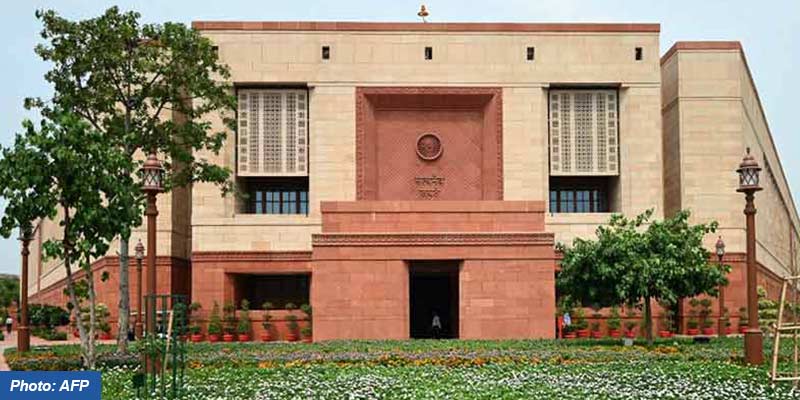
• Union Minister Shivraj Singh Chouhan introduced the ‘Viksit Bharat-Guarantee for Rozgar and Ajeevika Mission (Gramin)’ (VB-GRAMG) Bill, 2025 in Lok Sabha on December 16.
• Opposition members strongly opposed the proposed legislation at the introduction stage and pressed for sending the Bill to a parliamentary panel for greater scrutiny.
Why the govt brings in new Bill?
• Post-Independence, rural development policies in India focused on addressing poverty, improving agricultural productivity, absorbing surplus and under-employed rural labour through various wage employment schemes, strengthening rural infrastructure, etc.
• Over the decades, the approaches have evolved, ranging from community development programmes to employment generation schemes to uplift rural communities.
• The nature of rural employment generation schemes has undergone continuous change based on the evolving socio-economic scenario.
India’s rural employment schemes have evolved through several phases, starting with early programmes, like, the Rural Manpower Programme (1960s) and Crash Scheme for Rural Employment (1971).
• In the 1980s, the National Rural Employment Programme and Rural Landless Employment Guarantee Programme were launched, later merged into Jawahar Rozgar Yojana in 1993 which consolidated into the Sampoorna Grameen Rozgar Yojana in 1999, to streamline structured rural employment efforts.
• The Employment Assurance Scheme was introduced in 1993 to provide work during agricultural lean seasons.
• The Food for Work Programme, initiated in 1977-78 and later expanded as the National Food for Work Programme in 2004, provided food grains as wages for manual labour on public works, targeting most backward districts to improve both food security and employment.
• Notably, the Maharashtra Employment Guarantee Act, 1977 provided right to work to adult members of every rural household who volunteered to do unskilled manual work, thus bringing in the concept of a statutory right.
• While the earlier initiatives offered some relief to rural households, their scale and resources remained limited in relation to the broader challenges of unemployment and poverty in rural India.
• It was in this background that, in 2005, the Mahatma Gandhi National Rural Employment Guarantee Act, 2005, (MGNREGA) was enacted to provide a statutory framework for employment generation in rural areas.
• Over the past 20 years, MGNREGA has provided a guaranteed wage-employment to rural households ensuring wage income.
• However, further strengthening has become necessary in view of the significant socio-economic transformation witnessed in the rural landscape driven by widespread coverage of the social security interventions and saturation-oriented implementation of major government schemes.
• Similarly, rural connectivity, rural housing, electrification, financial inclusion and digital access have deepened, the workforce has diversified, and aspirations have shifted towards better incomes, growth-oriented infrastructure, sustainable livelihoods and greater climate resilience.
• It is essential that rural infrastructure creation must transition from fragmented provisioning to a coherent and future-oriented approach and it is also essential that resources are distributed in a fair manner to reduce disparities and promote inclusive growth across all rural areas of the country based on objective parameters.
• As national development advances, rural development programs require periodical revision to remain aligned with emerging needs and further aspirations.
Features of the Bill:
• The primary objective of the Bill is to align the rural development framework with the national vision of Viksit Bharat @2047 by providing an enhanced statutory wage-employment guarantee of 125 days in each financial year to such rural households whose adult members volunteer to undertake unskilled manual work, thereby enabling them to participate more effectively in the expanded livelihood security framework.
• In view of the enhanced wage-employment guarantee for the rural workforce, it is also crucial to facilitate the availability of farm labour, especially during the peak agricultural season.
• In this context, the Bill shall have a provision to empower the states to notify in advance, certain duration, covering peak sowing and harvesting seasons, during which execution of works under this Bill will not be undertaken.
• The focus shall be on empowerment, growth, convergence and saturation with Gram Panchayats as the primary institutions for participatory planning and execution, backed by appropriate professional and technical capacity.
• The convergence, saturation-driven planning and whole of government delivery shall be institutionalised through integration of Viksit Gram Panchayat Plans with the PM Gati Shakti to address the varying needs of Gram Panchayats, and powered by geospatial systems, digital public infrastructure, district and state planning mechanisms, with such plans aggregated at the block, district, state and consolidated into Viksit Bharat
National Rural Infrastructure Stack.
• Every state government shall prepare a scheme for giving effect to the guarantee proposed under this Bill, within a period of six months from the date of the commencement of the Act and that shall be implemented as a Centrally Sponsored Scheme.
• The central government shall make normative allocation to each state, to be estimated based on objective parameters, as prescribed in the rules. Further, expenditure in excess of the approved normative allocation shall be the responsibility of the state governments
• Special relaxations shall be permissible during natural calamities or extraordinary circumstances as decided by the central government, enabling temporary modifications to the provisions for timely response and relief.
• The wage rates for unskilled manual work shall be notified by the central government for the purpose of this legislation. Until such time as separate rates are notified, the wage rates notified under the MGNREGA shall be deemed to be the applicable rates.
• If an eligible applicant is not provided work as per the provisions of this Bill within the prescribed time limit, it will be obligatory on the part of the state government to pay unemployment allowance at the prescribed rate.
• The Central Gramin Rozgar Guarantee Council and the State Gramin Rozgar Guarantee Councils shall be constituted for review, monitoring and effective implementation of the provisions of the legislation in their respective areas.
• Provision for transparency and accountability shall be ensured through biometric authentication, spatial technology-enabled planning, mobile and dashboard-based monitoring, and weekly public disclosure systems. The social audit mechanism shall be strengthened.