
- India
- Dec 22
VB-G RAM-G replaces MGNREGA with President’s assent
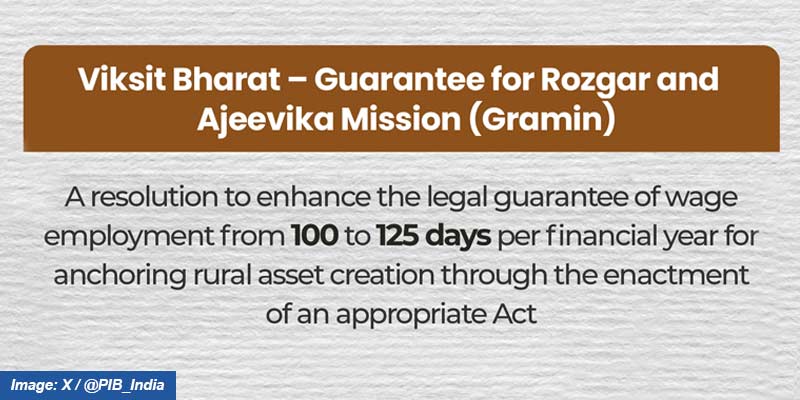
• President Droupadi Murmu gave her assent to the Viksit Bharat Guarantee for Rozgar and Ajeevika Mission (Gramin) (VB-G RAM G) Bill.
• VB-G RAM G Bill was cleared by the Parliament earlier amid strong objections from the Opposition.
• It replaces the Mahatma Gandhi National Rural Employment Guarantee Act (MGNREGA), 2005 enacted by the erstwhile UPA-government led by Manmohan Singh.
Evolution of wage employment programmes
• Post-Independence, rural development policies in India focused on addressing poverty, improving agricultural productivity, absorbing surplus and under-employed rural labour through various wage employment schemes, strengthening rural infrastructure, etc.
• Over the decades, the approaches have evolved, ranging from community development programmes to employment generation schemes to uplift rural communities.
• The nature of rural employment generation schemes has undergone continuous change based on the evolving socio-economic scenario.
• India’s rural employment schemes have evolved through several phases, starting with early programmes, like, the Rural Manpower Programme (1960s) and Crash Scheme for Rural Employment (1971).
• In the 1980s, the National Rural Employment Programme and Rural Landless Employment Guarantee Programme were launched, later merged into Jawahar Rozgar Yojana in 1993 which consolidated into the Sampoorna Grameen Rozgar Yojana in 1999, to streamline structured rural employment efforts.
• The Employment Assurance Scheme was introduced in 1993 to provide work during agricultural lean seasons.
• The Food for Work Programme, initiated in 1977-78 and later expanded as the National Food for Work Programme in 2004, provided food grains as wages for manual labour on public works, targeting most backward districts to improve both food security and employment.
• Notably, the Maharashtra Employment Guarantee Act, 1977 provided right to work to adult members of every rural household who volunteered to do unskilled manual work, thus bringing in the concept of a statutory right.
• While the earlier initiatives offered some relief to rural households, their scale and resources remained limited in relation to the broader challenges of unemployment and poverty in rural India.
• It was in this background that, in 2005, the Mahatma Gandhi National Rural Employment Guarantee Act, 2005, (MGNREGA) was enacted to provide a statutory framework for employment generation in rural areas.
• Over the past 20 years, MGNREGA has provided a guaranteed wage-employment to rural households ensuring wage income.
• However, further strengthening has become necessary in view of the significant socio-economic transformation witnessed in the rural landscape driven by widespread coverage of the social security interventions and saturation-oriented implementation of major government schemes.
• Similarly, rural connectivity, rural housing, electrification, financial inclusion and digital access have deepened, the workforce has diversified, and aspirations have shifted towards better incomes, growth-oriented infrastructure, sustainable livelihoods and greater climate resilience.
• It is essential that rural infrastructure creation must transition from fragmented provisioning to a coherent and future-oriented approach and it is also essential that resources are distributed in a fair manner to reduce disparities and promote inclusive growth across all rural areas of the country based on objective parameters.
• As national development advances, rural development programs require periodical revision to remain aligned with emerging needs and further aspirations.
Key features of the new Act:
• The Act enhances the statutory wage employment guarantee to 125 days per financial year for rural households.
• The Act also facilitates adequate availability of agricultural labour during peak sowing and harvesting seasons by empowering states to notify a pause period aggregating to 60 days in a financial year.
• The Act seeks to transform rural employment from a standalone welfare intervention into an integrated instrument of development.
• It mandates payment of wages on a weekly basis or, in any case, within 15 days of completion of work.
• In cases of delay beyond the stipulated period, delay compensation will be payable.
The wage employment under the Act is explicitly aligned with the creation of durable public assets across four priority thematic domains:
i) Water security and water-related works.
ii) Core rural infrastructure.
iii) Livelihood-related infrastructure.
iv) Works to mitigate extreme weather events.
• All works originate from Viksit Gram Panchayat Plans (VGPPs), prepared at the Gram Panchayat level through participatory processes and approved by the Gram Sabha.
• These plans are digitally and spatially integrated with national platforms, including PM Gati Shakti.
• This integrated planning framework will enable ministries and departments to plan and implement works more effectively, avoid duplication and wastage of public resources, and accelerate development through saturation-based outcomes.
• Cost-sharing pattern is 60:40 between the Centre and states, 90:10 for northeastern and Himalayan states, and 100 per cent central funding for Union Territories without legislatures.