
- India
- Jan 05
Explainer - Bharati Braille
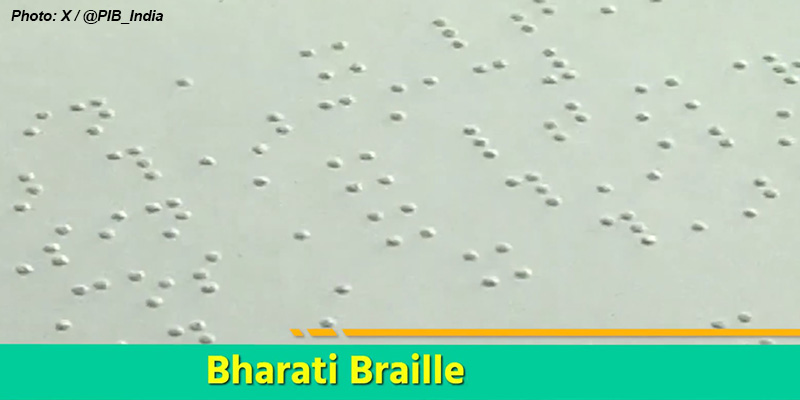
• The United Nations observes World Braille Day on January 4.
• According to World Health Organisation (WHO) estimates, around 2.2 billion people globally have a vision impairment.
• The day is observed to raise awareness of the importance of Braille as a means of communication in the full realisation of human rights for blind and partially sighted people.
• World Braille Day was established by the UN General Assembly in December 2018.
What is Braille?
• Braille is a tactile representation of alphabetic and numerical symbols using six embossed dots to represent each letter and number, and even musical, mathematical and scientific symbols.
• Braille (named after its inventor in 19th century France, Louis Braille) is used by blind and partially sighted people to read the same books and periodicals as those printed in a visual font.
• Braille can be written using a Braillewriter, a device similar to a typewriter, or by using a pointed stylus and a Braille Slate to punch dots on paper.
• World Braille Day commemorates the birthday of Louis Braille. He was born on January 4, 1809. Having become blind after a childhood accident, at age 15, Louis Braille created the eponymous system we know today.
• It has been tweaked over the years and as early as 1949, the UNESCO took the initiative to promote a survey of problems aimed at establishing Braille uniformity.
• The 2006 Convention on the Rights of Persons with Disabilities, which has advanced the rights and well-being of persons with disabilities, considers Braille essential for education, freedom of expression and opinion, access to information and social inclusion.
Bharati Braille
• The Braille script was introduced in India in 1887.
• But, in 1951, a single national standard, Bharati Braille, was adopted with the common codes for Indian languages.
• According to the 2011 Census, there are 50,32,463 persons with visual impairment in India, who face significant barriers in accessing healthcare, education, and employment.
• Recognising the needs of this population, Braille in India is embedded in a rights-based ecosystem anchored in initiatives, acts and policies like the Rights of Persons with Disabilities Act, 2016, and the National Education Policy (NEP) 2020 and others.
• These efforts position Braille as both a literacy tool and a public accessibility norm.
• The government of India recognises Bharati Braille as the unified script for multiple Indian languages.
• Under the aegis of the Department of Empowerment of Persons with Disabilities and the National Institute for Empowerment of Persons with Visual Disabilities (NIEPVD), a Standard Bharati Braille Code (with Unicode mapping) has been published on January 4, 2025 with official adoption of a consistent Braille system across Indian languages for education and accessibility.
Unified Braille system for Indian languages
• Bharati Braille is the standardised tactile writing system used for most Indian languages.
• It was developed to harmonise multiple disparate Braille scripts that existed across languages into a single, consistent code.
• This ensures that visually impaired readers can learn and use a common Braille system across multiple Indian languages
• It employs the standard six-dot Braille cell.
• The Standard Bharati Braille Codes provide rules to represent vowels, consonants, numerals and punctuation in different Indian scripts such as Hindi, Marathi, Bengali, Telugu, Kannada, Malayalam, etc, using a common tactile framework.
• This helps learners with visual impairment transition between languages while reading Braille without having to relearn different Braille codes.
• Bharati Braille serves as the foundation for Braille education, transcription, publishing and accessible material production in India.
• The standards are used by publishers, Braille presses, and accessibility implementers to produce textbooks, learning materials and digital Braille content that are consistent and reliable.
• The standard supports national initiatives for inclusive education and literacy.