
- India
- Jan 08
Veteran ecologist Madhav Gadgil dies at 83
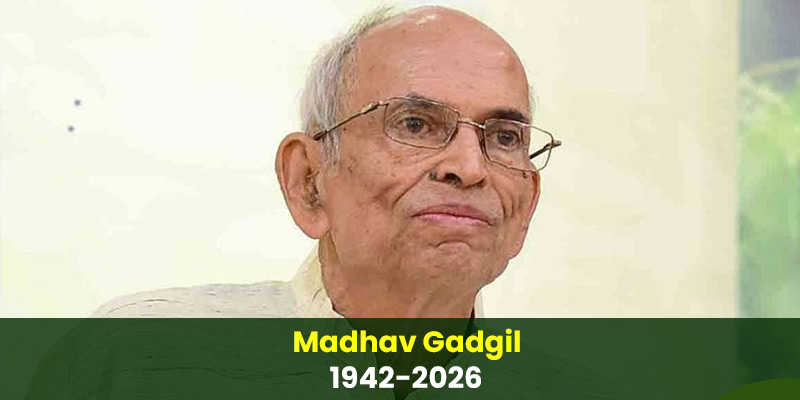
• Madhav Gadgil, the renowned ecologist, passed away in Pune on January 7. He was 83.
• Gadgil was widely known for his pioneering work on the Western Ghats.
• He was the founder of the Centre for Ecological Sciences.
• He also served as a member of the Scientific Advisory Council to the Prime Minister of India.
• Gadgil’s wide-ranging contributions throughout the years have earned him some of India’s highest civilian honours — including the Padma Shri (1981) and Padma Bhushan (2006) awards — as well as the Tyler Prize for Environmental Achievement and the Volvo Environment Prize.
He established key institutions
• Madhav Gadgil was born in Pune on May 24, 1942.
• He graduated in biology from Fergusson College in 1963 and completed his master's degree in zoology from the University of Mumbai in 1965.
• He went on to pursue a PhD from Harvard University in 1969, where he worked on mathematical ecology and animal behaviour.
• After returning to India in 1971, Gadgil joined the Indian Institute of Science (IISc) in 1973.
• During his tenure at IISc, he established key institutions, including the Centre for Ecological Sciences and the Centre for Theoretical Studies, laying the foundation for modern ecological research in the country.
• He retired from IISc in 2004 and later continued his academic engagement with the Agharkar Research Institute in Pune and the University of Goa.
• Gadgil served on several high-level national and international bodies, including the Scientific Advisory Council to the Prime Minister, the National Advisory Council, and the National Tiger Conservation Authority.
• A prolific researcher and writer, Gadgil authored or co-authored several influential books, including ‘This Fissured Land’ and ‘Ecology and Equity’, and published over 250 scientific papers.
The Gadgil Report on Western Ghats
• Madhav Gadgil spent decades protecting people and the planet through research and community engagement.
• From landmark environmental impact assessments of state and national policies to grassroots environmental engagement, Gadgil’s work has greatly influenced public opinion and official policies on the protection of natural resources.
• He is renowned for his seminal work in the ecologically fragile Western Ghats region of India, which is a unique global biodiversity hotspot.
• Gadgil chaired the government-constituted Western Ghats Ecology Expert Panel to study the impact of population pressure, climate change, and development activities on the ecologically fragile region.
• The committee’s 2011 report, widely known as the Gadgil Report, warned that the Western Ghats would face imminent natural disasters unless urgent measures were taken to protect its eco-sensitive zones.
• The panel recommended that the entire hill range be declared an Ecologically Sensitive Area (ESA) and divided into three Ecologically Sensitive Zones (ESZ 1, 2, and 3) based on their environmental sensitivity.
• It also recommended a ban on mining, quarrying, new thermal power plants, hydropower projects, and large-scale wind energy projects in ESZ-1.
• The Gadgil Report sparked widespread protests across the six states in the Western Ghats region. However, its recommendations gained renewed attention following the devastating floods in Kerala and Kodagu in 2018.