
- India
- May 11
VB-G RAM G Act to come into force from July 1
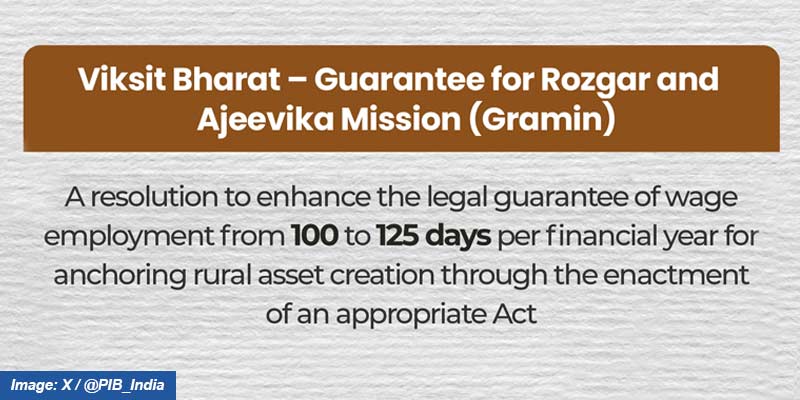
• The government notified the commencement of the Viksit Bharat – Guarantee for Rozgar and Ajeevika Mission (Gramin): VB-G RAM G Act, 2025 across all rural areas of the country with effect from July 1.
• The Act establishes a statutory guarantee of 125 days of wage employment in every financial year to every rural household whose adult members volunteer to undertake unskilled manual work.
• This enhanced guarantee is expected to provide renewed momentum to rural household incomes, livelihood security, village-level infrastructure creation, and sustainable rural development.
• Simultaneously, it seeks to create durable and productive rural infrastructure that strengthens water security, rural infrastructure, rural livelihoods, local economic growth, and resilience against climate-related challenges.
• The commencement of the Act marks a historic transition from the earlier framework of MGNREGA.
• The Union government has made extensive financial provisions for operationalisation of the new framework across the country.
• For FY 2026–27, a provision of Rs 95,692.31 crore has been made as central share under the programme.
• Including the estimated state share, the total programme outlay is expected to exceed Rs 1.51 lakh crore.
Evolution of wage employment programmes
• Post-Independence, rural development policies in India focused on addressing poverty, improving agricultural productivity, absorbing surplus and under-employed rural labour through various wage employment schemes, strengthening rural infrastructure, etc.
• Over the decades, the approaches have evolved, ranging from community development programmes to employment generation schemes to uplift rural communities.
• The nature of rural employment generation schemes has undergone continuous change based on the evolving socio-economic scenario.
• India’s rural employment schemes have evolved through several phases, starting with early programmes, like, the Rural Manpower Programme (1960s) and Crash Scheme for Rural Employment (1971).
• In the 1980s, the National Rural Employment Programme and Rural Landless Employment Guarantee Programme were launched, later merged into Jawahar Rozgar Yojana in 1993 which consolidated into the Sampoorna Grameen Rozgar Yojana in 1999, to streamline structured rural employment efforts.
• The Employment Assurance Scheme was introduced in 1993 to provide work during agricultural lean seasons.
• The Food for Work Programme, initiated in 1977-78 and later expanded as the National Food for Work Programme in 2004, provided food grains as wages for manual labour on public works, targeting most backward districts to improve both food security and employment.
• Notably, the Maharashtra Employment Guarantee Act, 1977 provided right to work to adult members of every rural household who volunteered to do unskilled manual work, thus bringing in the concept of a statutory right.
• While the earlier initiatives offered some relief to rural households, their scale and resources remained limited in relation to the broader challenges of unemployment and poverty in rural India.
• It was in this background that, in 2005, the Mahatma Gandhi National Rural Employment Guarantee Act, 2005, (MGNREGA) was enacted to provide a statutory framework for employment generation in rural areas.
• Over the past 20 years, MGNREGA has provided a guaranteed wage-employment to rural households ensuring wage income.
• However, further strengthening became necessary in view of the significant socio-economic transformation witnessed in the rural landscape driven by widespread coverage of the social security interventions and saturation-oriented implementation of major government schemes.
• Similarly, rural connectivity, rural housing, electrification, financial inclusion and digital access have deepened, the workforce has diversified, and aspirations have shifted towards better incomes, growth-oriented infrastructure, sustainable livelihoods and greater climate resilience.
• ‘Viksit Bharat-Guarantee for Rozgar and Ajeevika Mission (Gramin)’ (VB-G RAM G) Bill, 2025 was passed by Parliament in December 2025.
Transition from MGNREGA to VB-G RAM G
• The transition from MGNREGA to the new framework has also been designed in a seamless and worker-friendly manner.
• Existing e-KYC-verified Job Cards shall continue to remain valid until Gramin Rozgar Guarantee Cards are issued.
• Workers who do not currently possess job cards may apply at the Gram Panchayat level for registration and issuance of new cards.
• Workers shall not be denied employment merely due to pending e-KYC, and facilitation mechanisms have been provided for completion of e-KYC, including at worksites, wherever necessary.
• Workers may continue to demand employment orally, in writing through the existing Form-6 framework, or through digital platforms.
• Employment shall continue to be provided within the prescribed timeframe, failing which workers shall remain entitled to unemployment allowance as per the provisions of the Act.
• The unemployment allowance shall be payable at not less than one-fourth of the notified wage rate for the first 30 days of the financial year and at not less than one-half of the notified wage rate for the remaining period of the financial year, thereby strengthening the legal guarantee of employment and the accountability of the implementation framework.
• Wages shall continue to be transferred directly into workers’ bank or post office accounts through Direct Benefit Transfer (DBT), thereby strengthening transparency and reducing delays.
• Under the framework, wages are to be paid weekly or, in any case, within 15 days from the closure of the muster roll.
• In cases where wages are delayed beyond the stipulated period, workers shall be entitled to compensation in accordance with the provisions of the Act.
• The Act further provides that where payment of wages is not made within 15 days from the date of closure of the muster roll, wage seekers shall be entitled to receive compensation for the delay at the rate of 0.05 percent of the unpaid wages for every day of delay beyond the sixteenth day after closure of the muster roll.
• These provisions are intended to strengthen accountability in wage disbursement and ensure timely payment to workers.
• Attendance at worksites shall be captured through National Mobile Monitoring System (NMMS) enabled systems and face authentication-based attendance mechanisms.
• At the same time, suitable exception handling provisions have also been incorporated to ensure that genuine workers are not adversely affected due to technical or connectivity-related issues.
Four priority thematic areas:
i) Water security: Water related works such as conservation structures, irrigation support, groundwater recharge, rejuvenation of water bodies, watershed development and afforestation will strengthen water security across rural regions.
ii) Core rural infrastructure: Essential civic, social and service‑ delivery assets — rural roads, public buildings, school infrastructure, sanitation systems, renewable energy facilities and housing work under Central Government schemes — will ensure better basic amenities and improved access to services.
iii) Livelihood related infrastructure: Productive assets for agriculture, livestock, fisheries, storage, markets, skill development, and circular economy models will support sustainable livelihoods, value addition, and diversified rural income opportunities.
iv) Special works for extreme weather events: Disaster preparedness and climate adaptation works — such as shelters, embankments, flood management structures, rehabilitation works, and forest fire management — will help create climate-resilient villages.