
- India
- May 25
- Sreesha V.M
What is BHAVYA scheme?
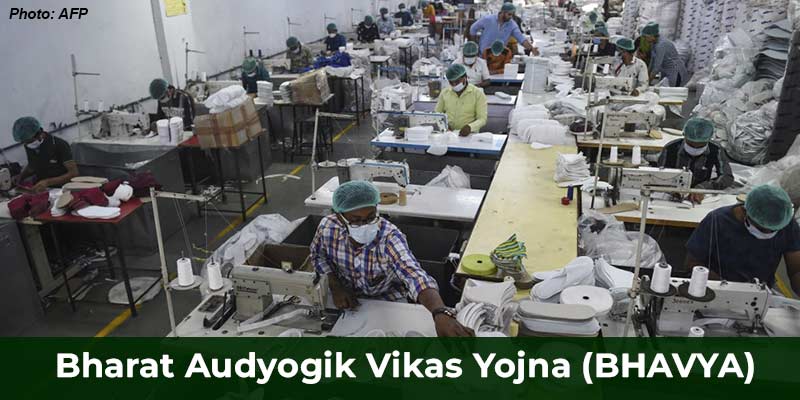
• The Department for Promotion of Industry and Internal Trade (DPIIT) has released the detailed operational guidelines for the implementation of Bharat Audyogik Vikas Yojna (BHAVYA) scheme.
• The Union Cabinet approved the scheme on March 18.
What is BHAVYA scheme?
• BHAVYA has been designed to strengthen India’s manufacturing ecosystem through development of integrated industrial infrastructure aligned with the objectives of Make in India, PM GatiShakti, and the Government’s broader vision of positioning India as a globally competitive manufacturing destination.
• The scheme aims to develop world-class industrial infrastructure, unlocking manufacturing potential and driving India’s growth story.
• The scheme provides for development of 100 industrial parks over a period of six years from 2026-27 to 2031-32, with a total financial outlay of approximately Rs 33,660 crore.
• In the first phase, up to 50 industrial parks will be taken up through a challenge-based competitive selection process.
• It aims for deregulation and ease of doing business, with streamlined approvals, effective single-window systems, and investor-friendly reforms led by states.
• The scheme will deliver plug-and-play industrial ecosystems, enabling industries to move from intent to production with speed and certainty.
• With pre-approved land, ready infrastructure, and integrated services, BHAVYA will significantly reduce entry barriers for investors.
Implementation of the scheme
• The SPVs will be responsible for project planning, development, operation, management, investor facilitation, and long-term maintenance of assets created under the Scheme.
• The scheme will provide financial assistance in the form of equity contribution linked to the value of land transferred to the SPV and achievement of prescribed project milestones.
• The National Industrial Corridor Development Corporation (NICDC) has been designated as the project management agency for implementation and monitoring of the scheme.
• The major focus of the scheme is on creation of “investment-ready” industrial ecosystems with plug-and-play infrastructure, multimodal logistics connectivity, reliable utility systems, worker-support infrastructure, digital governance systems, and sustainable development features.
• The guidelines provide for development of both greenfield and eligible brownfield industrial parks.
• Minimum land requirements have been prescribed at 100 acres for non-hilly states and 25 acres for hilly states, northeastern states, Union Territories, and smaller states.
• The scheme also permits consideration of larger parks up to 1,000 acres.
• The guidelines provide for evaluation on quality of infrastructure for components such as underground utility systems, water and waste management infrastructure, common effluent treatment systems, renewable energy infrastructure, worker housing, testing laboratories, digital single-window systems, skill development facilities and integrated common infrastructure.
Expected outcomes:
• Primary beneficiaries: Manufacturing units, MSMEs, startups, and global investors seeking ready-to-use industrial infrastructure.
• Secondary beneficiaries: Workers, logistics providers, service sector enterprises, and local communities.
• BHAVYA scheme is expected to drive large-scale job creation, generating substantial direct and indirect employment across manufacturing, logistics, and services, while catalysing significant investments.
• The scheme will extend to all states and Union Territories, creating lakhs of employment opportunities across the country and accelerating industrial growth nationwide.
• By fostering cluster-based development and enabling co-location of industries, suppliers, and service providers, BHAVYA scheme will strengthen domestic supply chains, and promote regional industrialisation.
(The author is a trainer for Civil Services aspirants.)