
- India
- Jun 01
- Sreesha V.M
CPGRAMS unveils AI-enabled chatbot ‘Samadhan Didi’
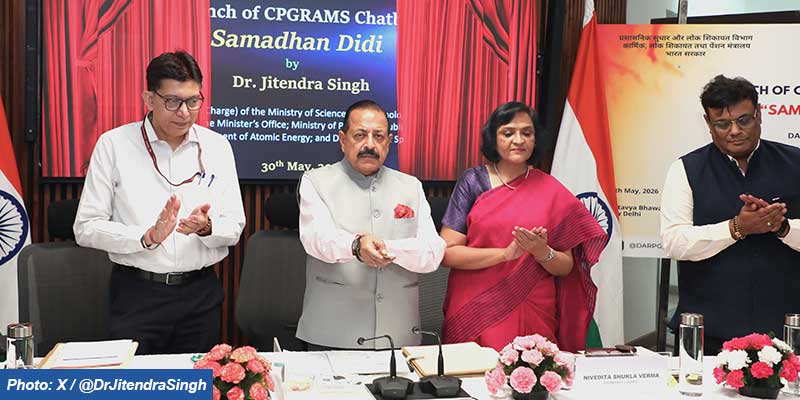
• The Union Minister Jitendra Singh launched the CPGRAMS AI-enabled chatbot ‘Samadhan Didi’.
• It was developed by the Department of Administrative Reforms and Public Grievances (DARPG) in collaboration with Bhasini, at Kartavya Bhawan, New Delhi.
• Centralised Public Grievance Redress and Monitoring System (CPGRAMS) is an online platform available to the citizens to lodge their grievances to the public authorities on any subject related to service delivery.
• The chatbot marks a significant step towards making public grievance redressal simpler, more accessible and truly multilingual.
• A citizen can now lodge a grievance simply by speaking, in their own language, describing the concern in plain words — without needing to know which ministry, department, category or sub-category it belongs to.
• The chatbot understands the concern, asks a few relevant clarifying questions, automatically identifies the appropriate ministry, department, category and sub-category, and files the grievance with the correct authority.
• The system integrates the language capabilities of Bhashini with grievance-classification models trained on CPGRAMS data, enabling a seamless experience across Indian languages.
• Beyond the 22 languages of the Eighth Schedule of the Constitution already supported, regional and indigenous languages such as Bhojpuri, Garo, Khasi and Mijo and Bodhi are being incorporated in a phased manner, ensuring greater inclusivity for citizens from diverse linguistic backgrounds.
What is CPGRAMS?
• Centralised Public Grievance Redress And Monitoring System (CPGRAMS) is an online web-enabled system over NICNET developed by NIC, in association with Directorate of Public Grievances (DPG) and Department of Administrative Reforms and Public Grievances (DARPG).
• CPGRAMS aims to enable submission of grievances by the aggrieved citizens from anywhere and anytime (24x7) basis to ministries/departments/ organisations who scrutinise and take action for speedy and favorable redress of these grievances.
• The grievances received on the Centralised Public Grievance Redress and Monitoring System (CPGRAMS) shall be resolved promptly as soon as they are received but within a maximum period of 21 days.
• Tracking grievances is also facilitated on this portal through the system generated unique registration number.
• National Informatics Centre (NIC) through its Information and Communication Technology (ICT) Network — NICNET, has institutional linkages across all the ministries/departments of the central government, state governments, Union Territories and district administrations of the country. NICNET is a satellite-based nationwide computer-communication network, that is a type of Wide Area Network (WAN).
• In order to check the quality of disposal, CPGRAMS provides facility to the citizens to record their feedback on the portal and if a disposal is rated as poor, the option to file an appeal to the next higher authority is enabled.
• The government has also set up a call centre to get citizen feedback on disposed of grievances. Citizens can also get the appeal filed through the call centre if they are not satisfied with the disposal of the grievance.
(The author is a trainer for Civil Services aspirants.)